Wall Street’s main indexes dropped on Tuesday as investors grappled with an escalating Iran War that threatens global energy supplies and markets.
The Dow Jones Industrial Average fell 0.84 percent at the open, while the S&P 500 dropped 1.18 percent and the Nasdaq Composite declined 2.01 percent.
Iran is carrying out attacks on vessels across the Gulf of Oman and the wider Persian Gulf, as tensions escalate following U.S.–Israeli strikes on the Middle Eastern nation under Operation Epic Fury.
About a fifth of the world’s seaborne oil trade flows and 20 percent of liquefied natural gas travel via the Strait of Hormuz, according to the U.S. Energy Information Administration.
The pan-European STOXX 600 slid nearly 4 percent, with banking, travel, and insurer stocks leading the sell-off amid surging oil and gas prices.
German stocks fell to their lowest level in nearly two months, while France hovered near one-month lows, Spain touched a more than two-month low, and London’s Stock Exchange slipped to a two-week low.
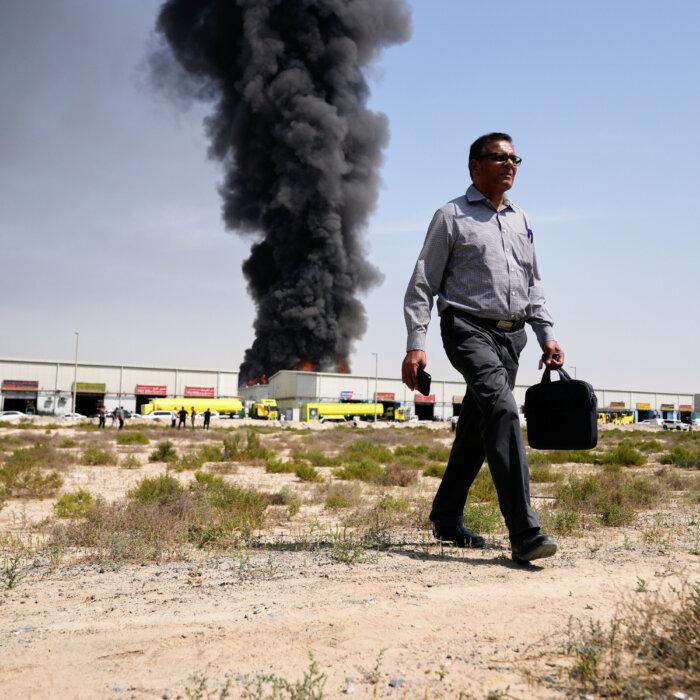

The benchmark Brent crude oil contract gained nearly 8 percent on Tuesday to above $83 per barrel, the highest since July 2024.
A wave of attacks on energy infrastructure in the Middle East is also rattling markets.
Sky News economics editor Ed Conway said in a March 3 post on X that UK wholesale gas prices have almost doubled in 48 hours, the biggest two-day jump on record.
“The near 100 percent rise in UK wholesale gas prices in the past 48 hours is now the biggest two-day rise since comparable records began in the 1990s,” he said.
“Bigger even than any two-day period in the early days of the Ukraine war.”
In a Goldman Sachs Exchanges podcast on March 2, Daan Struyven, co-head of Global Commodities Research and head of oil research at Goldman Sachs, said the immediate impact is being felt in export flows through the Strait of Hormuz.
He said that in the oil markets, “the impact is the most significant in terms of export flows, with a very sharp drop in volumes coming to the Strait of Hormuz.”
“Not because the Strait is completely shut, but because shippers, oil producers are going into a ‘wait and see mode’ because they have seen reports of three ships that have been damaged, and because insurance premiums have skyrocketed,” he said.
He added that the impact on prices is likely non-linear and depends on how long the supply disruption lasts.
“So to put some numbers on this, if you see 100 percent full closure of the Strait for about a month, and if we can use the roughly 4 million barrels per day of estimated spare pipeline capacity to bypass the Strait, sur models point to $12 of upside to prices,” he said.
Struyven said if the disruption is significantly shorter than one month, crude could simply be stored on land in those producing countries in the Middle East, and oil would still be delivered down the road, so essentially, deliveries would be delayed, but with “no significant effect on cumulative supply available to the global oil markets.”
But the disruption could drag on, with storage capacity exhausted, production shut off, and the Strait of Hormuz closed for an extended period.
“You cannot draw inventories forever, and the market may have to rebalance by incentivizing prices to such high levels that you generate demand destruction,” he said.
Demand destruction is when prices rise so high that consumers and businesses are forced to reduce their use of a product.
“And we typically find that in oil markets, to generate substantial demand destruction, prices may have to rise into triple-digit territory,” he added.