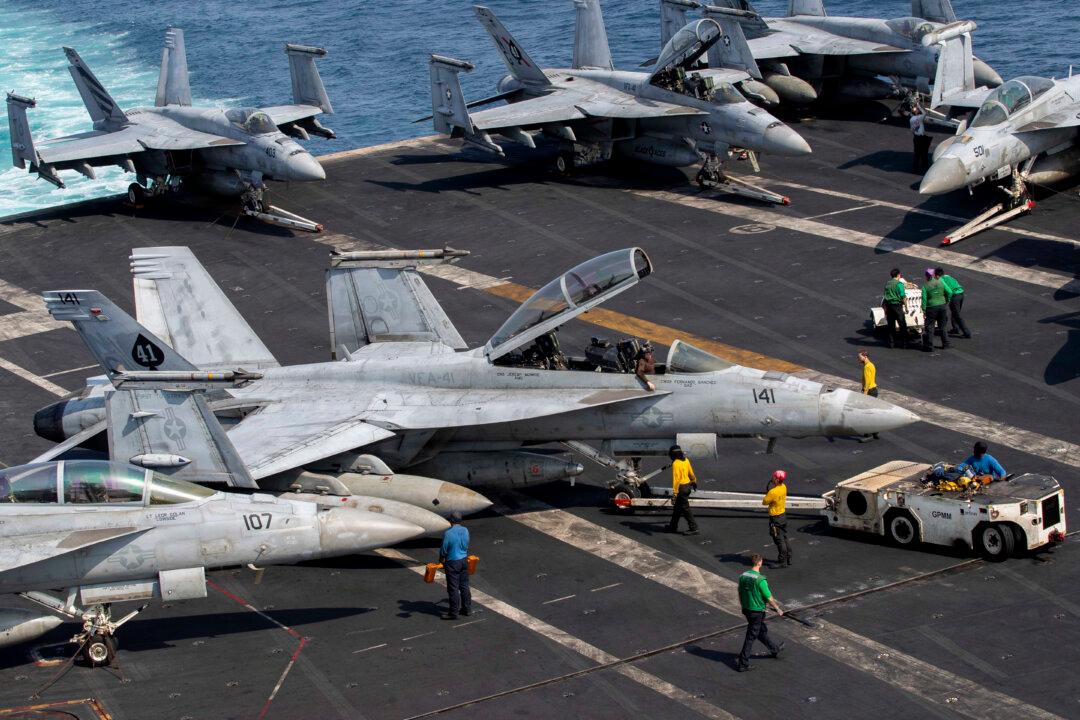
ARLINGTON, Va.—Secretary of War Pete Hegseth announced on March 13 that U.S. forces have made significant progress gaining control over Iran’s skies, and are now relying almost entirely on relatively cheap gravity bombs to strike targets inside the country.
Hegseth provided the update following concerns U.S. forces could exhaust stocks of long-range weapons to strike Iran. Referred to in military parlance as stand-off weapons, these long-range weapons allow U.S. aircraft to attack Iran from a distance while incurring relatively little risk of being shot down, but are expensive and in shorter supply.
“I can say, based on the report I read this morning at 0600, only one percent of the munitions we’re using today are stand-off munitions,” Hegseth said in response to a question from The Epoch Times during a Pentagon press briefing.
He said the rest of the U.S. strikes will rely on weapons that can be dropped from directly over Iranian airspace.
The transition from long-range weapons to bombs dropped from within Iranian airspace allows U.S. forces to fight more economically. Early on in the conflict, U.S. forces relied less heavily on these relatively cheap gravity bombs due to the prevalence of Iranian air defense systems.
During the March 13 press briefing, Hegseth said Iran has no remaining air defenses.

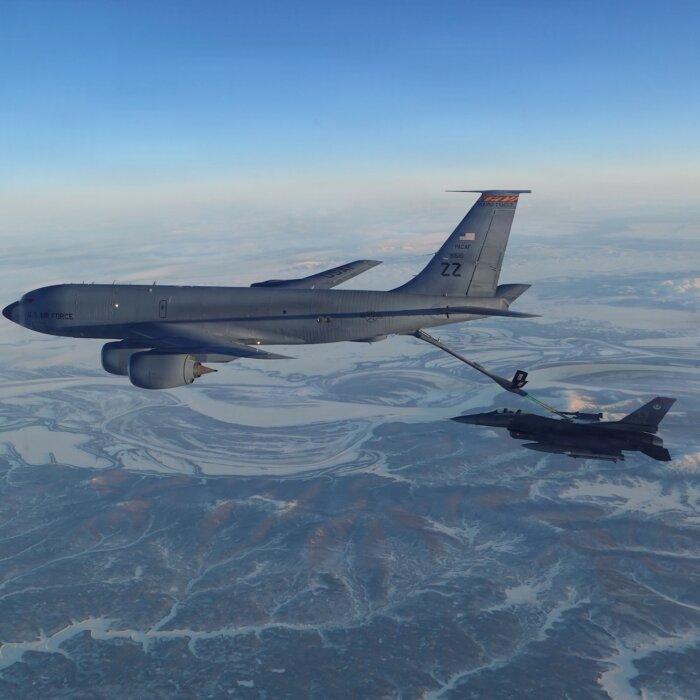
U.S. forces are taking advantage of their increased air superiority to intensify strikes on Iran.
“Today will be, yet again, the highest volume of strikes that America has put over the skies of Iran and Tehran,” Hegseth said. “The number of sorties and number of bomber pulses; the highest yet. Ramping up and only up.”
Hegseth said Iran’s offensive capabilities are also falling.
He said Iranian missile launches are down 90 percent from their height early on in the conflict, while launches from explosive-laden Iranian one-way attack drones are down 95 percent.
Despite the reduction in Iran’s offensive capabilities, several recent attacks have struck merchant vessels operating in the Persian Gulf and the Strait of Hormuz.
Gen. Dan Caine, chairman of the Joint Chiefs of Staff, said Iranian forces had used surface-to-surface missiles to target shipping at the northern end of the Persian Gulf, near Kuwait.
About 25 percent of the world’s seaborne oil leaves the Persian Gulf through the narrow Strait of Hormuz, according to the International Energy Agency.
Attacks on merchant vessels in the key waterway have spooked shipping industry members and slowed oil flows, fueling recent price spikes.
President Donald Trump and members of his administration have announced steps to help calm oil markets and improve oil flows from the Middle East.
U.S. forces have also taken measures to block Iranian threats to commercial shipping in the region, including by attacking dozens of Iranian warships and mine-laying vessels in recent days.
Trump has raised the prospect of sending U.S. warships through the Persian Gulf to escort civilian vessels, but the military has yet to task warships to such an effort. On March 12, U.S. Energy Secretary Chris Wright said it may take until the end of March before warships are ready to take on such escort missions.
In his remarks on March 13, Caine said the Persian Gulf and Strait of Hormuz remain “a tactically complex environment.”
“Before, I think we want to take anything through there at scale, we want to make sure that we do the work pursuant to our current military objectives,” Caine added.