President Donald Trump said on July 23 that the nuclear deal with Saudi Arabia is contingent on the kingdom normalizing ties with Israel.
In a post on Truth Social, Trump said that there would be no enrichment of nuclear material by Saudi Arabia and that the deal “pertains only to non-military use” and “will be approved but is totally subject to Saudi Arabia joining the very respected and successful Abraham Accords.” The president added that the United States is not opposed to civil nuclear facilities.
The Epoch Times has reached out to the Saudi Embassy in Washington for comment.
The long-held Saudi position on joining the Abraham Accords is that it will not do so unless Israel commits to there being a Palestinian state. Israel has been unwilling to consider one until there is Palestinian recognition of Israel’s right to exist as a Jewish state.
“With an accord or without an accord, Israel must have security control over the entire territory West of the Jordan River. That’s a necessary condition. It clashes with the principle of sovereignty but what can you do,” Netanyahu said in 2024.
White House press secretary Karoline Leavitt told reporters on July 23 that Trump has said that if Saudi Arabia does not join the Abraham Accords, “the deal is off.”
The Abraham Accords were first signed in 2020 between Israel and the United Arab Emirates and Bahrain. Morocco and Sudan soon joined afterward. Kazakhstan joined in 2025.
The 123 Agreement, named after Section 123 of the U.S. Atomic Energy Act, was signed by U.S. Secretary of Energy Chris Wright and Saudi Energy Minister Prince Abdulaziz bin Salman. Both sides also signed a bilateral agreement surrounding safeguards.
“Together, these two agreements lay the legal foundation for a decades-long, multi-billion-dollar partnership that advances several priority economic and strategic objectives, including nuclear nonproliferation,” the statement reads.
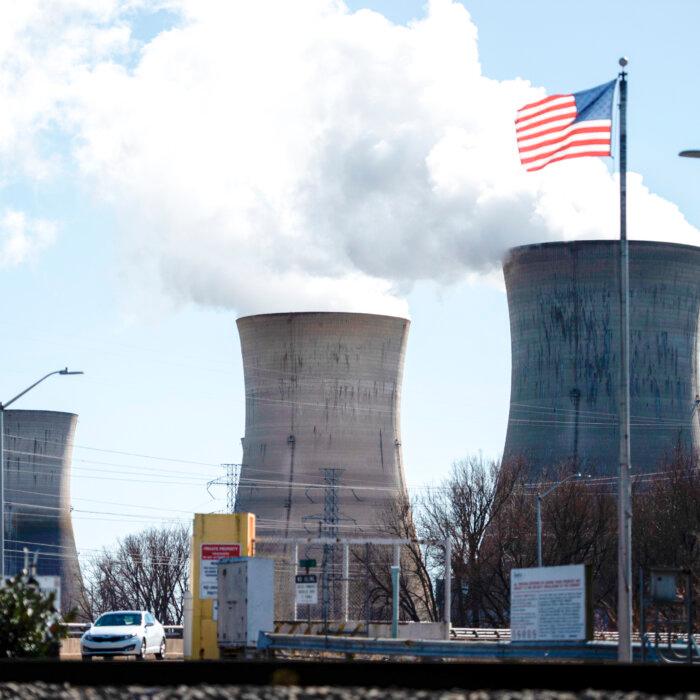
The 30-year agreement will give U.S. companies a critical role in developing Saudi Arabia’s nuclear infrastructure.
The civil nuclear agreement follows nonproliferation agreements in the U.S. Atomic Energy Act, which are among the most stringent in the world.
A crucial part of the accord allows U.S. companies to build a uranium enrichment facility in Saudi Arabia if a joint U.S.–Saudi study deems it necessary. This would give the United States leverage over the Saudi nuclear program and help prevent it from being used for military reasons.
Saudi Arabia said the agreement is an effort to diversify energy sources, and includes the “highest international standards” of nuclear safety, security, and nonproliferation.
The agreement is subject to congressional approval. Were Congress to block the deal and Trump were to veto, it would take two-thirds of both the House of Representatives and the Senate to override the veto.