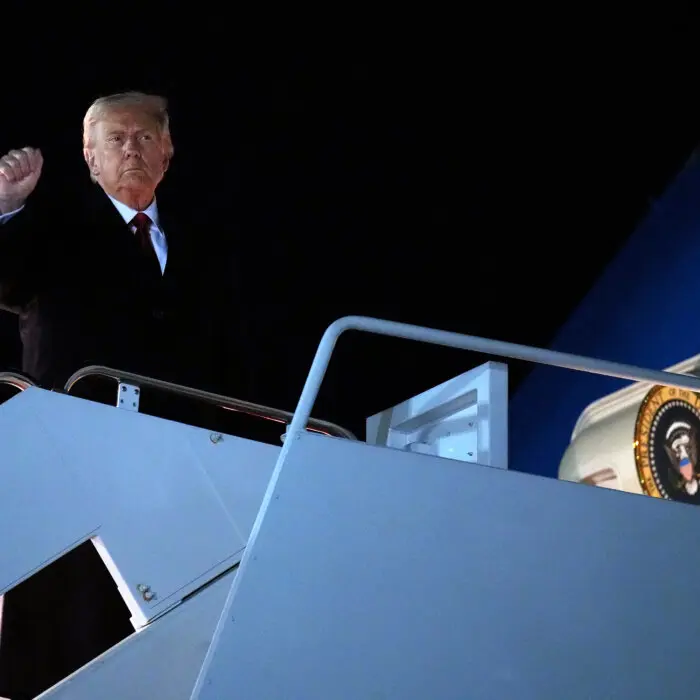
President Donald Trump on Saturday met with the emir and the prime minister of Qatar on Air Force One during a refuel stop, signaling that Qatar may contribute to the peacekeeping efforts in Gaza.
Trump welcomed Qatari Emir Tamim bin Hamad Al Thani aboard while refueling at Al-Udeid Air Base near Doha. The president hailed the Gulf state monarch as “one of the great rulers of the world, not just the Middle East.”
Joining their meeting was Qatari Prime Minister Mohammed bin Abdulrahman bin Jassim Al Thani, whom Trump described as “my friend and a friend to the world.”
“We have done a lot together,” Trump said, adding that Qatar was “a very big factor” in mediating the June cease-fire between Iran and Israel.
“We express our thanks, and you have a safe Middle East right now, and you’re going to keep it that way for a long time,” Trump said.
After the meeting, Trump told reporters that his plan to stabilize Gaza was moving “pretty quickly” with an international peacekeeping force now taking shape. He said Qatar would join the effort “at the time they need.”
“We have 59 countries. We have a lot of countries that are signed on,” Trump said. “This should be an enduring peace.”
Secretary of State Marco Rubio, who is traveling with Trump, has separately confirmed that Washington is weighing options to formally authorize the peacekeeping mission—either through the United Nations or via a separate international agreement that would allow countries bound by legal mandates to participate.
Rubio visited Israel in support of implementing the U.S.-brokered peace plan for Gaza. Fighting has largely subsided in the war-torn region since the cease-fire was signed on Oct. 10—two years after the war erupted with Hamas’s Oct. 7, 2023, massive terror attack on Israel, but tensions remain high.
Among nations volunteering to participate are Indonesia, the world’s largest Muslim-majority country; the United Arab Emirates, which normalized relations with Israel in 2020 as part of the Abraham Accords championed by Trump; and Turkey, the first Muslim-majority country to recognize Israel, although Turkish President Recep Tayyip Erdoğan has been critical of Israel’s policies toward Palestinians.
Currently, about 200 U.S. troops are deployed in Israel to operate the Civil-Military Coordination Center, which facilitates humanitarian aid deliveries and supports the cease-fire implementation.