Carney outlined his top priorities during a Sept. 10 address to the Liberal caucus in Edmonton, where he pledged to build a more united and economically resilient Canada in the face of U.S. tariffs.
“What’s happening in the global economy is not a transition, it’s a rupture. It is a major change in a fast period of time. The U.S. is fundamentally transforming all of its trading relationships, not just with Canada,” Carney said.
“The effect is profound. It’s displacing workers, it’s disrupting supply chains, it’s causing immense uncertainty that’s curbing investment and increasing unemployment. We’re over the shock, but we should never forget the lessons. We have to look out for ourselves, and we have to take care of each other,” he added.
On specific measures, Carney said that Canada will seek the best deal possible under the United States-Canada-Mexico Agreement (USMCA), which is due for review next July. Carney noted 85 percent of Canada’s trade with the United States continues to be tariff-free under the agreement, but that 50 percent sectoral tariffs on Canadian steel and aluminum, and a 25 percent tariff on Canadian autos continue to plague the economy.
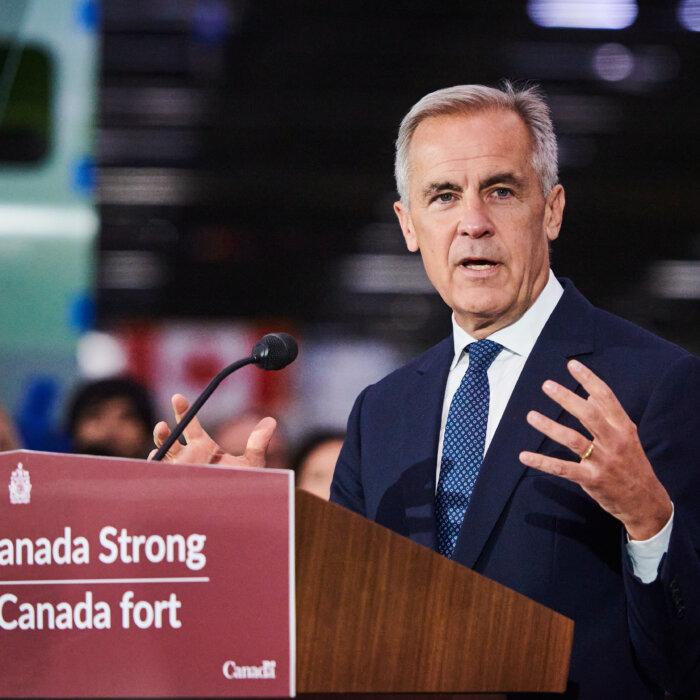
Carney said Canada will respond by seeking to grow its export opportunities in Europe, Asia, and other markets, while protecting Canadian workers from the impact of U.S. tariffs and moving forward with development of the critical minerals sector, energy, defence, and artificial intelligence (AI).
“We have to transform our economy from one that’s too reliant on a single trading partner, to one that’s more resilient, one that’s built for Canadian workers and their families on the strong foundation of Canadian industries and supported by new diverse trading partners,” Carney said.
In his Sept. 10 remarks, Carney also focused on housing, which he said will be a priority, citing next week’s launch of the Build Canada Homes project aiming to double housing construction in the next ten years and make homes more affordable.
“Build Canada Homes will address, first and foremost, the enormous needs of the most vulnerable in our society. But we won’t stop there. We’ll make housing more affordable for the middle class,” Carney said, adding that, “Build Canada Homes will create an entirely new Canadian housing industry using Canadian technology, Canadian workers, Canadian lumber.”
Major Projects, Military Modernization
Carney also pointed to the Aug. 29 opening of the Major Projects Office to get “nation-building” projects fast-tracked for approval and repeated his pledge to boost Canadian defence spending to 5 percent of GDP in the next decade.“We have begun to make historical investments to modernize our military, investments that will get us to 2 percent of GDP defence spending this year and 5 percent within the next decade,” Carney said.
“In doing so, we will ensure that our workers and businesses across Canada benefit from this huge increase in procurement — using Canadian steel, Canadian aluminum, Canadian critical minerals, and Canadian cyber and AI technologies,” he added.
In terms of crime, Carney said his government will crack down on illegal weapons, strengthen bail laws, and boost border security by hiring 1,000 new border agents and 1,000 new RCMP officers.
Opposition’s Priorities
In a Sept. 7 letter to Carney outlining Conservative priorities when Parliament reconvenes, Conservative Leader Pierre Poilievre said his party will focus on decreasing Canada’s rising costs by reducing household debt, lowering home prices, and getting more Canadians employed.He said the Liberal government’s polices have raised the cost of living and made homes less affordable, noting 106,000 jobs lost in the last two months and youth unemployment at its highest in 25 years outside the pandemic.
Poilievre criticized Carney on progress made on his campaign promises, saying “everything is worse” since Carney took the helm following the resignation of former Primer Minister Justin Trudeau earlier this year.
“You promised the fastest-growing economy in the G7. You delivered the fastest shrinking economy in the G7. You promised to spend less. Yet, even without introducing a budget, you are already spending 8 percent more and you have doubled the deficit Trudeau left behind,” he said.
Poilievre said the Conservatives will pursue measures such as reducing taxes, cutting red tape, removing legislation that stalls major projects and curbing immigration, while also pushing for tougher measures and stricter bail laws for violent criminals.
Poilievre also criticized Carney for not achieving a trade deal with the United States by the Aug. 1 deadline, when 35 percent tariffs kicked in on all non-USMCA-compliant goods. He characterized Carney’s removal of counter-tariffs on approximately $30 billion of U.S. goods on Sept. 1 as a “concession” that did not achieve any benefits for Canada.