Over 25 tonnes of drugs, about the weight of a fully laden garbage truck and worth around $8.4 billion (US$5.75 billion), was stopped at Australian borders last year.
The total is down from the record 38.5 tonnes seized in 2019-20 and considerably lower than last year’s figure of 33.7 tonnes.
Yet the Australian Federal Police (AFP) and Australian Border Force (ABF) warned crime syndicates were finding more creative ways to conceal and smuggle illegal substances using buses and even mosaic tiles.
- 9.2 tonnes of methamphetamine, with an estimated street value of $5.5 billion
- 7.8 tonnes of cocaine, worth around $2.5 billion
- 6.3 tonnes of 1,4-butanediol, estimated to be worth $18.9 million
- 1.3 tonnes of ketamine, which had an estimated street value of $273 million
- 260 kg of MDMA, worth around $42.6 million
- 220 kg of heroin, with an estimated street value of $110 million
AFP Says Drug Criminals Are Motivated by ‘Greed and Profit’
AFP Commander Adam Rice said the AFP continued to work with its state, commonwealth, and international partners to share intelligence and to disrupt and dismantle organised criminal syndicates.

“Criminals are driven by their own greed and profit. The harm caused by organised crime syndicates’ involvement in the Australian illicit drug trade is significant and extends beyond individual users to a myriad of violent and exploitative crimes and harm to the community,” Rice said.
ABF Commander David Coyles said that the agency had seen an increased number of cases where criminal entities used drug mules within the international traveller domain to exploit Australia’s border.
How Transnational Criminals Try to Beat Our Borders
The AFP and ABF have released a number of case studies on how criminal syndicates have tried to deceive border security and smuggle illicit drugs into the country.In May 2025, three men were charged with allegedly importing 360 kg of methamphetamine impregnated in mosaic tiles. The 360 boxes of tiles had an estimated street value of $333 million.
In August, ABF officers examined a container that arrived at Port Botany in New South Wales, declared as “vegetable spring rolls and more,” and identified more than 900 kg of amphetamine–one of the largest ever seizures in the state.
In September, a Victorian man was sentenced to 11 years’ imprisonment for smuggling about 100 kg of methamphetamine hidden inside leather shoes from a consignment which had arrived in Sydney from Thailand.
In July, three NSW men were charged for allegedly importing of 600 kg of methamphetamine concealed in in eight wooden crates declared as “UV protective fabrics.” The illicit drugs had an estimated street value of $555 million.
Also in July, a Sydney man was charged for allegedly travelling to a town in the Gold Coast hinterland to take delivery of 140 kg of cocaine hidden inside two marine engines.
Addiction and Imprisonment Data
According to the Australian Bureau of Statistics, at the end of June, 2025, there were 5,209 people imprisoned for illegal drug offences in Australia, representing 11 percent of the total prisoner population.While drug offences were not a primary cause of imprisonment among men, they were among the top three most serious offences for women, with 15 percent incarcerated for this reason.
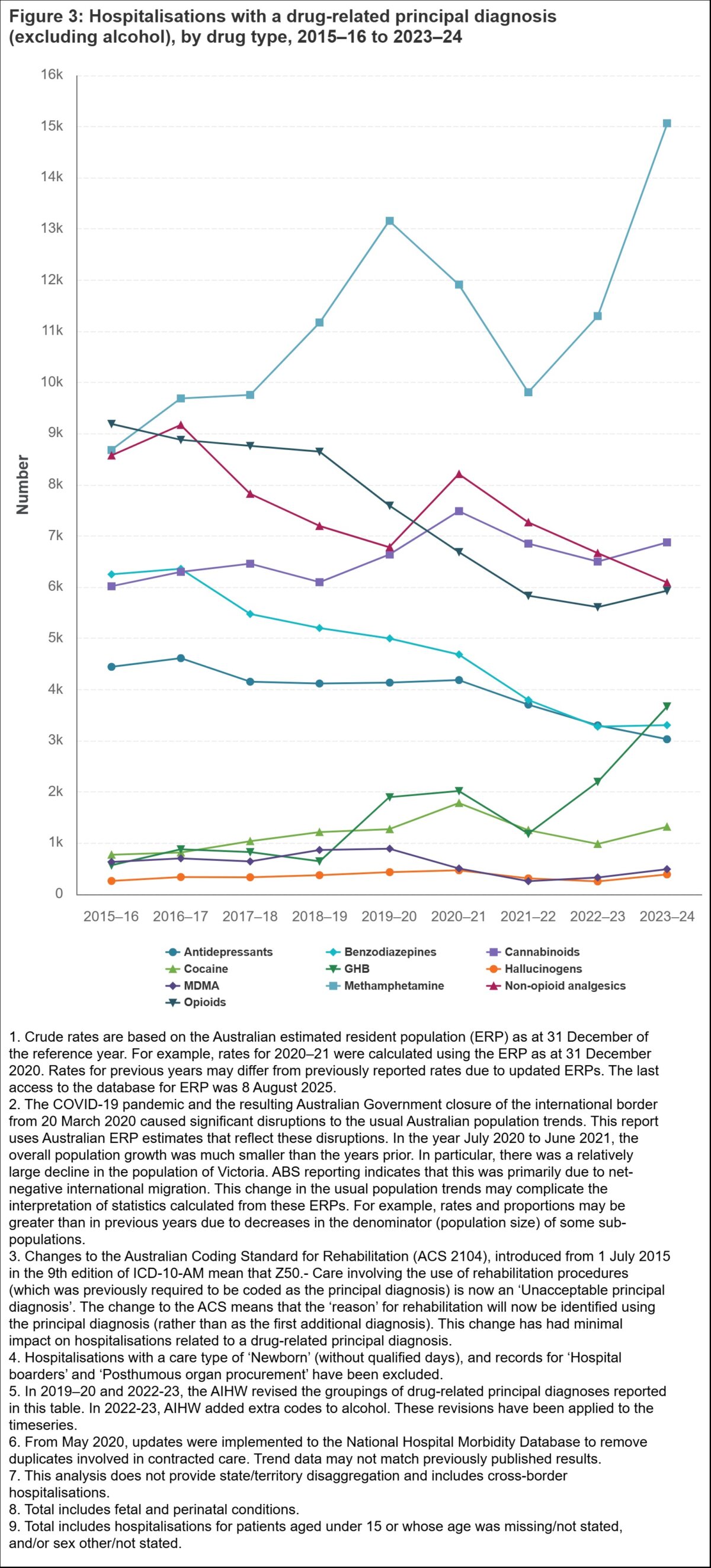
Of those admissions, 61,443 were drug related, with methamphetamine (10 percent) and cannabinoids (4.7 percent) the most common illicit drugs involved in hospitalisations.
“Every day, on average, 76 people are admitted to Australian hospitals from methamphetamine, cocaine, cannabinoid, GHB (gamma-hydroxybutyrate), MDMA and hallucinogen use,” Coyles said.
- For free and confidential advice about alcohol and other drug treatment services, call the National Alcohol and Other Drug Hotline on 1800 250 015.
- Access free 24/7 drug and alcohol counselling online.
- For information about drug and alcohol addiction treatment or support, go to the Turning Point website.
- Australian Community Support Organisation (ACSO) provides a range of alcohol and other drug treatment programs and services available for people engaged with the criminal justice system.
- Path2Help provides resources to assist people looking for ways to support others who uses alcohol or drugs.