This copy is for your personal, non-commercial use only. Distribution and use of this material are governed by our Subscriber Agreement and by copyright law. For non-personal use or to order multiple copies, please contact The Epoch Times Reprints.
Syrian Bedouin families gesture as they ride in a convoy led by Red Crescent vehicles in Busra al-Harir, heading to Daraa after being evacuated from Sweida, following more than a week of violent clashes, on July 21, 2025. AP Photo/Malek Khattab
The Syrian interior ministry on July 21 confirmed the start of the evacuation of Bedouin families from the city of Sweida, following week-long clashes between Druze fighters and Bedouin tribes.
Gen. Ahmad al-Dalati, commander of the Interior Security Forces in Syria’s southern province, said the government would facilitate the departure of those wishing to leave Sweida, Syria’s state-run SANA news agency reported.
“We affirm our full commitment to ensuring the exit of all those wishing to leave Sweida Province, and we will provide the possibility of entry to those who wish to do so, as part of our ongoing efforts to consolidate stability and restore security to the province,” al-Dalati said.
The statement came after Bedouin fighters withdrew from Sweida on July 20, allowing humanitarian convoys to enter the city. The evacuation marked a step toward deescalating the violence, which has displaced tens of thousands of people.
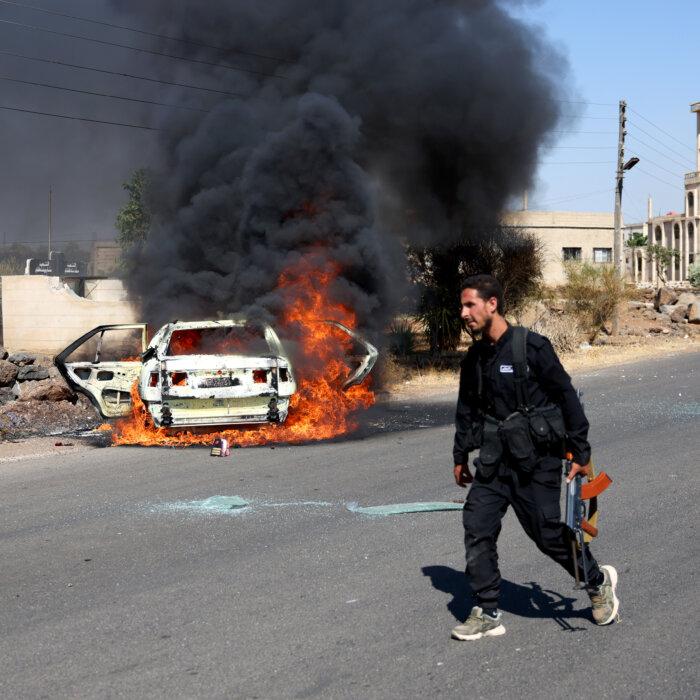
The clashes began a week ago between Druze militias—representing a religious minority present in Syria, Lebanon, and Israel—and Bedouin tribes. According to a report provided to The Epoch Times, the U.N. International Organization for Migration (IOM) stated that 128,571 people were displaced during the fighting, including 43,000 on July 19 alone.
The Syrian government, whose interim president, Ahmed al-Sharaa, recently pledged to protect Druze rights, initially sent troops to the area, intensifying the fighting.
The conflict has expanded to involve neighboring Israel, which carried out airstrikes on July 16 in southern Syria and Damascus, targeting the Syrian regime’s military headquarters. According to the Israel Defense Forces, the attacks were intended to safeguard Druze civilians.
A cease-fire, mediated last week by the United States, Turkey, and Arab states and announced on July 18, was briefly disrupted on July 19 but appeared to hold on July 20.
Syrian Interior Minister Anas Khattab said security forces had succeeded in restoring calm to the area. Bedouin fighters and allied tribesmen retreated to the outskirts of Sweida as security forces cordoned off the city.
U.S. Ambassador to Turkey Tom Barrack said on X on July 20 that the sides had “navigated to a pause and cessation of hostilities,” adding that the next step would be a “complete exchange of hostages and detainees.”
Damascus warned that any breach of the cease-fire would be considered a violation of national sovereignty and would be met with legal measures in line with the constitution and existing laws, according to a SANA report.
Barrack, who also serves as the U.S. special envoy to Syria, met on July 20 with Mazloum Abdi, the commander of the Syrian Democratic Forces. They discussed the situation on the ground and the need for urgent steps to stabilize the country.
Humanitarian Situation
Syrian government forces imposed a security cordon around Sweida to facilitate civilian evacuations and distribute aid, SANA reported, adding that government officials are working to meet humanitarian needs and respond to appeals over relief supplies and basic services within Sweida.
The IOM reported electricity blackouts, water shortages, and a lack of fuel across the province.
“Internally displaced people (IDP) in shelters lack basic [Water, Sanitation, and Hygiene] services, while sector partners face mounting challenges due to road blockages, insecurity, and overstretched resources amid concurrent emergencies like wildfires and drought,” the IOM stated.
The Syrian Red Crescent said it had sent 32 aid trucks to Sweida on July 20. A separate government convoy was turned away after Druze factions loyal to spiritual leader Sheikh Hikmat al-Hijri allegedly blocked its entry, SANA reported.
The Syrian Foreign Ministry said the government convoy included two ambulances carrying aid from local and international organizations.
Al-Hijri did not directly respond to the accusations but said in a statement that he welcomed humanitarian assistance for Sweida. He also denounced what he described as smear campaigns against him.
“We reaffirm that we have no dispute with anyone on any religious or ethnic basis,” he said in the statement. “Shame and disgrace be upon all those who seek to sow discord and hatred in the minds of young people.”
The IOM said nearly 33,150 IDPs have arrived in neighboring Daraa Province and are in urgent need of shelter, food, and medical supplies.
Evgenia Filimianova is a UK-based journalist covering a wide range of international stories, with a particular interest in foreign policy, economy, and UK politics.