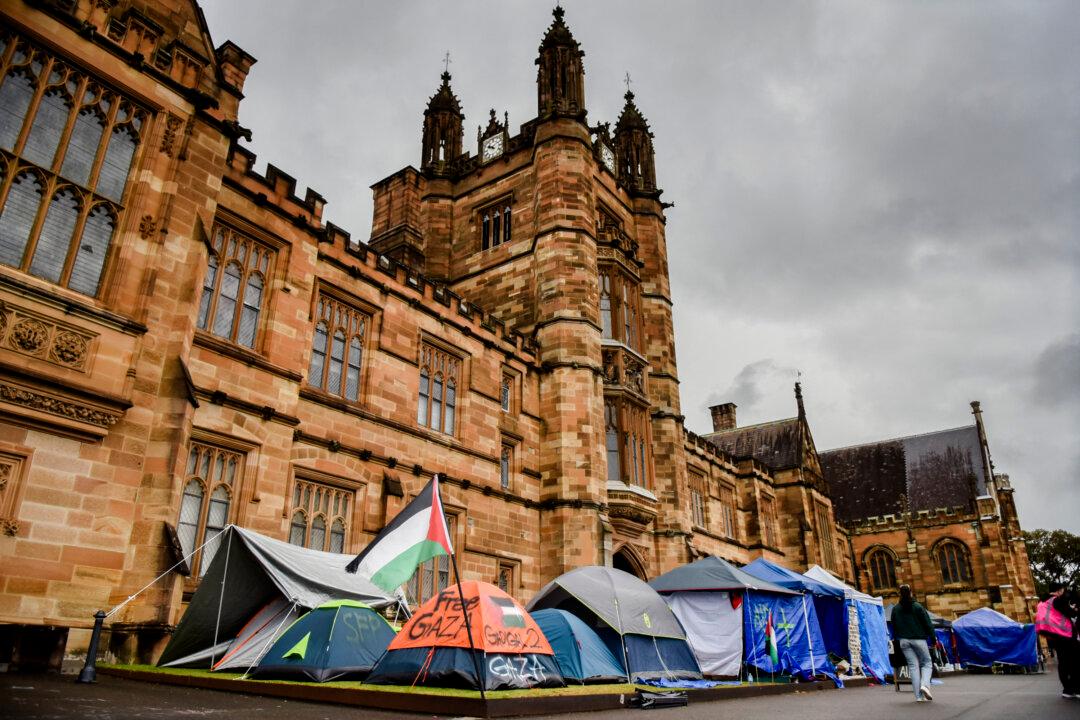
Jewish students at Australian universities began sharing their experiences with anti-Semitism during a Royal Commission investigating the issue.
One witness, known only by her first name, Liat, was co-president of the ACT branch of the Australasian Union of Jewish Students and attended Australian National University (ANU).
“The encampment had a very intimidatory and isolating effect on Jewish students,” said Liat, who is a dual citizen of both Australia and Israel.
She said her first experience of anti-Semitism came during orientation, when she was told she would not be welcome as a member of the university’s Middle East Club.


From that point on, “I was called a ‘baby killer’ and a ‘genocide supporter’ with relative regularity,” she said.
She told of making “a series of calculations every single day” about when and where to reveal she was Jewish.
“I would have to pick: Am I ‘Jewish Liat’ today or am I regular Liat? I wouldn’t use my name ordering at coffee shops for fear that someone would ask me where it’s from.”
Other Incidents
When a group of Jewish students organised a counter-protest, which Liat said involved only singing, a person approached them and performed a Nazi salute.“According to the university ... they were not a member of the university in any capacity but came up to us despite us being surrounded by security during the counter-protest.”
She then sponsored a resolution at the annual general meeting of the ANU students’ association—a meeting of around 650 people held on Zoom.
It called for the association to condemn Hamas, support for a two-state solution to end the conflict in the Middle East, condemn the use of slogans, including calls for an intifada, and confirm that Jewish students had a right to participate in the student association free of discrimination.
During the debate, she said, other students were holding up Palestinian flags and keffiyehs (scarves) and pressing emojis, all of which are deemed to be heckling.
“If a room full of my peers couldn’t bring themselves to condemn a terrorist organisation or affirm in plain terms that Jewish students deserve to feel safe on their own campus, it was very hard to see what ground there was left to stand on as a Jew at the ANU.”
The university’s management, she said, was concerned with “optics over substance ... more about how it was portrayed, that it was tackling racism as best as it could over actually tackling the racism on campus.”
He told of not feeling unwelcome in Australia until after the Oct. 7 attack by Hamas on Israel, and the subsequent pro-Palestine rally at the Sydney Opera House, which he described as a “gut-wrenching turning point in Australia.
“The anti-Semitism, I think, has really changed my sense of belonging, my sense of community at the university, and also it affected my employment,” he said.