Australia’s Productivity Commission has revealed just 56 public and community housing units were added to the nation’s total stock in the past year.
Chair Danielle Wood outlined a range of issues with home building during her testimony to the Select Committee on Intergenerational Housing Inequity last week.
The Commission’s submission notes that housing costs have risen due to decades of inadequate supply and high demand.
While many factors, including the availability of land and the cost of materials, affected the cost of housing, productivity in the sector emerged as a major constraint.
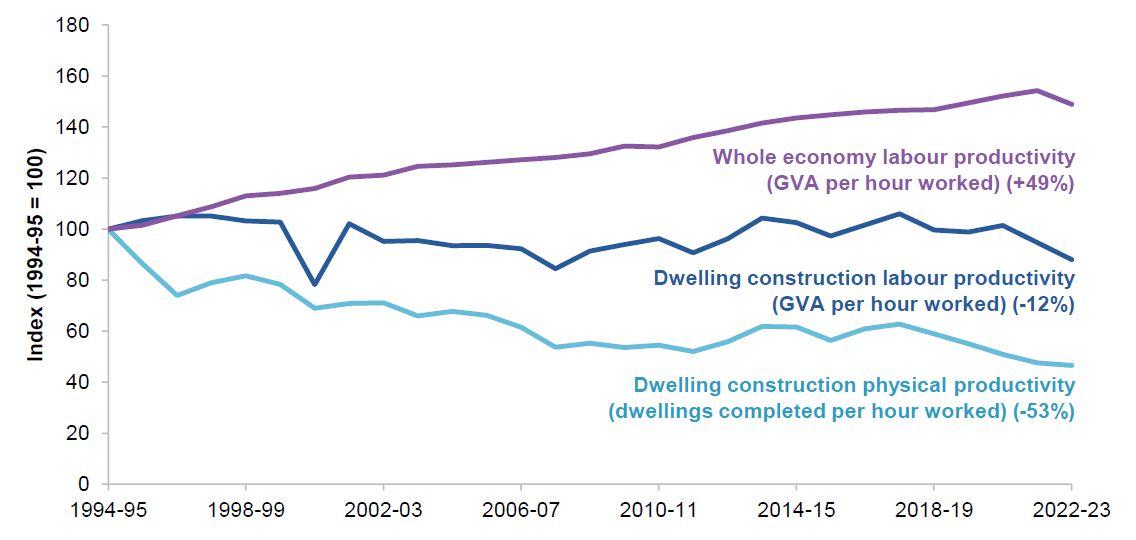
Over the past 30 years, the number of homes completed per hour worked by housing construction workers declined by 53 percent, whereas overall productivity across the economy rose 49 percent.
The Commission attributed the fall-off in construction productivity to four main factors, Wood told the committee.
While some state governments were cutting red tape, construction approvals were often still complex and slow, running to 10 years in some cases.
“We do see differences at the state government level in processes, and we’re seeing a number of states are taking this quite seriously and trying to introduce reforms. The same applies at a local council level,” Wood said.
Another constraint is that the building sector is slow to innovate, as measured by their spending in that area.
Only 35 percent of all construction firms are rated “innovation-active,” and the sector has been slow to take advantage of digital technologies and new processes like prefabrication.
That in turn was driven by fragmentation, industry culture, lack of direct benefits from innovation and frequent changes in regulations.
Wood told the committee that an inability to build new dwellings near to job centres was almost a “spatial leash” and a drag on overall workforce productivity.
“To the extent that we are pushing people into longer commutes, there is broader drag. It also can have impacts on participation. I’ve seen studies in the past suggesting that it particularly impacts the participation of second earners, who tend to be women, because they might need to be closer for school pickups or if a child is sick, which then constrains the types of jobs they can have. It’s sort of a spatial leash effect.
“So, in a city like Melbourne, a woman who trains as a lawyer, for example, who can’t get accommodation for her family within reasonable distance from the inner city finds herself living a long way out ... and feels she cannot use her legal skills and finds herself in hospitality. That’s a spatial leash.”
Issues With Scaling Up for Construction Firms
Fragmentation also limited the ability of building firms to grow.“The construction industry is one of the least concentrated in Australia. The combined market share of the largest four firms was just 12 percent in 2017, the lowest of any sector,” the Commission said in its submission.
“The average residential building construction firm employs less than 2 people, much smaller than the average firm size in Australia,” it said, attributing this to the tendency to manage projects via subcontracting.
“But jurisdictional differences, in the way building standards are implemented, and planning is undertaken and regulated, may also reduce the capacity and appetite for successful firms to scale up.”
The Commission has been tasked by the government with conducting a formal inquiry into housing supply regulation. It received the terms of reference on May 20 and is expecting to publish an interim report by the end of July and a final report by March next year.