



Members of Alberta’s governing United Conservative Party passed nearly all proposed policy resolutions at this year’s annual convention, including measures to require parental review of sexual-education and gender-identity materials in schools, expand provincial control over immigration, and restrict non-governmental flags on public buildings.
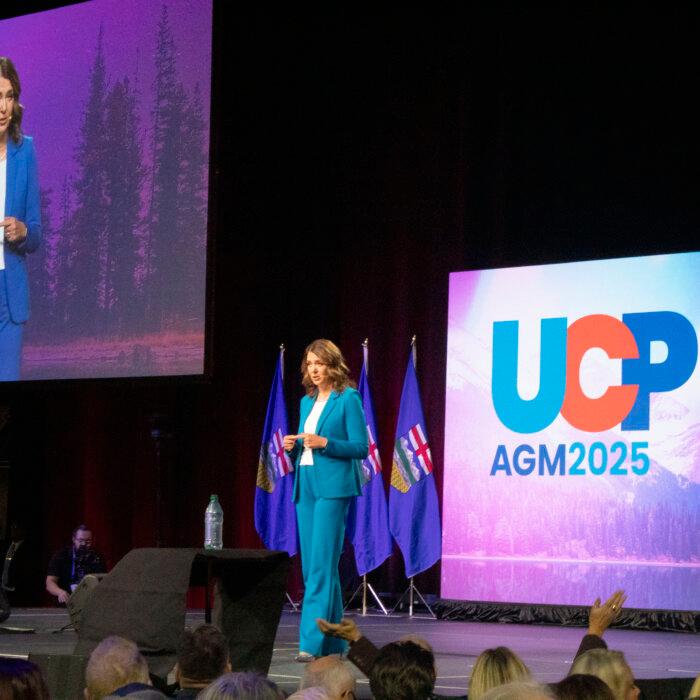
Attendees discussed 36 policy resolutions on Nov. 29, the second day of the UCP’s annual general meeting in Edmonton, which drew more than 4,200 members. Passed resolutions represent the party’s grassroots priorities but are not binding for the government to adopt.
Most resolutions passed with majority support without a count, but one related to increasing Albertans’ legal capacity to protect themselves, their families, and their property required a counted vote due to nearly equal support and opposition. It was ultimately carried.
Meanwhile, one resolution calling on the province to limit provincial land ownership to citizens or permanent residents failed to pass, due in part to a lack of clarity on the terms of the proposal.

Parental Rights
One resolution that received overwhelming support called on the government to ensure all third-party educational materials on gender identity, sexual orientation, or human sexuality used in Alberta schools are made available to parents upon request.“Parents shouldn’t have to guess what their kids are being taught,” one member said.

“You’re the parents, you’re the protectors,” she added. “You deserve to be involved in their education and not be kept in the dark.”
Increased Immigration Control
Another resolution that received major support called on the province to negotiate an agreement with Ottawa granting Alberta greater control over immigration. This includes having a say in the number of temporary and permanent residents admitted to Alberta, and requiring provincial input in the selection and rejection of those approved by the federal government to settle in the province on a temporary or permanent basis.“The premier is way ahead of us,” the member said. “She’s already committed to do exactly what we’re asking for and more–that’s great news.”
During a keynote address that morning outlining her government’s priorities and next steps, the premier said immigration has been “essential to our economic prosperity and rich culture for over 100 years,” but she described the past decade as having produced unsustainable immigration levels.
Flags in Public Buildings
Limiting flags flown at government buildings to the Canadian flag, the provincial flag, or municipal flags was another policy resolution that received unanimous support at the convention. Proponents said that displaying flags representing “non-governmental entities or special interest groups creates ideological division amongst Albertans and negatively impacts the social fabric of our Province.”“Public spaces must reflect all citizens equally by reserving flagpoles for official emblems. We deserve neutrality, fairness, and respect for everyone,” one member said.
Foreign Ownership of Provincial Land
A resolution calling on the provincial government to maintain that “ownership of provincial land remains in the hands of Canadian citizens or permanent residents” was defeated during the policy debate.Policy proponents said the measures would not only protect food security and support domestic investment, but also prevent foreign governments or entities from using land ownership to influence the province’s economy or policies.
“We’re all aware that land in Alberta is one of our strongest assets,” a member in favour of the resolution said. “I think we need to keep it Canadian-owned, and more importantly, Alberta-owned.”
One member questioned whether the resolution referred to Crown land or privately held land. Another expressed concern that the measure could invite government involvement in private transactions, while a third raised doubts about its feasibility.
Adopting Pandemic Report Recommendations
Another resolution adopted by UCP members calls on the government to implement all recommendations from the Jan. 24 Alberta COVID-19 Pandemic Data Review Task Force Report, which assessed the province’s pandemic response.The task force, composed of medical doctors and epidemiology experts, was headed by Dr. Gary Davidson, former chief of emergency medicine at the Red Deer Regional Hospital Centre.
Among the report’s recommendations was halting the use of COVID-19 vaccines without full disclosure of their potential risks, ending their use in healthy children and teenagers, and conducting further research into their effectiveness.
A member speaking in support of the resolution said the authors’ expertise gives weight to their recommendations and can help the province avoid repeating past mistakes.
“They do know what they’re talking about—their report gives a clear picture of what went wrong in the application of the mandates and how to prevent it from happening again,” the member said.
“Supporting this resolution supports accountability, protects rights, and ensures Albertans are better prepared in the future.”
Another member spoke against the proposal, citing the effectiveness of vaccines and the work it would take to implement the recommendations.
“The vaccines do work—I am vaccinated, I am alive,” he said. “There’s no need to increase the burden on our already overturned health care system by ensuring more clinical disease that can be prevented through vaccines.”
The motion was passed by a majority vote.
Other resolutions adopted during the convention include ending community water fluoridation, stopping public funding for third-trimester abortions when the mother’s physical health is not at risk, and requesting that the provincial government review the use of diversity, equity, and inclusion frameworks in Alberta’s K-12 education system.


