This copy is for your personal, non-commercial use only. Distribution and use of this material are governed by our Subscriber Agreement and by copyright law. For non-personal use or to order multiple copies, please contact The Epoch Times Reprints.
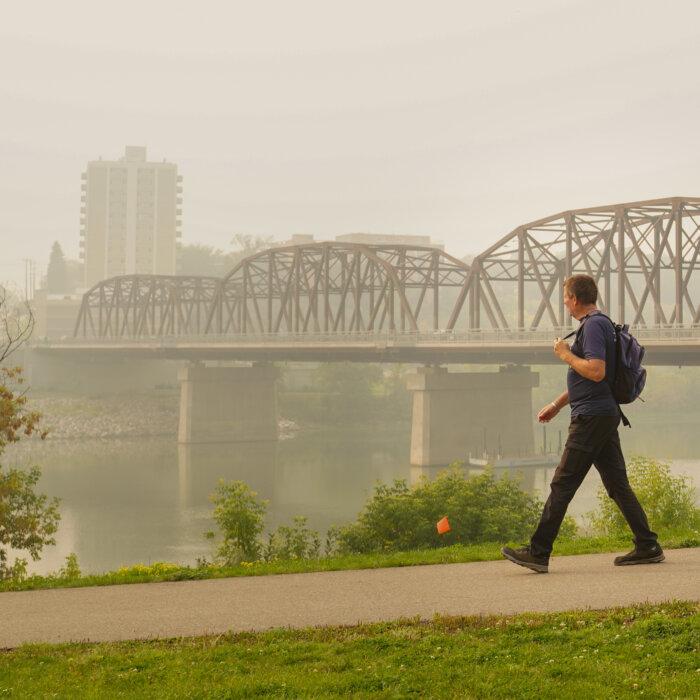
Tourists take their dogs out for a quick break under billowing wildfire smoke off Highway 97 north of Buckinghorse River, B.C., on May 30, 2025. The Canadian Press/Nasuna Stuart-Ulin
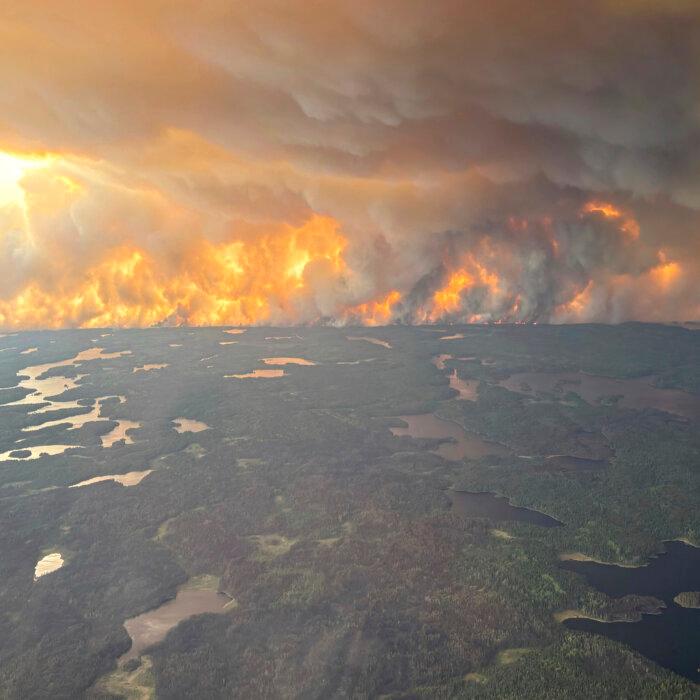
Out-of-control wildfires in Western Canada have forced some 17,000 Manitobans to evacuate while Saskatchewan Premier Scott Moes has asked for help from several U.S. states.
Both provinces have declared a state of emergency as hot and dry weather is expected to fuel the blazes in the coming days.
The fires have already forced 17,000 people from several Manitoba communities including First Nations to evacuate to safety. They are being housed in Winnipeg in arenas and soccer fields set up as shelters. Among the evacuees are more than 5,000 from Flin Flon, a mining city located on the Manitoba-Saskatchewan border.
Manitoba Premeir Wab Kinew was the first to declare the emergency last week, on May 28, making it much easier to request federal assistance, while the Saskatchewan premier’s declaration came a day later.
Saskatchewan Premier Moe has so far declined federal assistance from the Canadian government, instead seeking equipment and personnel from U.S. jurisdictions—including the states of Oregon, Arizona, and Alaska—as well as from other provinces of Canada.
“It’s about the resource that you actually require at that point in time,” Moe said at a press conference on May 31, adding that the federal government “traditionally doesn’t have water bombing support.” He said he would request federal help if it had water bomber support.
There are 176 active fires burning nationwide as of June 1 late afternoon, with 89 categorized as being out of control across northeastern B.C., north and central Alberta, central Saskatchewan, mid- and southeastern Manitoba, and parts of Ontario, according to the Canadian Interagency Forest Fire Centre.
As of May 31, more than 8,000 people have been evacuated in Saskatchewan, where over 500,000 hectares of land have already been burned by wildfires. With hot and dry weather forecasted, Moe told reporters at the press conference that the number of evacuees could climb to 10,000.
Communities evacuated in Saskatchewan include Brabant Lake, Canoe Lake, Pelican Narrows, East Trout Lake, Little Bear Lake, Hall Lake, Lower Fishing Lake, Piprell Lake, Whiteswan Bay, and Peter Ballantyne Cree Nation. As of June 1, the province is dealing with 15active wildfires, mostly in the province’s north, according to the Saskatchewan Public Safety Agency.
Parts of the province have seen power outages, SaskPower said in an update on June 1 in the late afternoon, including La Ronge, Deschambault Lake, Denare Beach, Pelican Narrows, Jan Lake, Creighton, and surrounding areas. The ongoing wildfires have caused delays to repairs in some of the affected areas. Helicopters and water bombers have been helping to battle the blaze.
“Resources are stretched thin because of the severity of the situation that we’re facing and the intensity and the ferocity of the fires,” Moe said May 31. “The next four to seven days are absolutely critical until we can find our way to changing weather patterns, and ultimately a soaking rain throughout the north.
“That’s why we are asking people in the north to be very, very careful. We cannot manage and handle a single other fire.”
As of June 1 in the late afternoon, 47 active wildfires were burning in Alberta, according to Alberta Wildfire. Among them, 24 were classified as out of control, meaning growing or expected to grow; 5 as being held, meaning it is not expected to grow past existing boundaries given the current weather conditions and resources; and 18 as under control. Alberta Wildfire warned that strong winds and hot weather could cause the fires to grow.
Oilsands operations in northern Alberta have been evacuated, including in the Cold Lake and Christina Lake regions by Canadian Natural Resources Ltd. and MEG Energy Corp. respectively, where production has been curtailed by the threat of wildfires.
Premier Daniel Smith said on social media that her thoughts are with the many northern Albertans who have had to evacuate from their homes.
“I’m incredibly grateful to the firefighters, emergency responders, and support staff who are working around the clock to protect lives, property, and communities,” she posted on X. “Please be safe, stay alert and follow all instructions from authorities.”
The province of B.C. is fighting 65active wildfires as of June 1 in the late afternoon, according to the B.C. Wildfire Service, with over half (33) considered out of control. Fires in the province last week quadrupled in size around the rural communities in the Peace River Regional District, near the Alberta border in north central B.C., where residents had to be evacuated.
Michael Wing is a writer and editor based in Calgary, Canada, where he was born and educated in the arts. He writes mainly on culture, human interest, and trending news.