This copy is for your personal, non-commercial use only. Distribution and use of this material are governed by our Subscriber Agreement and by copyright law. For non-personal use or to order multiple copies, please contact The Epoch Times Reprints.
Russian Prime Minister Vladimir Putin opens a throttle during the opening ceremony for the Russian section of the Russia-China oil pipeline in the Amur region, Russia, on Aug. 29, 2010. Alexey Druzhinin/AFP via Getty Images
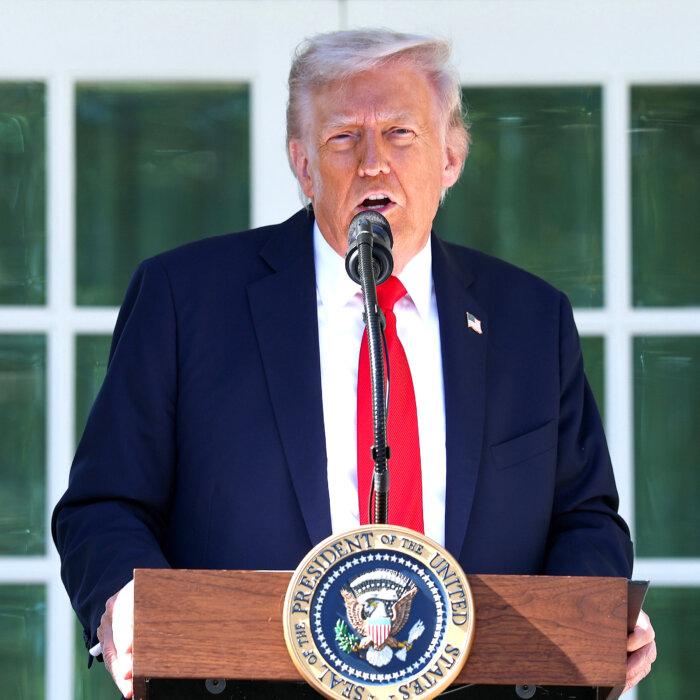
President Donald Trump announced new sanctions on Russia on Oct. 22, targeting its two largest oil companies, Rosneft and Lukoil.
A day later, the European Union imposed new measures on Moscow’s shadow fleet, banks, third-country entities, and cryptocurrency providers.
These sanctions are part of a concerted effort by the Trump administration and its allies in Europe to put pressure on the Kremlin and stymie its ability to fund its war machine, which is heavily based on the exports of oil and gas.
Trump announced on Oct. 15 that India has pledged to stop purchasing oil from Russia.
On Oct. 21, the president said that he had just spoken to Indian Prime Minister Narendra Modi and that “he’s not going to buy much oil from Russia.”
Maria Bertzeletou, a senior market analyst with The Signal Group, told The Epoch Times, “Russian oil has become attractive to countries like India mainly because it is sold below international market prices, a result of Western sanctions and the G7 price cap, which restricts the use of Western shipping and insurance for Russian crude sold above a set threshold.”
So how will the added pressure affect the Russian economy, and could it sap the country’s appetite for persisting with the war in Ukraine?
Russia’s Financial ‘Shock’
“Russia is absorbing the financial shock of war and sanctions better than many Western models predicted, but it is not thriving,” said a spokesman for Dallas, a private analytics and reconnaissance company that has exposed companies that help Russia evade sanctions.
“Confidential forecasts obtained by Dallas from Russia’s Ministry of Economic Development reveal a grim economic trajectory through 2027,” he told The Epoch Times in an email. “The Kremlin is leaning heavily on state coffers, tax increases, and a reallocation of investment toward military production to keep the economy afloat.”
Russian Foreign Ministry spokeswoman Maria Zakharova called the Rosneft and Lukoil sanctions “exclusively counterproductive” at a briefing on Oct. 23, reported by the Russian state-owned news agency Tass.
She said the EU’s attempts to sanction Russia are backfiring and that options for expanding sanctions “are largely exhausted.”
The Dallas spokesman said the Kremlin was running a “precarious, war-footing economy that still generates large energy revenues but is borrowing from future fiscal space to fund today’s fighting.”
U.S. Treasury Secretary Scott Bessent said on Oct. 22, “Now is the time to stop the killing and for an immediate cease-fire.”
Bessent said the Treasury is prepared to take further action if necessary to support Trump’s effort to end the war.
Announcing the latest package of sanctions on Oct. 23, the EU’s foreign minister, Kaja Kallas, said: “It is becoming increasingly difficult for [President Vladimir] Putin to finance his war. Every euro we deny Russia is one it cannot spend on war.”
Russia’s fiscal health and the stability of its currency, the rouble, are directly tied to movements in the price of crude oil, Bertzeletou said.
“The Russian economy is heavily dependent on global oil prices, with oil and gas revenues contributing around 30–40 percent of the federal budget and about 45–50 percent of total export earnings,” she said.
A day after a Truth Social post, in which Trump said Putin and his country “are in big economic trouble,” the U.S. president told reporters on Sept. 25 that Russia’s economy is “absolutely terrible right now.”
With crude oil imports exceeding $52 billion last year, India accounts for an estimated one-third of Russia’s petroleum exports, fueled by a sanction-driven discount.
Bertzeletou said the sanctions applied to Russia since February 2022—when it invaded Ukraine—prompted the Kremlin to offer its oil at discounted rates to non-Western buyers to sustain export volumes, “effectively shifting some of the sanction-related costs into lower prices.”
“India benefits from these reduced prices, gaining a stable and affordable energy supply, while Russia secures consistent demand outside Western markets,” she said.
Russian Oil ‘Geopolitically Advantageous’
“Additional factors—such as flexible payment mechanisms in non-dollar currencies and the use of alternative shipping and insurance arrangements—further enhance the appeal, making Russian oil a cost-effective and geopolitically advantageous option for countries like India,” Bertzeletou said.
But the pressure that the Trump administration is bringing to bear on New Delhi has made Russian oil seem less of a bargain for Modi.
“Within a short period of time, they will not be buying oil from Russia,” Trump told reporters in the Oval Office on Oct. 15.
The price of Brent crude fell from $101 in February 2022 to $61 on Oct. 20, although it rose slightly after news of the sanctions on Rosneft and Lukoil.
“Oil prices decline due to higher global supply from OPEC+ producers such as Saudi Arabia and the [United Arab Emirates], increased U.S. shale production, and expanding output from non-OPEC countries like Brazil, Norway, and Guyana,” Bertzeletou said.
Prices also went down because of lower global demand as a result of weaker economic activity in China, India, and the European Union, combined with the faster adoption of renewable energy by many countries, she said.
This has left the Russian Federation with a budget deficit of $60 billion in the first seven months of 2025.
But Russia has managed to create an axis of trade with other countries, such as Iran and North Korea, which are also under U.N. sanctions.
Then there is China, which has built a close relationship with Moscow in recent years, as they shared antipathy toward the United States, the UK, and the European Union.
Modi joined China and Russia at the Shanghai Cooperation Organization summit, which was held from Aug. 31 to Sept. 1 in the northern Chinese port city of Tianjin.
But India’s show of solidarity with Putin and Chinese leader Xi Jinping appears to have crumbled in the face of U.S. trade sanctions.
On Aug. 27, Trump imposed an additional 25 percent tariff on imports from India, bringing the total rate to 50 percent, in response to India’s purchase of Russian oil.
U.S. President Donald Trump (R) and Indian Prime Minister Narendra Modi meet in the Oval Office on Feb. 13, 2025. Andrew Harnik/Getty Images
The Dallas spokesman said Russia had also built up an extensive sanctions-evasion network that relied on an “army of intermediaries” spread around the world.
But he also said that “despite billions from oil exports, the Kremlin continues to dip into its reserves.”
“If that’s not proof that sanctions are biting, what is?” he said.
Russia’s National Wealth Fund (NWF), the reserve of foreign currency and gold designed to backstop state pensions, had liquid assets of $113.5 billion in early 2022, representing 7.3 percent of gross domestic product (GDP).
But that reserve had depleted at the rate of $1.7 billion per month, he said.
The independent Russian news agency, Interfax, reported in August that the NWF stood at $48.3 billion, which it said was 1.8 percent of GDP.
The Dallas spokesman said that at current spending rates, Russia’s liquid assets could be exhausted by late 2026, which might explain why the Kremlin recently announced plans to increase the value-added tax from 20 percent to 22 percent next year.
But there is no sign, as yet, that Russia’s economic pain has forced Putin to change course.