Russian Foreign Minister Sergei Lavrov has called for clarification of the United States’ role in trying to end the war in Ukraine.
His comments, made on June 26, came a day after U.S. Secretary of State Marco Rubio denied that any binding agreements had been made at a meeting between U.S. President Donald Trump and Russian President Vladimir Putin in Anchorage, Alaska, last summer.
During a visit to Bahrain on June 25, Rubio said that though there was a “proposal” made in Alaska, there was “no agreement,” adding that “if there had been an agreement, we would have had an end to the war.”
He said that the United States remains “prepared to play whatever constructive role we can to bring about an enduring end to this war in Ukraine,” adding that this had been the case for a year and a half, and saying that the lack of a real agreement being reached in Anchorage has been “the fundamental problem.”
Rubio made the comments in response to a question regarding allegations from Moscow that the United States had failed to deliver on “understandings” reached between Trump and Putin at the summit in the Last Frontier State.
A trio of Kremlin officials all recently accused Washington, in some way, of deviating from those understandings allegedly achieved in Alaska, or using them as a strategy to give Ukraine more time to rearm.
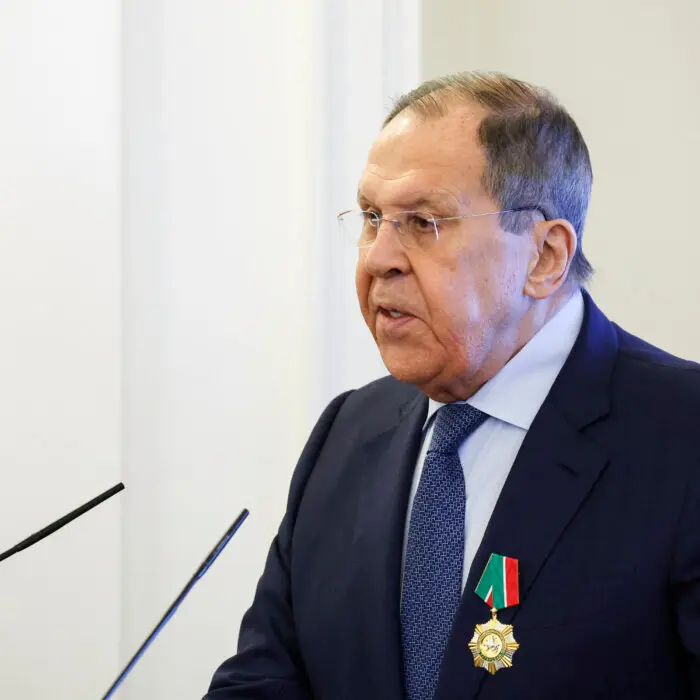
The triumvirate of Moscow functionaries included Lavrov, Deputy Russian Foreign Minister Sergey Rybakov, and Kremlin aide Yuri Ushakov.
Ushakov on June 21 said that only one side had remained committed to these understandings, “while the other side, as it now appears, has not been fully able to do its part,” Reuters reported.
Lavrov on June 23 suggested the United States had used the talks as a “ploy to buy time to rearm the Kyiv regime,” according to Reuters, while Rybakov, the same day, accused Washington of departing from “understandings” reached last summer, Interfax reports.
Responding to Rubio’s June 25 remarks, Lavrov, in written answers to questions from the media and reported by Russian state news agency TASS, insisted that Trump and Putin had reached an understanding on the outlines of a peace deal when they met in Alaska last August.
“Of course, this whole situation needs to be clarified. But the fact remains: US proposals were discussed in Alaska, and they were accepted by the Russian side,” Lavrov said.
Describing the meeting in Anchorage, Lavrov said that “when the two presidents sat down to negotiate (Rubio and yours truly were also there), Russian President Vladimir Putin, looking at [U.S. Special Envoy] Steve Witkoff, who was also there, began listing the American proposals point by point.”
“After each point, in the presence of US President Donald Trump and Secretary of State Marco Rubio, he asked Witkoff whether he had correctly labeled the ideas he had brought to Moscow the day before Anchorage,” he continued, saying that Witkoff responded in the affirmative after each point was raised.
“Therefore, when my colleague Rubio says that in Alaska there were only proposals, but no agreement, this raises questions for me in terms of what we mean by agreement,” Lavrov said, suggesting that his American counterpart’s description of their having been no agreement “is somehow not very elegant.”
He also raised questions over whether the United States could act as a mediator in any Russia–Ukraine peace deal, given its support for Ukraine, specifically referring to a statement from Rubio to this effect before a congressional hearing earlier this month.
“We are not impartial mediators in that war,” Rubio told Congress on June 3. “We do not provide weapons to Russia; we only provide weapons to Ukraine. We do not impose sanctions on Ukraine; we only impose sanctions on Russia, so we have clearly taken a side.”
Following Lavrov’s remarks, Kremlin spokesman Dmitry Peskov struck a more conciliatory tone, saying Moscow believed it was Trump’s “sincere desire” to “help bring the settlement process onto a peaceful track,” TASS reported.
“No one has dismissed the US intention to continue its efforts,” he said. “In fact, President Donald Trump has stated that once issues related to the Iranian settlement—an inherently complex and demanding process—are resolved, the United States will once again intensify its diplomatic efforts regarding Ukraine.”
Peskov went on to say that “absolute neutrality” was not the term to describe Washington’s position because “the United States supplies weapons to Ukraine.” He stipulated, however, that under the Trump administration, this was done “for a price, whereas earlier it was allegedly done for free.”
Russia has regularly pointed to the summit in Anchorage when discussing proposals for the end of the war, however, the precise details of what was discussed by those present have never been made public.