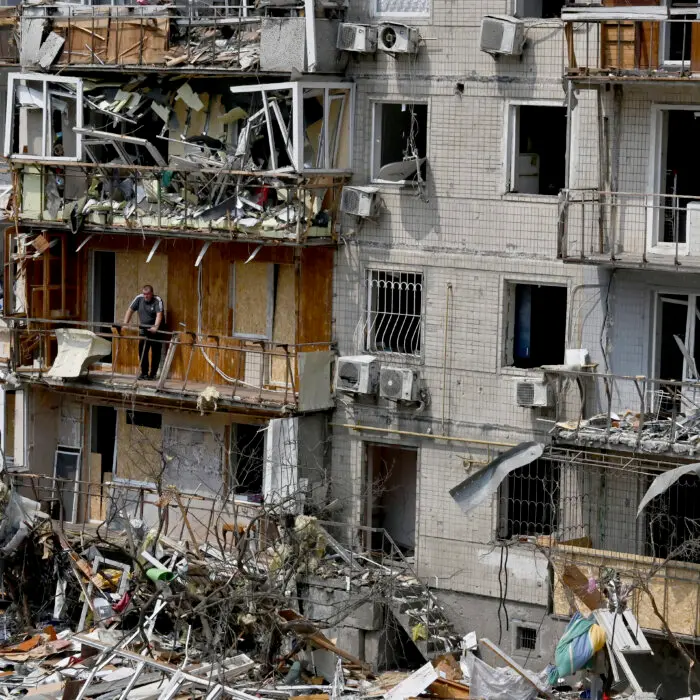
Russian missiles and drones hit Kyiv early on July 6, killing 12 people and heavily damaging apartment buildings in strikes just a few days after the deadliest assault on the Ukrainian capital this year.
The attack occurred before a planned NATO summit in Turkey this week, where U.S. President Donald Trump will meet with Ukrainian President Volodymyr Zelenskyy to make a renewed push to end the war.
Rescue crews were pulling residents from buildings shattered by the overnight barrage, Kyiv Mayor Vitali Klitschko said in a post on Telegram. Klitschko said the death toll in the capital had risen to 12, with dozens wounded throughout the capital.
Ukraine’s air force said Russia had used 68 missiles, including 23 ballistic and six super and hypersonic missiles, as well as 351 drones in the attack.
The Ukrainian Air Force shot down or neutralised 37 cruise missiles and 326 drones, but stopped none of the ballistic missiles or super and hypersonic missiles, the air force data showed.
Ukraine has said it is short of interceptors for its Patriot defense system, the only effective weapon to down incoming ballistic projectiles.
Zelensky said in a July 6 post on X that the reason for the success of the Russian attack was “the insufficient supply of interceptor missiles.”
“It is critically important that the world—first and foremost the United States and our European partners—come out of the NATO Summit in Ankara with strong decisions in support of our air defense, and thus the protection of ordinary people’s lives,” he said.
“As long as Patriot missiles remain in our allies’ stockpiles, Russia is only encouraged to keep ‘vanquishing’ residential buildings. The United States and Europe have enough strength to stop this terror.”
Tymur Tkachenko, head of the Kyiv city military administration, said four residential buildings had been struck in the Podilskyi district alone and that damage was also recorded in two other city districts.
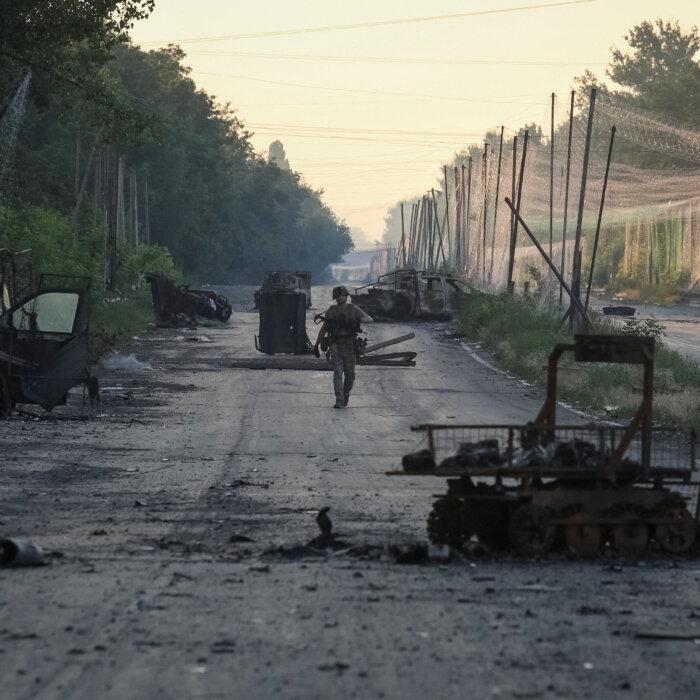
Russia conducted a “massive” attack on Ukraine’s capital and other locations with long-range, high-precision air-, land-, and sea-launched weapons and drones, Moscow’s Ministry of Defense said on July 6, adding that military and energy facilities were hit in Kyiv and Kyiv oblast, as well as military airfields in several other Ukrainian regions.
Poland briefly scrambled fighter jets as a preventive measure, the Polish Operational Command of the Armed Forces said in a July 6 post on X.
Ukraine launched its own drone attacks on Russia, damaging the Baltic Sea ports of Vysotsk and Ust-Luga, local Russian authorities said on July 6.
The same day, Kyiv’s attacks also caused a blackout in the Crimean port of Sevastopol.
“The US President reaffirmed his readiness to facilitate an early termination of the hostilities and the search for peaceful solutions to the crisis,” Russian presidential aide Yuri Ushakov wrote in a statement on July 5.
It is the second time in a month that Trump has spoken with Putin over the phone to discuss ending the war in Ukraine, which began with Russia’s invasion of Ukraine in February 2022.
“The Russian President reaffirmed our commitment to a political and diplomatic settlement of the conflict, with due consideration for Russia’s known principled approaches,” Ushakov wrote.
“No matter how hard the Kyiv regime clings to the remaining fortified areas, our army will definitely take them.”
Ushakov said that White House special envoys Steve Witkoff and Jared Kushner “will carry on their mediation efforts and are ready to come to Moscow.”
Zelenskyy said he also received a call from Trump over America’s Independence Day holiday.
Washington-based think tank the Institute for the Study of War (ISW) said on July 5 that Russia is “using a short-term ceasefire proposal it knows Ukraine will logically reject as part of Russia’s expanded cognitive warfare effort to falsely portray Ukraine as the unwilling negotiator.”
The ISW said it “continues to assess that these short-term ceasefire proposals do not represent a Russian diplomatic concession but allow Russian forces to stockpile weapons and equipment and conduct rotations, reinforcements, and logistics, all while aiming to shape Western perceptions of Russia’s steady frontline advances and willingness to negotiate.”