Russia said on Dec. 1 that remarks by NATO’s top military officer that the alliance could consider a “preemptive strike” were “extremely irresponsible.”
Italian Navy Adm. Giuseppe Cavo Dragone, chair of NATO’s military committee, said earlier that day that the organization was considering being “more aggressive” against hybrid warfare from Moscow.
He said the key test for NATO was deterrence of future aggression.
“How deterrence is achieved—through retaliation, through preemptive strike—this is something we have to analyze deeply because there could be in the future even more pressure on this,” he said.

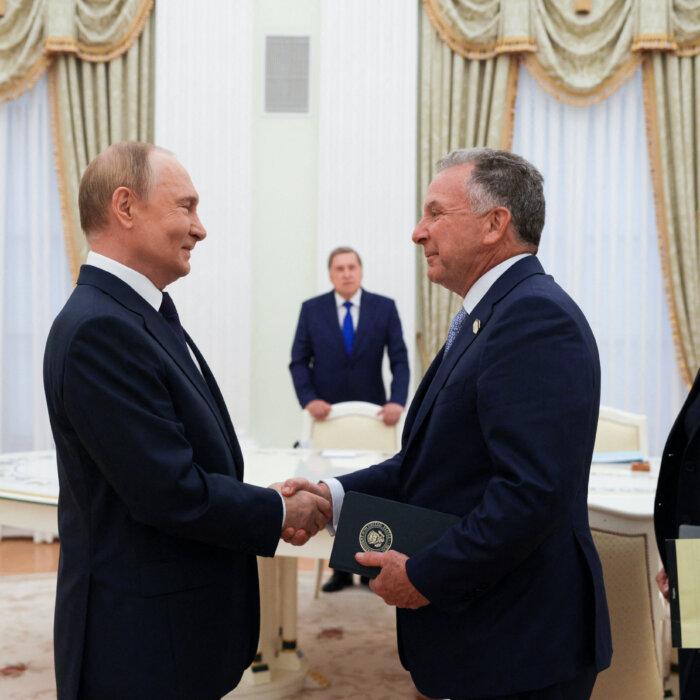
Responding to these comments, Russian Foreign Ministry spokeswoman Maria Zakharova called them “an extremely irresponsible step, indicating the alliance’s readiness to continue moving towards escalation.”
“The people making such statements should be aware of the risks and possible consequences, including for the alliance members themselves.
“We view Giuseppe Cavo Dragone’s statement about possible preemptive strikes against Russia as an extremely irresponsible step, demonstrating the alliance’s readiness to continue escalating.
“We see it as a deliberate attempt to undermine efforts to resolve the Ukrainian crisis. Those making such statements must be aware of the ensuing risks and potential consequences, including for the alliance members themselves.”
Zakharova went on to accuse NATO of “whipping up” anti-Russian hysteria of an imminent attack by Moscow, and she said Dragone’s comments “seriously inflame the already existing confrontation.”
Russian hybrid warfare has increasingly been an issue of concern within both NATO and the European Union.
Concern over this prompted NATO to launch a major air operation on Sept. 12, dubbed “Eastern Sentry,” with the stated aim of defending its eastern flank.
Alongside NATO, the EU has announced plans for new measures to counter hybrid warfare.
“It’s time to call it by its name: This is hybrid warfare, and we have to take it very [seriously],” she told lawmakers in Strasbourg, France.
“We must not only react; we must deter because if we hesitate to act, the gray zone will only expand,” von der Leyen said, without directly naming Moscow, although she did say that Russia aimed to “sow division” in Europe.
The plans outlined four defense strategies: the European Drone Defense Initiative, the Eastern Flank Watch, the European Air Shield, and the European Space Shield.
Russia has consistently denied accusations that it has intentionally entered NATO airspace and has previously denied involvement in other alleged sabotage and attacks on European infrastructure.