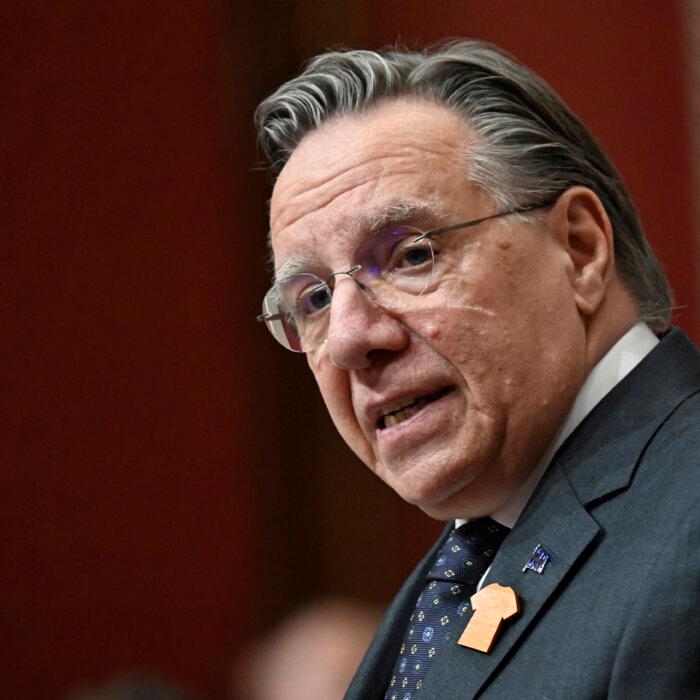
Quebec Premier François Legault said the province is under threat from Islamists seeking to undermine Quebec’s values in his inaugural speech before the National Assembly.
Legault said in his Sept. 30 speech that “radical Islamists” are attempting to impose their own values and challenge those of the Quebec people, and he cited women’s right to equality as an example.
“We must be very clear on this, we are not going to let anyone attack the freedom dearly acquired by Quebec women for decades,” Legault said.
Legault, who leads the Coalition Avenir Quebec, added that his government would take “all possible means to counter the attacks against our common values.” He said that while immigrants are an “asset” to the province, the federal government should control immigration rates to ensure the country’s capacity is not overburdened.
The Quebec government, which aims to maintain secularism in the province, has implemented some policies that have impacted Muslim communities.
Legault previously said in December 2024 that he was examining ways to end prayer in public places in order to send a “very clear message to Islamists” that Quebec would fight against disrespect shown toward its secular values. His comments came in light of groups of Muslims gathering to pray in public places in Montreal, including a group coming together in a city park to celebrate Eid al-Adha.
In August 2025, the Quebec government announced it was planning to introduce legislation in the fall banning prayer in public places. In response, the Canadian Muslim Forum said in a statement it was concerned with the proposal, and that the provincial government should be “focused on solving real problems, not policing the fundamental rights of its citizens.”
Following a series of reports that found Islamic practices were appearing in some public schools, which included some Muslim students praying in classrooms and hallways, Education Minister Bernard Drainville said in late 2024 that the government would introduce a new bill to reinforce secularism in Quebec schools.
In 2019, the Quebec government introduced Bill 21, which bans teachers, judges, and police officers from wearing religious symbols while working. The province invoked the notwithstanding clause to shield the law from constitutional challenges, as the clause prevents judicial review of the legislation in question for five years, and may be renewed.
The Supreme Court has agreed to hear a challenge to Bill 21, and the federal government recently filed a factum with the court that outlines its position on “constitutional issues raised” by the repeated usage of the notwithstanding clause by the provinces. The Bloc Québécois has called for the federal government to revoke the factum, arguing Ottawa is proposing to take constitutional powers away from Quebec and the other provinces.