
A high-level official at the U.S. Department of War is dismissing the idea that middle powers can amplify their global influence by banding together, calling the strategy detached from reality.
Colby said there has been a “great deal of hubbub” about the strategy recently, while adding that his department is “not concerned that this is a serious possibility.”
“Rather, we are more concerned that a few allies and partners will *think it is* and waste valuable time, money, and political capital on a distraction,” he wrote.
The comment comes a week after the NATO Summit in Turkey, after which U.S. President Donald Trump said there had been “tremendous unity” between leaders.
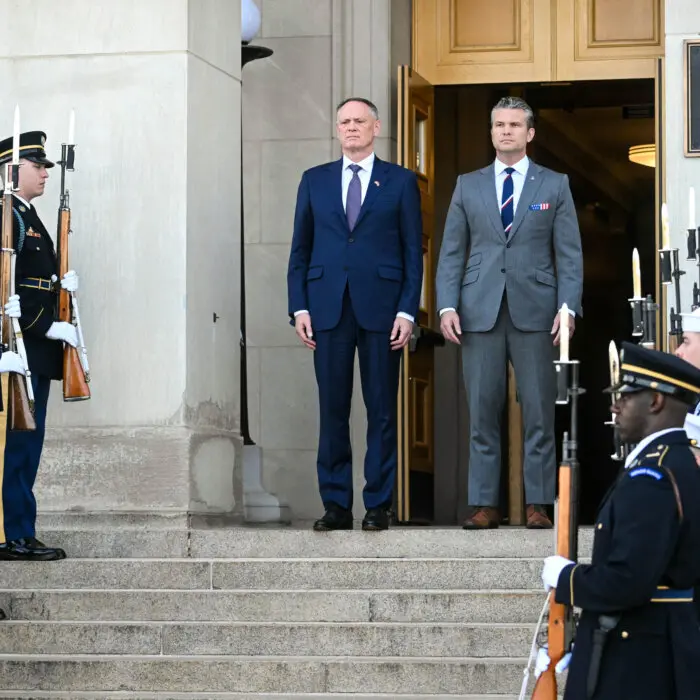
His previous comments on Greenland took place before the meeting of the World Economic Forum (WEF) in Switzerland in January.
“The middle powers must act together, because if we’re not at the table, we’re on the menu,” Carney said in his speech. “In a world of great power rivalry, the countries in between have a choice – compete with each other for favour, or to combine to create a third path with impact.”
Since taking office in March last year, Carney has undertaken a series of trips and signed agreements abroad as he seeks to reduce Canada’s dependency on the United States.
In his July 14 message, Colby said that the collective middle powers strategy is “based on a faulty understanding of international relations.”
He describes the U.S. administration as “flexible realists” who view the world through a lens of interests, geography, economics, and military power. Colby said middle powers “don’t have a coherent basis for alignment.”
Colby added that countries are not distancing themselves from the United States and that he’s seeing an “upsurge” in a desire for engagement. He rejected the view that U.S. arms sales will go down and the defence industrial base will dwindle as countries are frustrated with the United States and buy their weapons elsewhere.
“This is neither feasible nor accurate,” he said, adding that no country can compete with the U.S. defence industry.
Colby concluded in saying that allies should still work on building their own defence industrial bases to boost collective security, while adding it should be done “in ways that are collaborative with America’s rather than trying in vain to replicate or supplant it.”
The Canadian government is currently increasing spending on defence and seeks to bolster the country’s defence industrial base. It has made some moves to diversify its defence relationships, including by joining Europe’s SAFE rearmament program, which provides loans to speed up defence procurement.
Ottawa’s purchase of additional F-35s has also been under review for over a year, and says it is also considering the Swedish Gripen fighter jet to replace its aging fleet of CF-18s.
Canadian government officials insist that the defence and security relationship remains robust with the United States amid trade tensions.
“We can no longer avoid the gaps between rhetoric and reality,” Colby said, adding that “real powers must sustain our rhetoric with shared defense and security responsibilities.”
Carney downplayed Washington’s move, saying he “wouldn’t overplay the importance of this.”