A third of students across years 3, 5, 7, and 9 have failed to meet the National Assessment Program – Literacy and Numeracy (NAPLAN) benchmarks, with only numeracy showing any sign of improvement.
In March, 1.3 million students sat the standardised tests, representing 98.3 percent of those enrolled, the highest participation rate since 2017.
The results have now been released by the Australian Curriculum, Assessment and Reporting Authority (ACARA). They show four in 10 (39.2 percent) failed to meet expectations for understanding grammar and punctuation, while one in three were still falling behind in reading, spelling, writing, and numeracy.
Students in years 5, 7, and 9 were the first to have completed two NAPLAN tests since changes were made in 2023, allowing for a comparison of their performance to be made.
Since then, the performance of students across all years has shown no overall improvement.
Girls continue to outperform boys in literacy skills, while boys remain ahead in numeracy. Additionally, those whose parents have higher education and more skilled occupations tended to perform better than their peers.
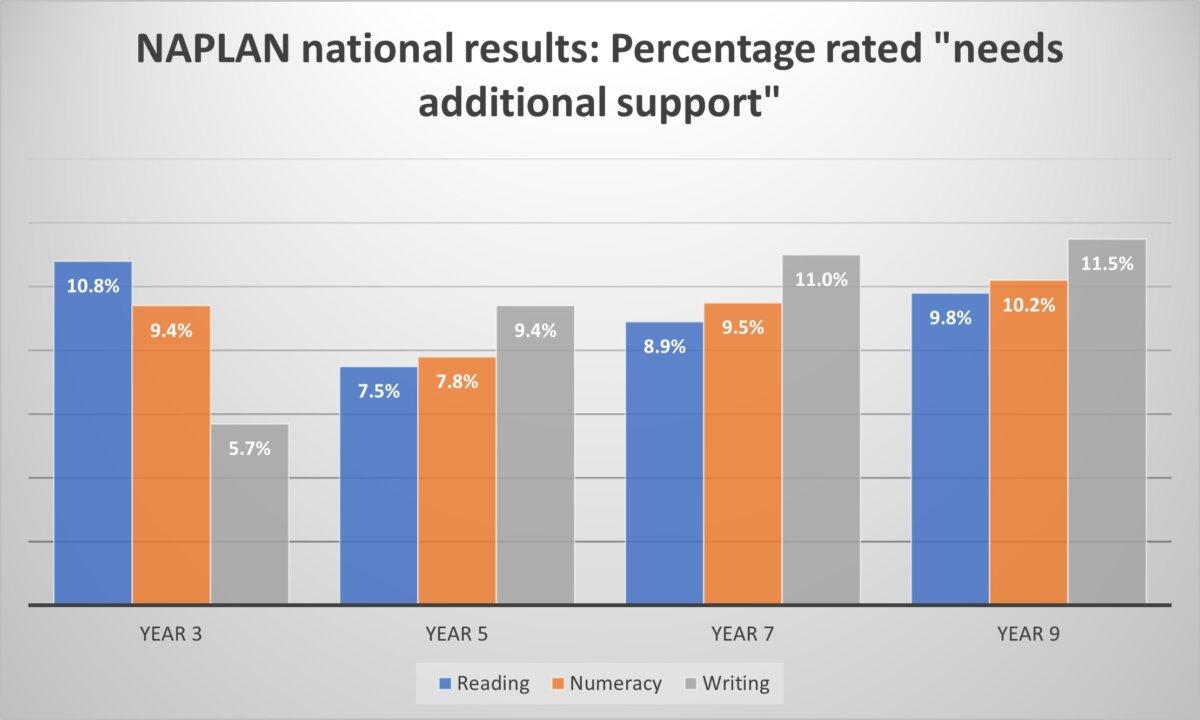
However, positive trends were apparent. All year cohorts returned higher-than-average scores in numeracy, with 20,000 additional students attaining the highest level, called “exceeding,” compared to 2024. The number of those who achieved a similar result in literacy also slightly improved across all year levels.
He pointed to the agreements the federal government had signed with all states and territories, which would see $16 billion in funding over the next decade.
This would be tied to “real, practical reforms to reduce the number of students who need additional support,” he said.
‘Tried and Tested’ Methods the Key
Glenn Fahey, Director of the Education program at the Centre for Independent Studies (CIS), said the most recent failure to lift overall performance is just the latest measure of a long-term trend.“This is despite decades of supposed reforms to the school system and record investment to the tune of around $90 billion in public funding per year,” he told the Epoch Times.
“Literacy and numeracy are the foundation of every other form of learning. When students fall short here, it shows up down the track in poor employment outcomes, welfare dependency, and social disengagement.”
The problem is that the investment isn’t translating into results, as evidenced by these latest statistics, because it’s blocked by an “establishment that’s unable or unwilling to meaningfully improve student outcomes.”
“If Australia’s school system is to maximise the success of students, it needs to supercharge the teaching practices that are tried and tested,” Fahey said, calling the current education system “high-spend, but low-impact.”
“It’s no secret that the schools that punch above their weight are committed to great teaching that’s explicit, where the teacher runs the room, and where learning is intentional, not left to chance. This can’t just happen in pockets, but [needs to] become the norm.”
Don’t Overrate NAPLAN: Union
Unsurprisingly, the Australian Education Union (AEU) takes the opposite view, saying that NAPLAN results are “just one measure of student achievement, and its importance should not be overrated.”AEU Federal President Correna Haythorpe pointed out that public schools educate most of the students with higher needs, “yet only 1.3 percent are funded to the Schooling Resource Standard (SRS), which is the minimum level governments agree they need.”
In contrast, the Union says, government funding for private schools has been increasing at twice the rate of public school funding, and 98 percent of private schools are resourced at or above the SRS.
“Funding public school systems at 100 percent of the SRS is the only way to ensure every child gets every opportunity to succeed, and we have the teachers we need for the future. This has to happen by 2028,” Haythorpe said.
“The needs of our children are growing but the funding from governments hasn’t kept up.”