This copy is for your personal, non-commercial use only. Distribution and use of this material are governed by our Subscriber Agreement and by copyright law. For non-personal use or to order multiple copies, please contact The Epoch Times Reprints.
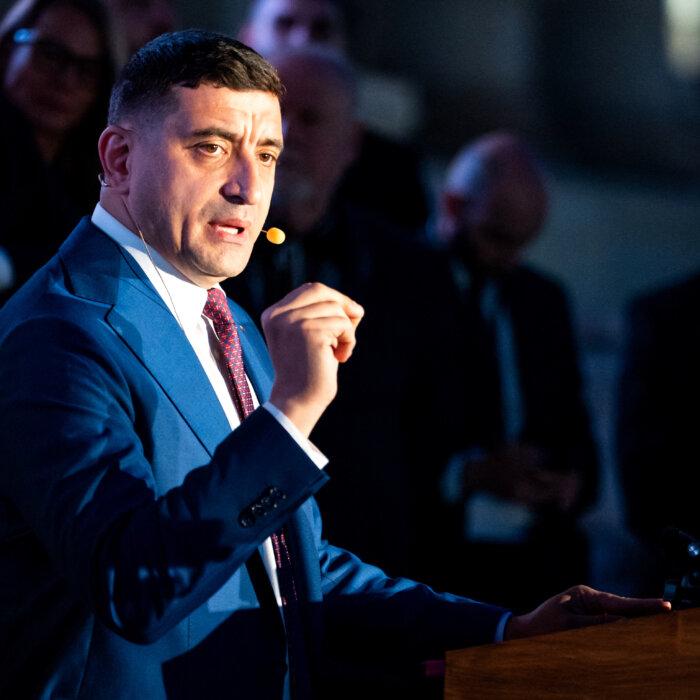
Romanian Prime Minister Ilie Bolojan delivers a speech in the Palace of the Parliament in Bucharest on June 23, 2025. Photo by DANIEL MIHAILESCU/AFP via Getty Images
Romania’s three-week-old government survived a no-confidence vote on July 14, allowing it to push through tax hikes in an effort to lower the nation’s budget deficit.
Prime Minister Ilie Bolojan’s coalition has fast-tracked an increase in value-added tax (VAT)—akin to U.S. sales tax—excise duties, and other levies through Parliament to take effect in August.
The move aims to prevent a ratings downgrade to below investment level and to unblock access to European Union funds. Bucharest currently has the largest deficit in the EU.
The governing coalition is made up of four pro-EU parties: the Social Democrat Party, the National Liberal Party, the Save Romania Union, and the Hungarians’ Union, which represents the country’s sizable Hungarian minority.
The coalition took power at the end of June, after months of political inertia caused by the cancellation of a presidential election in December 2024 and its re-run in May.
The tax increases have been criticized by employers and unions and prompted thousands of public sector workers to stage protests.
The coalition’s conservative opposition filed the July 14 no-confidence motion and has said it plans to file further ones.
“I understand that the opposition criticizes the government. It is its role and its right,” Bolojan told Parliament, according to Romanian news outlet digi24.
“However, I have appealed to the opposition parties to be part of the solution, not the problem. I understand that they do not agree with what the government is proposing. But then what are the opposition’s solutions?
“On the one hand, we are told that the economic problems are serious, but on the other hand, when we come up with a clear plan to solve them, they tell us not to take these measures. It cannot be like that.”
While all four parties in the government approved the increases, the largest party, the Social Democrats, also criticized the measures on July 14.
“For solid political support, we must quickly correct some absurd things that are found in the first package of measures,” Social Democrat leader Sorin Grindeanu said, according to digi24.
The party, which is integral to the continuation of the coalition, had supported replacing the flat rate of income tax with progressively escalating taxation according to income, instead of raising VAT. The other parties, however, did not support that move, according to a report in digi24.
Earlier this month, Bolojan said his government would do everything possible to lower the deficit to about 8 percent of gross domestic product by the end of 2025, down from 2024’s 9.3 percent, Radio Free Europe reported.
This target has been revised up from 7 percent. He further said he would move to lower it to nearer 6 percent by the end of 2026.
Romanian law stipulates that the tax measures could be challenged in the country’s constitutional court, and the opposition AUR party brought a case to block them on July 15, according to digi24.
Romania, which joined the EU in 2007, has been beset by political turmoil since a presidential election was voided after the first round of voting was held in December 2024.
In the first round, conservative outsider Calin Georgescu won the most votes, but that ballot was voided by the constitutional court, following allegations of electoral fraud and Russian interference.
Moscow has denied meddling in Romania’s politics.
Georgescu was then banned in March from taking part in the election rerun, which took place in May.
In that vote, Nicusor Dan, the mayor of Bucharest, won the presidency, beating George Simion in the second round, after the latter took the most votes in the first round.
Simion then challenged the vote in the constitutional court, but his appeal to annul the election was thrown out.
Dan, who ran for the presidency as an independent, appointed Bolojan, leader of the National Liberal Party, to the role of prime minister in June.
Bolojan’s plans for lowering state spending include—along with tax increases—laying off a fifth of civil service staff, postponing investments, and legislation to cut public sector bonuses, according to Radio Free Europe.
Along with being a member of the EU, Romania is part of NATO, and its location in Eastern Europe means its position has become more pivotal to both organizations since Russia invaded Ukraine in 2022.