The case stands out not only for the number of officers allegedly involved but also the scope of the alleged criminal activity, including the leaking of information used to facilitate shootings, extortions, and drug trafficking.
How does the case compare to previous scandals?
Former TPS homicide investigator and founding chair of Investigative Solutions Network David Perry agreed, saying the case is “unprecedented” in scope.
“If I was still in policing, I'd be in my 50th year, so I’ve been around a long time, and this is the most shocking corruption allegation that I think I’ve ever heard of in Canadian policing, let alone Toronto,” Perry said in an interview with The Epoch Times.


“It’s just unheard of. It’s on a scale that is just unprecedented.”
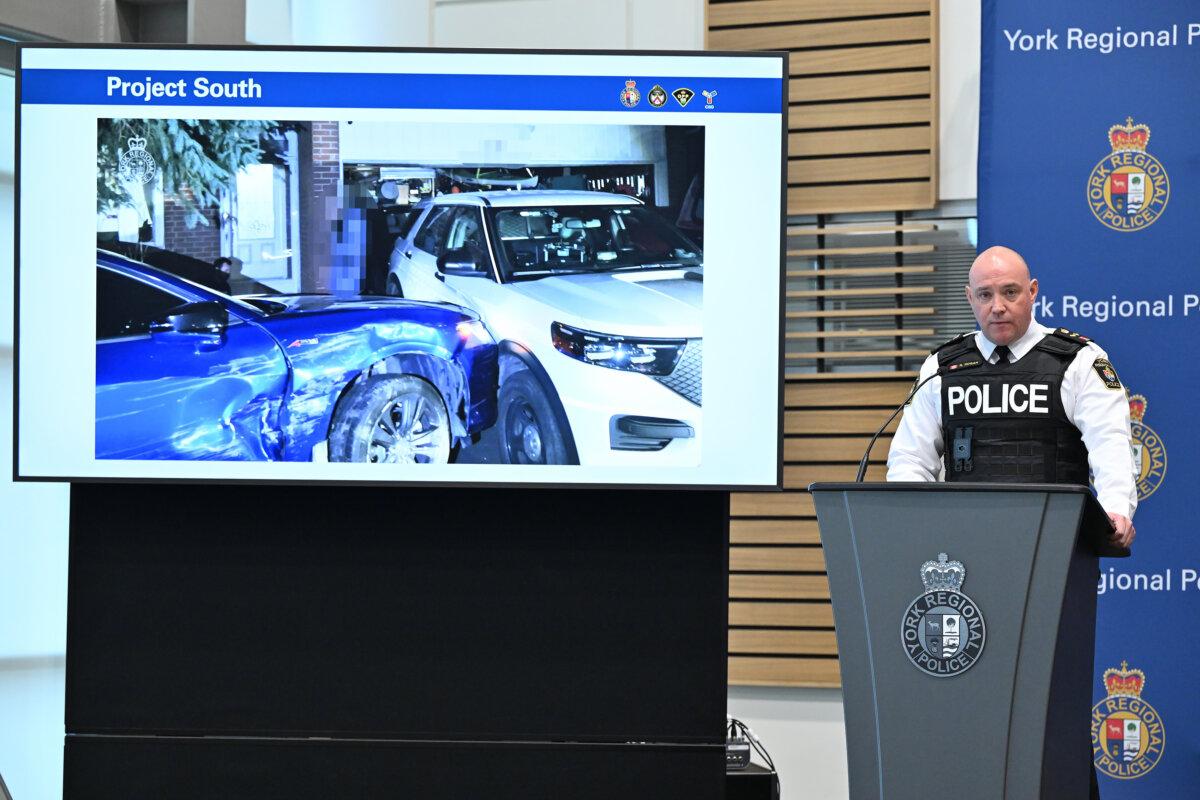
Project South
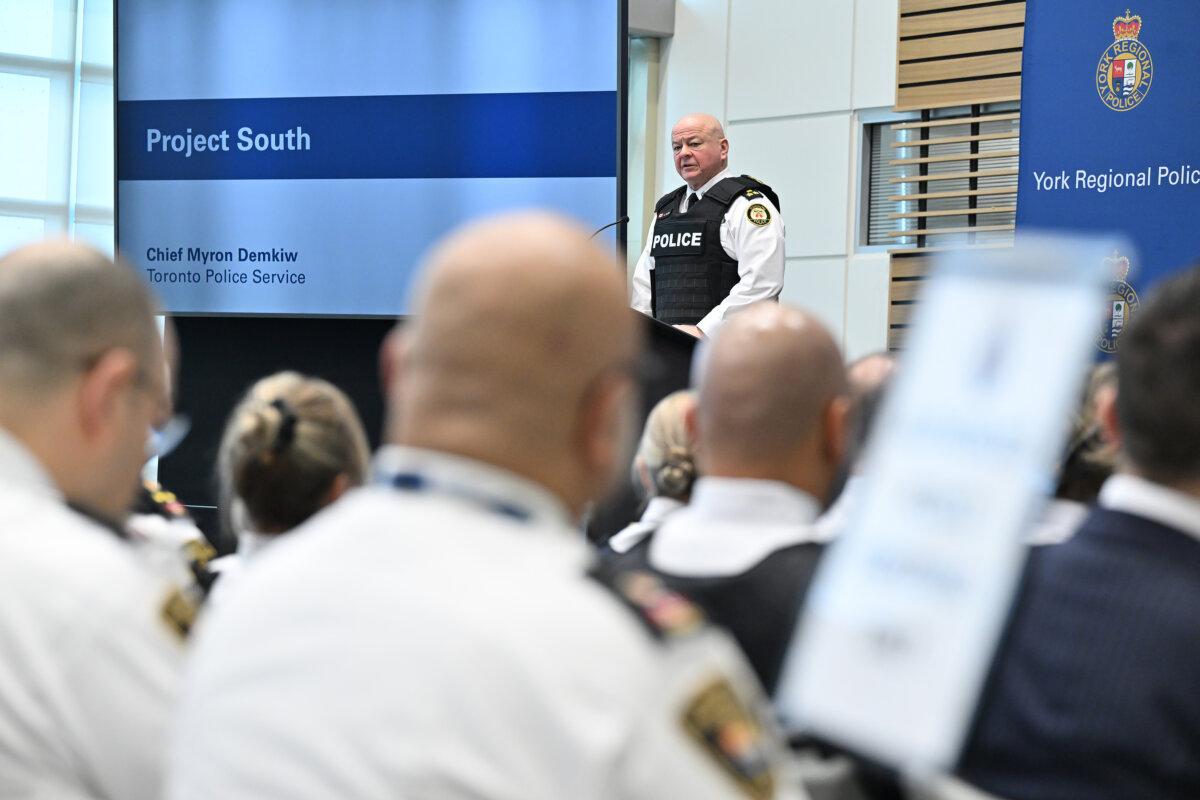
Chief Demkiw appeared Feb. 5 alongside York Regional Police (YRP) Chief Jim MacSween and YRP Deputy Chief Brian Hogan to announce criminal charges against 27 individuals, including seven active-duty TPS officers and one retired Toronto Police officer.The charges resulted from an investigation launched last June called Project South, which police say found officers illegally accessing and sharing sensitive information to assist organized crime in targeting individuals and which led to criminal activity such as shootings, extortions, robberies, and drug trafficking.
“These brazen actions highlight the clear dangers that were faced by the victim, his family, and the police officers that were there to protect him,” he said.
Alleged Police Corruption
This includes retired police officer John Madeley Sr., 62, and his son Const. John Madeley Jr., 29, both of Barrie, Ont.; Sgt. Robert Black, 42, of Vaughan; Sgt. Carl Grellette, 38, of Vaughan; Const. Saurabjit Bedi, 38, of Caledon; Const. Derek McCormick, 57, of Toronto; and Const. Elias Mouawad, 24, of Mississauga.
“To see those two men, father and son in that very proud moment, and to hear that they’re now two of the people at the centre of this scandal—I can’t even define it. I can’t put it into words,” former TPS officer Perry said of a photo circulating of Madeley Sr. with his son Madeley Jr. upon graduation from the police academy.
Police say the officers charged in the probe were also allegedly attempting to recruit other TPS officers to help in the criminal operations, which involved several figures allegedly linked to criminal networks, namely Brian Da Costa of Toronto and Elwyn Satanowsky of Richmond Hill. Both Da Costa and Satanowsky face a number of charges relating to the investigation.
None of the charges have been tested in court yet.
Police have noted the investigation is ongoing, and Perry said additional charges are likely.
“It’s not unusual to sort of have a phase one, which is the major portion of a large investigation like this,” he said. “People are going to be talking. Other people are going to be spoken to. Those could result in additional people being arrested, for sure.”
Why This Case Is Different
Former RCMP trainer, major crime investigator, and investigative interviewing expert Bruce Pitt-Payne said this case stands out because of the number of officers who are accused of working together to allegedly assist criminal enterprises.“My experience has been predominantly with individual officers who either associate with or commit crimes alone or with a non-police criminal,” Pitt-Payne told The Epoch Times. “This is different than most Canadian corruption cases due to the number of police officers involved as a group.”
Sidhu served as a drug detective with the RCMP, but after leaving the force in 2003, assisted the Hells Angels by recruiting a border services worker to allow the shipment of large amounts of cocaine into Canada and large amounts of illegal cannabis from B.C. into the United States. An investigation into the matter led to more than 1,700 pounds of cocaine and US$3.5 million being seized.
Sidhu received eight years in a U.S. federal prison for his role in trafficking the drugs and now runs a legal advocacy and reform organization.
Another past case that drew attention occurred in 2018 when Vancouver Police Department (VPD) Detective James Fisher was investigated and found to have engaged in sexual activity with women who were victims of sex trafficking cases he was investigating. Fisher pleaded guilty to two counts of breach of trust and one count of sexual exploitation, resulting in 20 months in jail.
Rising Threat of Organized Crime
Organized crime in Canada has contributed to a rise in violent crime, with more than 2,000 known groups operating across the country, according to Criminal Intelligence Service Canada (CISC).
These groups take part in a number of crimes including producing and trafficking drugs, money laundering, human trafficking and sex exploitation, weapons smuggling, fraud and financial crime, extortion and protection rackets, violence and gang activity, trying to seize monopolistic control of lawful industries like transportation and construction, and running online cybercrime operations.
Perry said the rise of organized crime is something every Canadian has been noticing and is tied to an influx of groups from all over the world committing crimes, in addition to domestic criminal organizations.
“[There are] organized crime groups coming out of just about every country in the world, including the Mexican cartels, who all are here and have strong footholds here in Canada and are involved in everything you can imagine,” he said.
“Canada is no longer the safe haven that it used to be.”
CISC notes that organized crime groups are increasingly seeking to infiltrate and buy off public institutions such as with law enforcement officers in order to facilitate their illegal activities.
How Does It Happen?
Pitt-Payne said corruption often begins with small ethical lapses or rule-breaking that then spirals into worse misconduct or corruption. He gave the example of a slowly boiled frog who doesn’t realize it’s in boiling water until it’s too late.
For his part, Perry said he can’t fathom the mentality of officers who would engage in the scale of alleged corruption uncovered in the Project South probe.
“I don’t understand, because I am a former police officer, and probably 90 percent of my friends are either current or former police officers, and we just don’t think this way,” he said. “We don’t act this way, you know, and to have seven officers all placed on these very serious charges and involving criminals and organized crime groups, it’s just such an unknown quantity to us.”
Perry said that his colleagues in law enforcement are all disgusted with the accused and would have been happy to make the arrests themselves.
“I’ve talked to dozens of police officers today,” he said. “The calls that I’ve gotten, the mantra is the same: disgusting, appalling. Hopefully they get convicted and get very long prison terms.”
Authorities noted that Ontario’s policing inspector general has been asked to conduct an independent review of how the alleged corruption happened and how it has been handled, something Perry said will be useful in finding out why and how this corruption could have occurred.
While acknowledging the gravity of the charges being faced and his responsibility in ensuring integrity at TPS, Chief Demkiw said the hard work and effective policing done by most TPS officers should be recognized, a sentiment echoed by YRP Chief MacSween.“The actions of a few should not be representative of the actions of many of our people who work really hard each and every day to uphold the trust our communities have in us,” MacSween said.
Chief Demkiw said all officers charged in the matter have been suspended and he will seek unpaid suspensions for four of them.
“I understand this news will be distressing for Torontonians and our police service members,” Demkiw said.
“No corner of society is immune from the reach of organized crime, but when organized crime penetrates the Toronto Police Service, the harm goes far beyond the immediate wrongdoing.”