This copy is for your personal, non-commercial use only. Distribution and use of this material are governed by our Subscriber Agreement and by copyright law. For non-personal use or to order multiple copies, please contact The Epoch Times Reprints.
Marine Le Pen Threatens to Bring Down French Government Over $51 Billion Budget Cuts
French Prime Minister François Bayrou plans to scrap two public holidays and freeze welfare as well as get rid of 3,000 public-sector worker posts by 2026.
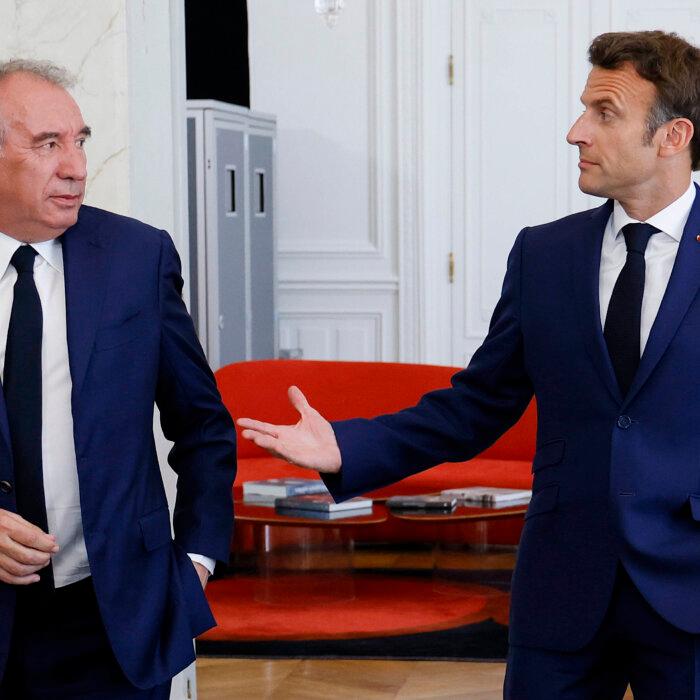
French Prime Minister François Bayrou attends a news conference to present a major public finance recovery plan for 2026, in Paris on July 15, 2025. Abdul Saboor/Reuters
French conservative politician Marine Le Pen has vowed to bring down the government unless Prime Minister François Bayrou rolls back massive budget cuts.
On July 15, Bayrou announced drastic measures to the Senate to reduce the public deficit by 43.8 billion euros (nearly $51 billion) in 2026.
“We’ve become addicted to public spending,” Bayrou said at a news conference where he presented the major public finance recovery plan, adding that no other country allocates as much public spending as France.
The plan is aimed at reducing France’s debt, projected to soar to above 3 trillion euros (about $3.49 trillion) this year, with public debt hovering at about 110 percent of gross domestic product (GDP).
The European Union advises member states to bring their public debts below 60 percent of GDP, and it advises them not to let budget deficits exceed 3 percent of GDP.
According to official EU estimates from May, France’s government deficit is forecast to decline to 5.6 percent of GDP in 2025 and to edge up to 5.7 percent in 2026.
Bayrou’s plan involves freezing welfare spending and even scrapping some public holidays.
Le Pen, leader of the National Rally party, said in a post on X on July 16 that there are “no savings on the cost of immigration, subsidies for out of control intermittent energies, seven billion in increased contributions to the European Union, nothing on bureaucracy in hospitals or education.”
“This government prefers to target the French, workers, and retirees, rather than hunt down waste,” she said.
“If Francois Bayrou does not revise his approach, we will vote for a motion of no confidence against him.”
The plan was also criticized by France’s political left.
Representatives from the country’s four main progressive forces—the Greens, the Socialists, the Communists, and Jean-Luc Mélenchon’s France Insoumise (France Unbowed) movement—said on X that Bayrou’s budget is “a true declaration of social war against the people of France.”
The Socialist Party also threatened to take down the government.
“The proposal presented is completely unacceptable. The Socialists will make their own proposals at the start of the new session. Based on the current plan, a vote of no confidence is the only option,” they said in a post on X on July 16.
Parliamentary channel Public Sénat reported that the prime minister said he was proposing a fiscal pause and the abolition of two public holidays.
Bayrou cited, for example, Easter Monday, as it has no “religious significance,” and also May 8, Victory in Europe Day (VE Day), as potential holidays to be cut.
He also announced a “solidarity contribution” that will “involve the highest incomes in the national effort.”
Bayrou proposed a reduction of 3,000 posts in public service as early as 2026.
“No ministerial department will be exempted,” he said.
Members of the French parliament will vote on Bayrou’s budget plan in the fall.
The collapse of former Prime Minister Michel Barnier’s government in early December 2024, after only a couple of months in the role, meant that France was unable to pass the budget before the year-end deadline.
Bayrou was named the new French prime minister later that month.
He survived a vote of no confidence on Jan. 16, which was called by the far-left La France Insoumise, the Greens, and the Communists.
Bayrou then used special constitutional powers to try to force the 2025 budget.
Article 49.3 allows the government to pass legislation without a vote and was written into the French constitution to bypass deadlocks on important matters.
Defense spending won’t face any cuts, however.
French President Emmanuel Macron on July 13 announced a plan to push forward France’s defense spending, pledging to double the military budget.
The president said that, in total, France will aim to spend 64 billion euros (about $74.5 billion) on defense in 2027, double the 32 billion euros that the country spent when he took office in 2017.
In a speech delivered on the eve of the French national holiday of Bastille Day, Macron said Europe is facing a mix of persistent and emerging threats, ranging from Islamist terrorism and cyberattacks to the Russia–Ukraine war on NATO’s doorstep.