This copy is for your personal, non-commercial use only. Distribution and use of this material are governed by our Subscriber Agreement and by copyright law. For non-personal use or to order multiple copies, please contact The Epoch Times Reprints.
French President Emmanuel Macron speaks to the army leaders at the Hotel le Brienne ahead of the Bastille Day parade in Paris on July 13, 2025. Ludovic Marin, Pool Photo via AP
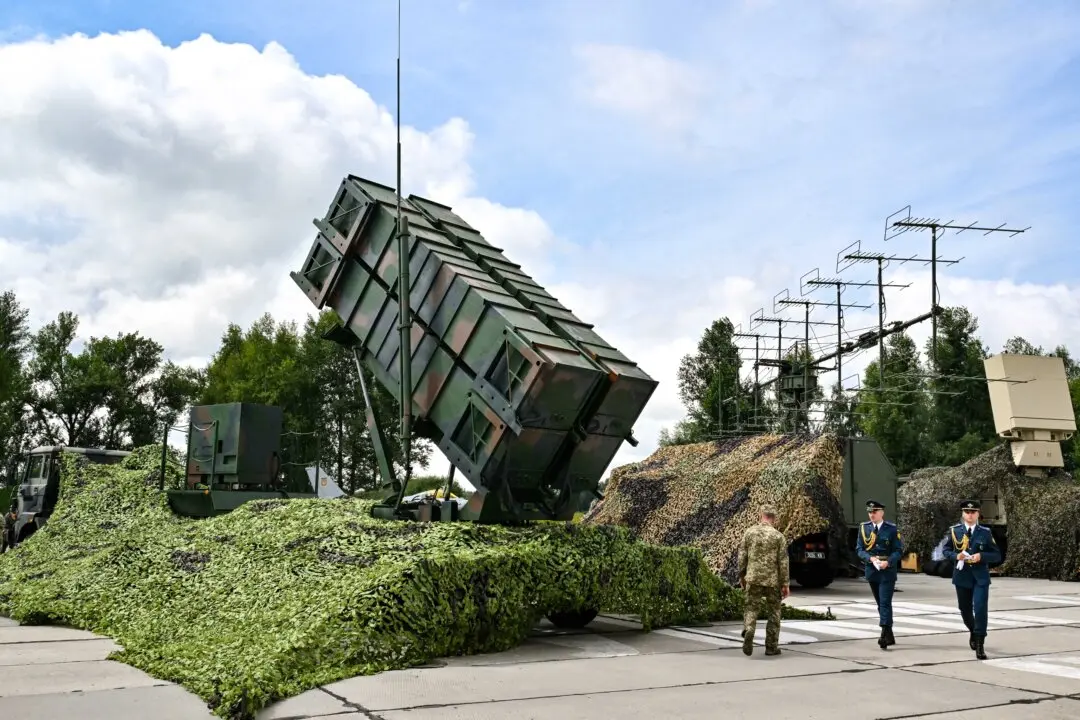
French President Emmanuel Macron said on July 13 that France will allocate an additional 6.5 billion euros ($7.6 billion) in defense spending to accelerate its rearmament in response to new security threats.
In a speech delivered on the eve of the French national holiday of Bastille Day, Macron said Europe is facing a mix of persistent and emerging threats, ranging from Islamist terrorism and cyberattacks to the Russia–Ukraine war on NATO’s doorstep.
“Perhaps never, since 1945, has liberty been so threatened, nor peace on our continent so dependent on the decisions we take today,” Macron said. “We are witnessing the return of nuclear tensions and the proliferation of major conflicts.”
Macron committed to spending an additional 3.5 billion euros ($4.1 billion) in 2026 and another 3 billion euros ($3.5 billion) in 2027, the final year of his second term, on defense.
The president said that, in total, France will aim to spend 64 billion euros ($74.8 billion) on defense in 2027, double the 32 billion euros ($37.4 billion) the country spent when he took office in 2017.
France is also developing strategic defense partnerships with its European allies.
On July 10, Macron and British Prime Minister Sir Keir Starmer pledged to coordinate their independent nuclear deterrents if needed to defend Europe. This marked the first time that France and the UK, NATO’s only nuclear powers on the continent, agreed to coordinate their use of nuclear weapons.
Touching on the agreement with Starmer, Macron said on July 13, “I reaffirmed with the British prime minister this week that there is no extreme threat against Europe that would not elicit a response from our two nations.”
Macron also said he had instructed his top military and defense officials to hold a strategic dialogue with European partners on the role that France’s nuclear deterrent could play in safeguarding the continent, building on his earlier suggestion that France might extend its nuclear umbrella to other countries.
NATO Defense Spending
Macron also indicated that in the face of these hybrid threats, countries in Europe should take a more independent approach to defense.
“Let us be clear: We Europeans must now ensure our own security,” he said.
The spending plans come amid a wider push for European countries to increase their defense spending. U.S. President Donald Trump has put pressure on allies to commit more to defense, a long-standing focus of the Republican president since his first term in office.
The imbalance between what the United States and other allies spend on defense “has been constant,” according to NATO, with the alliance saying: “The combined wealth of the non-US Allies, measured in [gross domestic product], is almost equal to that of the United States. However, non-US Allies together spend less than half of what the United States spends on defence.”
On June 25, NATO allies backed a commitment to increase defense spending to 5 percent of gross domestic product by 2035. Allies agreed that 3.5 percent should be designated for core defense, such as weapons and troops, with the remainder being spent on security-related infrastructure and protecting undersea cables and energy pipelines.
On July 8, Danish Prime Minister Mette Frederiksen said that Europe must build a stronger defense industry and rearm within the next five years to counter any potential threat from Russia.
In the July 8 speech marking the launch of Denmark’s six-month term as head of the EU presidency, Frederiksen told the European Parliament that strengthening Europe’s defense industry is an absolute top priority.
“We have to be able to defend ourselves by 2030 at the latest. ... Russia’s military rearming means that they could, within two to five years, pose a credible military threat to Europe and NATO,” Frederiksen said. “And Russia is not working alone. We see it in Ukraine. North Korea providing soldiers and ammunition. Missiles from Iran. And military technology from China. We must act now to respond to this threat.”
Victoria Friedman is a UK-based journalist covering a wide range of international stories, with a particular interest in technology, eastern Europe, and defense.