This copy is for your personal, non-commercial use only. Distribution and use of this material are governed by our Subscriber Agreement and by copyright law. For non-personal use or to order multiple copies, please contact The Epoch Times Reprints.
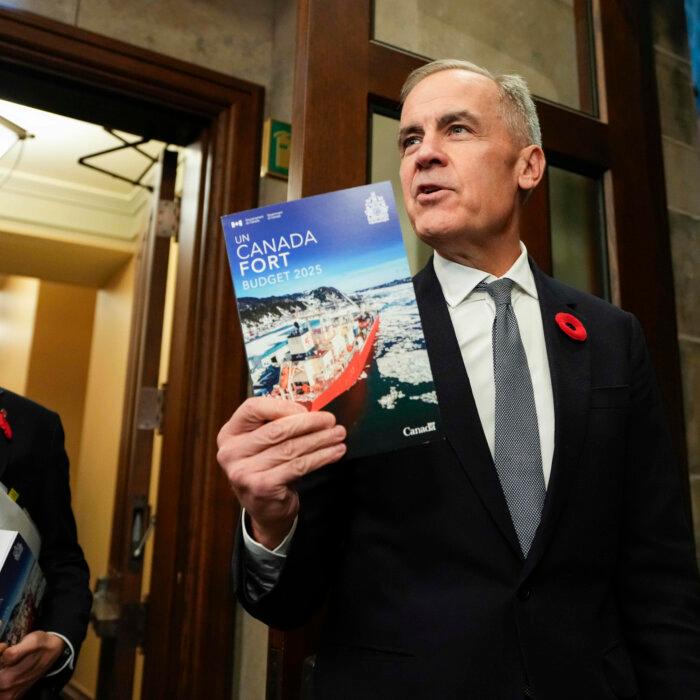
Prime Minister Mark Carney holds up a copy of Budget 2025 as he and Minister of Finance and National Revenue François-Philippe Champagne make their way to the House of Commons for the tabling of the federal budget on Parliament Hill in Ottawa on Nov. 4, 2025. The Canadian Press/Justin Tang
The Liberal government will face a crucial vote on Nov. 17 to determine whether the House of Commons will adopt its budget or send the country to an election, with no public commitment of support from the opposition parties so far.
The Liberals have 170 seats in the House of Commons, just two seats short of a majority required to pass bills without support from an opposition party. The Liberal MPs need support from at least one other party, aside from the Greens, to either vote with them or abstain from voting so that a majority of MPs vote in favour of the budget.
Since the budget is a confidence matter, the defeat of the budget would force Parliament to dissolve and trigger a second federal election in less than a year.
Conservative Leader Pierre Poilievre has said the Tories would vote against the budget due to the high deficit and because they want to see lower government spending and more tax cuts, including dropping the industrial carbon tax.
Prior to the budget’s release on Nov. 4, Poilievre had called on the Liberal government to draft an “affordable” budget that his party could support. After the budget was released, he said the budget “fails to consider that every dollar the Liberal government spends comes out of the pockets of Canadians in the form of higher taxes and inflation.”
Bloc Québécois Leader Yves-François Blanchet has said his party could not support the budget in its current form with the projected deficit and without meeting the Bloc’s demands.
The Bloc had issued a list of 18 budget demands, six of which they deemed essential for gaining their support of the Liberal budget. Among their demands are increased health and infrastructure transfers to the provinces with no strings attached, and increased Old Age Security payments.
Blanchet said all 22 Bloc MPs will be voting the same way on the budget.
Interim NDP Leader Don Davies has said his party would take time to review the budget, adding that it has a “very large” deficit. He said his party would not support an “austerity budget” and expressed support for federal investments to help workers, businesses, communities, and infrastructure impacted by U.S. tariffs. And while he noted that the budget contains some “record investments,” he also said it includes cuts to “public services that Canadians need.”
Davies said he “wouldn’t anticipate” what his party would do when it came to the final budget vote, though adding that the party traditionally votes together on confidence measures. Members are allowed to abstain from the vote with the whip’s approval, he said.
Green Party Leader Elizabeth May, her party’s sole MP, said she was “probably voting no on the budget” and would like to see large changes in order for her to vote in favour.
The Liberal government has already survived two confidence votes on its budget bill, after a Bloc amendment and a Conservative sub-amendment to the budget failed in the House of Commons. The Liberals, Bloc Québécois, NDP, and Green Party voted against the Conservative sub-amendment, while the Liberals and Conservatives voted down the Bloc amendment.
The Liberals went into the weekend ahead of the final budget vote without it being clear as to whether any of the opposition parties would vote in favour of the budget.
Budget
The Carney government’s first budget forecasts a $78.3 billion deficit this fiscal year and a debt-to-GDP ratio that is expected to climb before stabilizing in the years ahead. The budget says more than 75 percent of the measures the government is taking in the current fiscal year are to respond to “significant global economic shifts.”
The government says that in this fiscal year it is allocating $12 billion for defence; $10 billion to address the rising cost of living by cutting taxes, building homes, and cancelling the consumer carbon tax; and another $7 billion for “additional actions to support Canadians.”
The budget also allocates $115 billion over five years toward major projects and $81.8 billion over five years for the Canadian Armed Forces, as the government aims to meet NATO’s defence spending target of 2 percent of GDP by the end of this fiscal year.
Meanwhile, the Parliamentary Budget Officer (PBO), in his Nov. 14 budget analysis report, said the budget has an “overly expansive” definition of capital investments that overstates capital spending by $94 billion. He said that if the government used a stricter definition, it would not be able to meet its promise of balancing operational spending by 2028–29.
The PBO also said that even with Ottawa’s efforts to reduce spending, the federal debt-to-GDP ratio is projected to be higher than in the 2024 fall economic statement and is no longer on a declining path.
The PBO report said the government “abandoned” its previous fiscal anchor of reducing the debt-to-GDP ratio, while noting that the 2024 fall economic statement said maintaining a falling ratio was key to preserving Canada’s “AAA” credit rating.
The Liberal government defended its upcoming budget, saying the spending is necessary in response to U.S. tariffs.