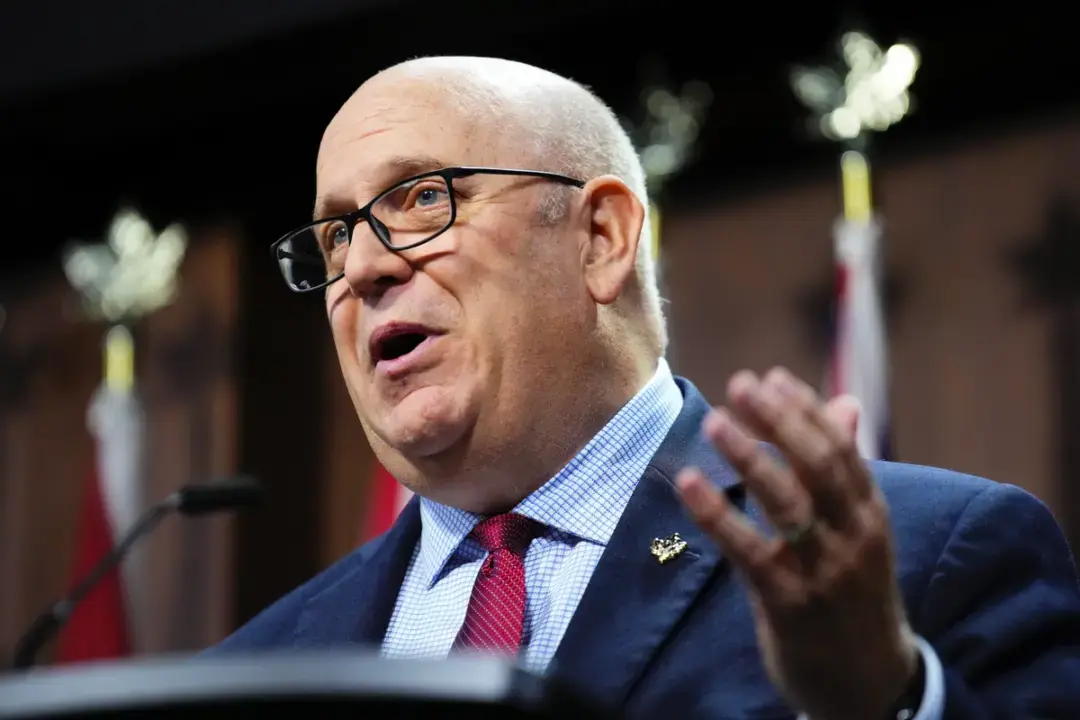
Canada-U.S. Trade Minister Dominic LeBlanc said he remains hopeful that the two countries can reach a deal around tariffs prior to the review of the U.S.-Mexico-Canada Trade Agreement (USMCA) in 2026, but said he will not give a timeline for when he expects one could be made.
“I have lost the illusion that we should predict a precise time when we might get to an agreement ... My view is an agreement is something that would improve the circumstances that we’re in today. I continue to be optimistic,” LeBlanc told MPs on the International Trade Committee on Oct. 2.
LeBlanc told the committee that the Canadian government has launched its second round of consultations with stakeholders across the country regarding USMCA. He said Ottawa is also collaborating with the United States to find a way to decrease tariffs and “promote a North American collective approach to face the challenges we both face.”
The United States has imposed a series of tariffs on Canada and global industrial sectors throughout 2025, targeting industries like steel, aluminum, automotives, lumber, and energy. While other countries like the United Kingdom and Japan were able to reach deals with the United States before the Aug. 1 deadline, Ottawa did not reach a deal.
During the committee meeting, Conservative MP Adam Chambers said the Liberal government is “negotiating with a country that seems to keep moving the goal post,” and questioned whether LeBlanc’s testimony in front of the Senate’s foreign affairs and international trade committee earlier in the day indicated that Canada was “not any closer to a deal” with the United States on sectoral tariffs.
During that testimony, LeBlanc had said he hoped to see “progress before the review process formally engages,” but said “time will tell us if my optimism is misplaced.” LeBlanc told Chambers that he’d had “encouraging” discussions with U.S. Commerce Secretary Howard Lutnick on trade, and remains optimistic that a deal can be made.

Chambers said Canada had made several concessions to the United States over trade, such as getting rid of the Digital Services Tax that would have impacted American tech companies, getting rid of counter-tariffs on the United States, and withdrawing complaints about American softwood lumber duties. “Can you point to one concession that the Americans have given to us?” Chambers asked.
Supply Management
During the committee meeting, Bloc Québécois MP Simon-Pierre Savard-Tremblay asked whether Canada’s supply management system would be protected during negotiations with the United States, or whether the import quotas would be modified. Canada’s supply management system coordinates production and demand relating to dairy, chicken, eggs, and turkey products while controlling imports as a way of setting stable prices for farmers and consumers, and involves tariffs as high as 300 percent.While U.S. President Donald Trump has repeatedly criticized Canada’s supply management tariffs, Ottawa has previously said that Canada would not make concessions on the issue.
LeBlanc responded that supply management is a “very central issue in Quebec” and said there is a “major consensus in Parliament” that it would not be included in negotiations with the United States. “I’ve repeated it to my American counterparts when they raise the issue, as Mr. Trump does,” LeBlanc said. Earlier this year, Parliament passed a law to keep the supply management system out of trade negotiations.
On Oct. 1, LeBlanc was asked by reporters on Parliament Hill about reports that Canada was considering giving greater retail access to U.S. dairy farmers. “We have been very clear from the beginning that supply management is not a subject of negotiation with the Americans,” LeBlanc said.
“It is not or will never be on a negotiating table.”