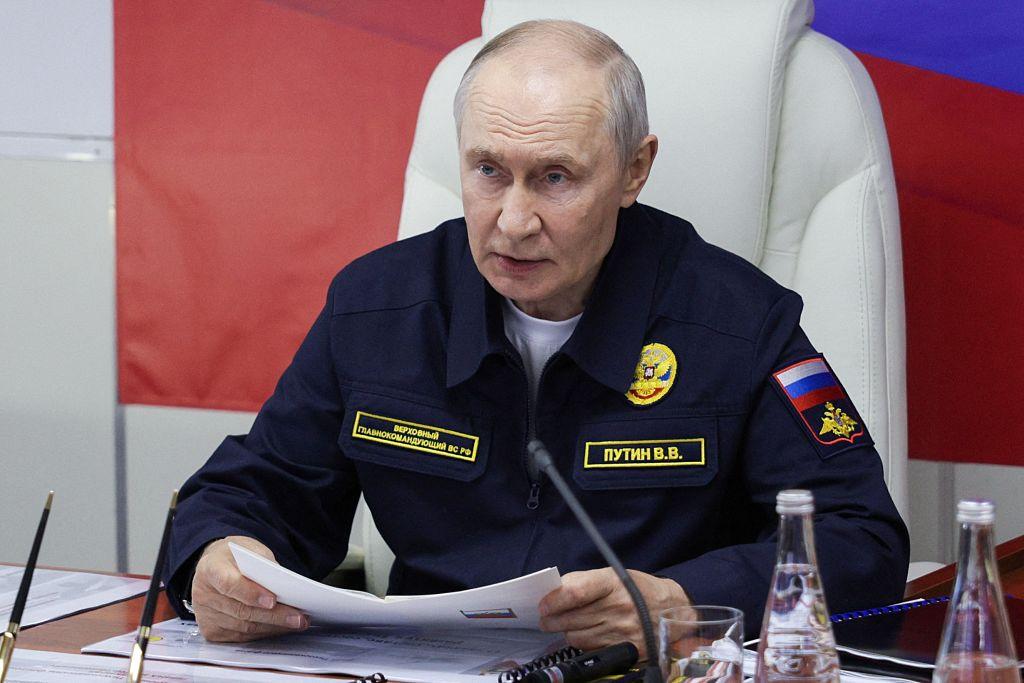
Russian Foreign Minister Sergey Lavrov has said that Europe is moving toward a dangerous military confrontation with Russia, warning that a nuclear exchange between Moscow and NATO could be the outcome.
In an article published on the Russian Ministry of Foreign Affairs English language website on June 19, the Kremlin’s long serving top diplomat said that “more than two decades of negotiation with Europe, as part of the collective West, leads to only one conclusion: engaging Russia in dialogue has served as a diplomatic smokescreen for the geopolitical expansion of Western institutions, above all NATO and the European Union, eastwards, right up to Russia’s borders.”
Lavrov, in his 1,500-word essay, described his assessment of how the war in Ukraine had been brought about at length, heavily criticizing the actions of the European Union, Britain, and the United States for what he sees as their role in spurring on the conflict.
He said that “Europe’s complicity in fuelling the Ukrainian crisis is undeniable,” and that “together with the United States, European countries orchestrated the Orange Revolution in Kiev in 2004.”
Lavrov argued this was undertaken to “create an anti-Russian bridgehead in Ukraine,” which was achieved by “buying off politicians and entire parties, rewriting history and educational curricula, cultivating and nurturing Ukrainian nationalism,” in an effort to pull Kyiv away from Moscow.
He went on to assert that the EU in 2013 “rejected outright” a Russian proposal for a compromise on the association agreement between Ukraine and the bloc, and, after then Ukrainian President Viktor Yanukovich requested a deferral on the deal, “the Europeans incited street riots which swiftly escalated into a coup d'état in Kiev in February 2014.”
Lavrov also chastised France and Germany for the way they behaved as co-guarantors of the 2015 Minsk Accords, accusing them of having “effectively encouraged the Ukrainian regime to sabotage its own commitments.”
In contrast, according to Lavrov, Russia “explored every diplomatic avenue to defuse Europe’s security crisis,” but, in January 2022, “the United States and NATO rejected Russia’s proposal for legally binding mutual security guarantees.” The EU and Britain then proceeded to “sabotage” negotiations to end the war after Russia launched its full-scale invasion in February 2022, he added.
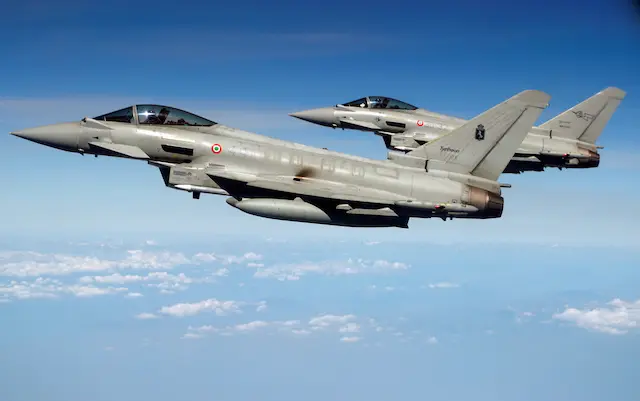
“This state of affairs poses serious threats to global security. A direct confrontation between NATO and Russia could rapidly escalate into an exchange of nuclear strikes, with catastrophic consequences,” Lavrov said.
He then reasserted Moscow’s repeated statement that it was open to negotiations, but that dialogue with Europe could not be “conducted as though it were an impartial third-party observer.”
Both the EU and NATO have always rejected Russian allegations that they in any way provoked Russia’s invasion of Ukraine.
Lavrov’s article was followed by statements the same day from Kremlin spokesman Dmitry Peskov, who said that the EU is making a mistake by trying to dictate to Russia.
“The Europeans have a very big misconception; they assume that negotiations with Russia should be conducted from a position of strength and based on Russia’s weakness,” he said, according to Russian state media outlet TASS.
“This is the biggest mistake, whether it stems from the incompetence of the Europeans, their misinformation or their stupidity - we don’t know for sure, but it’s a fact,” Peskov continued, adding that attempts by the EU to talk to Russia from a position of strength are “a dead-end.”
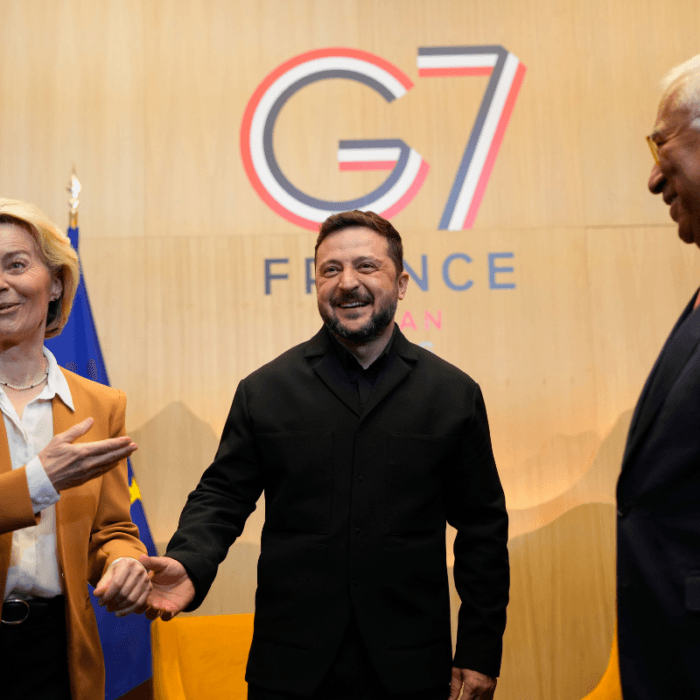
“We had a very good meeting,” Trump told reporters after a meeting with Zelenskyy at the G7 summit in France.
“Russia should make a deal. Russia has lost tremendous amounts of people and so has Ukraine,” he added.
At the same event, European Commission President Ursula von der Leyen said Ukraine is stronger now than it was at last year’s G7 summit in Canada.
“Ukraine is in a different position,” von der Leyen said at a press conference in Evian on June 15. “Ukraine is holding the frontline and even partially regaining territory.”
On June 15, Ukraine officially began European Union membership negotiations, launching a process that will require its government to commit to years of political reforms even as it fights the Russian invasion.
Ukraine sees EU membership as a security guarantee for a stable future once the war ends.