The top court in France has blocked a bill backed by French President Emmanuel Macron banning social media access for under-15s.
The Constitutional Council in Paris ruled on Aug. 14 that the proposed ban “constituted a disproportionate infringement on freedom of expression and communication” and “failed to provide sufficient legal safeguards to ensure the right to respect for private life,” according to a translation of a statement released by the court.
It added that the prohibition is “likely to apply to online communication services for which the risks to the health and safety of minors have not been established,” and said that its blanket nature did not take into account individual children’s “age, level of maturity, and family situation.”
“In this regard, the law does not specify the conditions under which those holding parental authority may, in the child’s best interests, decide to lift the prohibition, limit its scope, or authorize access to certain services,” the court said.
The court further stated that by blocking access for any minor under the age of 15 to certain online services “the law implies, by itself, that any person, even an adult, must prove their age before accessing them,” and said that by “failing to determine the conditions and limits within which it must be justified,” the legislature has not “provided the legal guarantees necessary to ensure compliance with these constitutional requirements.”

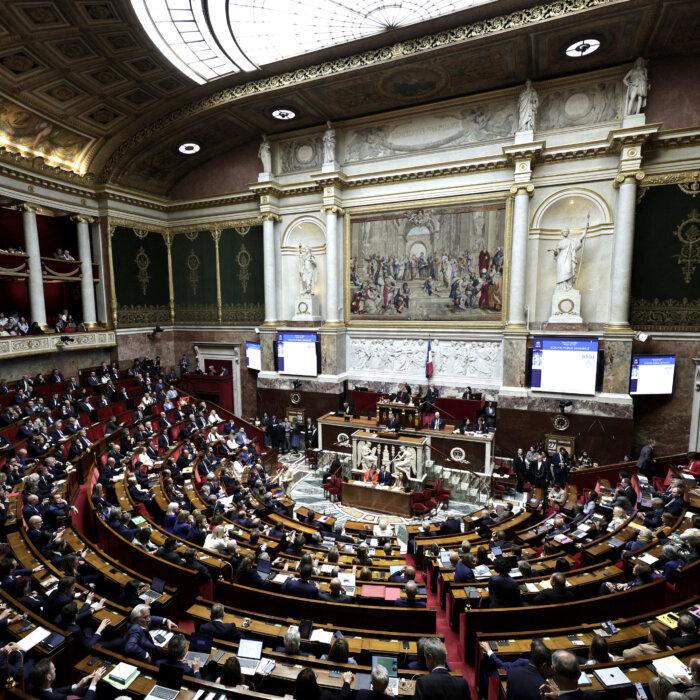
The Senate adopted the compromise text 243–2, and the National Assembly followed hours later, 279–81.
The ban covers new accounts from Sept. 1, while platforms have until Jan. 1, 2027, to close accounts already held by under-15s.
The law also extends the school cellphone ban to high schools and exempts online encyclopedias, educational repositories, and open-source development platforms. It carries no penalty for children or parents.
The move was publicly backed by Macron, who at the time labeled it “a major advance” in a video posted on social media.
“France is leading the way in Europe in protecting our children and our teenagers,” he said.
Following the court’s decision, Macron ordered French Prime Minister Sebastien Lecornu to rework the legislation into a more “legally sound” draft, the Élysée said in a statement.
The Élysée added that Macron “remains fully committed to bringing this reform to fruition by spring 2027,” which is when his presidency will end, as he cannot run for a third term.
Paris’s attempt to ban social media for teens comes as part of a worldwide trend sparked by Australia, which became the first country to set an age limit to access such services in December 2025.
That law requires social media platforms such as TikTok, X, Facebook, Instagram, YouTube, Snapchat, Reddit, and Twitch to check the age of Australian users and ban those under the age of 16.
Companies that fail to comply face penalties of up to AU$49.5 million (US$34 million).
The Australian ban inspired other nations around the world to consider similar legislation restricting teenagers’ usage of social media, including the UK, Canada, Turkey, Fiji, Malaysia, and New Zealand, as well as supranational organizations like the European Union, which is considering bloc-wide restrictions.