Japanese Defense Minister Shinjiro Koizumi questioned whether China’s official military-spending figures are factual, evidence-backed, and transparent, making public a concern long raised by U.S. and independent defense analysts about the limits of Beijing’s published budget data.
When asked in a Bloomberg interview on June 17 about China’s military spending, Koizumi said transparency was the key issue.
“We explain our strategy with high transparency. Our budgets undergo scrutiny and deliberation in the Diet,” he said, referring to Japan’s national legislature.
Koizumi said Japan provides explanations at home and abroad, and questioned whether countries outside democratic systems provide comparable scrutiny.
“Are the figures they put forward genuinely grounded in fact, backed by evidence, and highly transparent?” he asked. “When doubts arise on these points, how much effort do they put into explaining them?”
Koizumi’s challenge centered on whether Beijing’s public figures give other countries enough basis to trust the data.
“Despite whatever nominal figures are presented, countries hold reservations regarding that transparency,” he said.
Concerns of Hidden Spending
The Pentagon’s 2025 report to Congress said there is “broad consensus” among academic, think tank, and industry experts that China’s publicly announced defense budget does not include the totality of its defense spending.
The report estimated China’s total defense spending in 2024 to be $304 billion–$377 billion, or 32 percent to 63 percent higher than Beijing’s declared $231 billion budget.
That estimate included not only China’s announced defense budget, but also spending on the People’s Armed Police, provincial security, veterans’ affairs, mobilization activities, defense-related research and development, and capital spending, according to the Pentagon.
The Center for Strategic and International Studies (CSIS) said China announces defense-expenditure information annually but remains less transparent than many countries. It said estimates of China’s actual military spending vary widely because governments report military spending with different levels of detail and because no universally accepted reporting standard exists.
The Stockholm International Peace Research Institute estimated China’s military spending at $314 billion in 2024, saying China accounted for about half of all military spending in Asia and Oceania that year.
Transparency Concerns
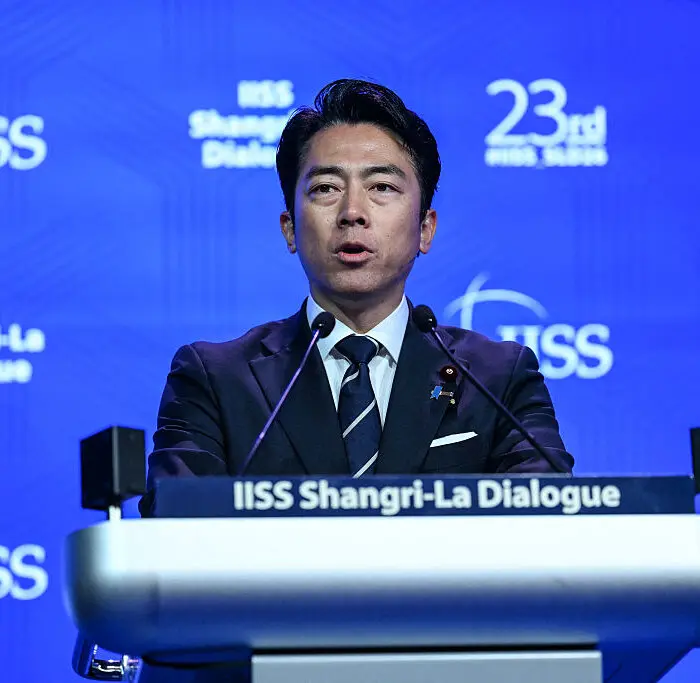
Koizumi’s comments followed his May 31 speech at the Shangri-La Dialogue in Singapore, where he warned that “opaque military buildups” and actions without clear intentions can cause distrust and miscalculation.
In the speech, Koizumi said the Indo-Pacific faces a “severe reality,” citing attempts to change the status quo by force or coercion, economic coercion, cyber operations, space, information warfare, and “the weaponization of everything.”
He said regional defense authorities need “trust, transparency, and talks.”
“Transparency is the baseline for reducing tensions and preventing crises,” he said. “And talks. All nations have different positions. All nations have different views. But that is precisely because we need to have talks.”
Koizumi said Japan would build up and update its defense capabilities “with a high degree of transparency,” naming artificial intelligence, unmanned systems, cyber, and space as areas in which new forms of warfare are spreading.
The contrast was central to his argument: Japan’s defense buildup is being debated through public budget and policy channels, while China’s published figures leave other governments questioning how much Beijing is actually spending and where the money goes.
China’s Published Budget
China’s Defense Ministry said in March that China’s national general public budget allocated 1.94 trillion yuan (about $267 billion) for defense spending in 2026, up 6.9 percent from the previous year’s executed budget. It said central government defense expenditure accounted for 1.91 trillion yuan, up 7 percent.
The Chinese State Council also stated in November 2025 that China participated in the United Nations’ military expenditure transparency system.
CSIS, however, said China’s reporting remains less transparent than that of many countries and that public data still leaves outside analysts debating the real scale of Chinese military spending.
Why Japan Is Raising It Now
Koizumi’s public challenge comes as Japan is preparing to revise its national security documents and as Tokyo puts more resources into defense technology, unmanned systems, and maritime security.
When asked in the Bloomberg interview how Japan should approach defense spending, Koizumi said Tokyo should not begin by focusing only on a percentage of gross domestic product.
Because Japan held to a 1 percent defense-spending restraint for so long, he said, the Self-Defense Forces (SDF) had been unable to allocate money to some areas that needed it.
Koizumi said Japan should first identify the equipment and personnel needs required by the current security environment, then determine the budget level that follows.
When asked which areas should be prioritized, Koizumi named drones, artificial intelligence, and unmanned systems.
“As new methods of warfare, like drones and AI, are observed globally, we must invest in fields that help realize new defensive methods capable of responding to these changing forms of warfare,” he said.
He said Japan’s shrinking population made unmanned systems a long-term necessity for the SDF.
“I believe the SDF must become the military that utilizes unmanned assets best in the world,” Koizumi said.
Sea-Lane Defense
Koizumi also tied Japan’s defense planning to maritime security in the Pacific.
He said Japan’s dependence on shipping lanes had been highlighted by developments around the Strait of Hormuz and that Tokyo must consider whether stable sea lines of communication can continue under current conditions.
Koizumi said Japan is watching coordinated military activity by Russia and China, as well as expanding Chinese activity beyond the first island chain and into the second island chain.
The first island chain generally refers to the line running through Japan, Taiwan, and the Philippines. The second island chain extends farther into the Western Pacific, including Guam.
“To absolutely ensure no new conflicts or wars erupt in this region, and to steadily safeguard this peace, we must invest more than ever into the Pacific side and sea-lane defense,” he said.
Regional Setting
Koizumi’s remarks came as Japan raised broader Indo-Pacific concerns during the G7 summit in Évian-les-Bains, France.
Japan’s Foreign Ministry said Prime Minister Sanae Takaichi explained Japan’s views on the Indo-Pacific situation and regional challenges, including those related to China, during a June 15 working dinner with G7 leaders.
The ministry said G7 leaders agreed to work together on those issues.
At Shangri-La, Koizumi said Japan remained open to direct talks with Beijing despite sharp disagreements.
“I remain committed to communicating with the countries concerned, including China, for the peace and stability in the region and of the world,” he said.