Some still remain hopeful, however, that the cancellation of TC Energy’s Energy East pipeline proposal eight years ago hasn’t erased the possibility of the project’s revival, particularly as Ottawa focuses on making Canada an “energy superpower” that is less reliant on the United States.

Still, as Eastern Canada remains largely reliant on foreign oil and offers access to Europe, could an Energy East-style project also make a comeback, or is it just a pipe dream?
Energy East
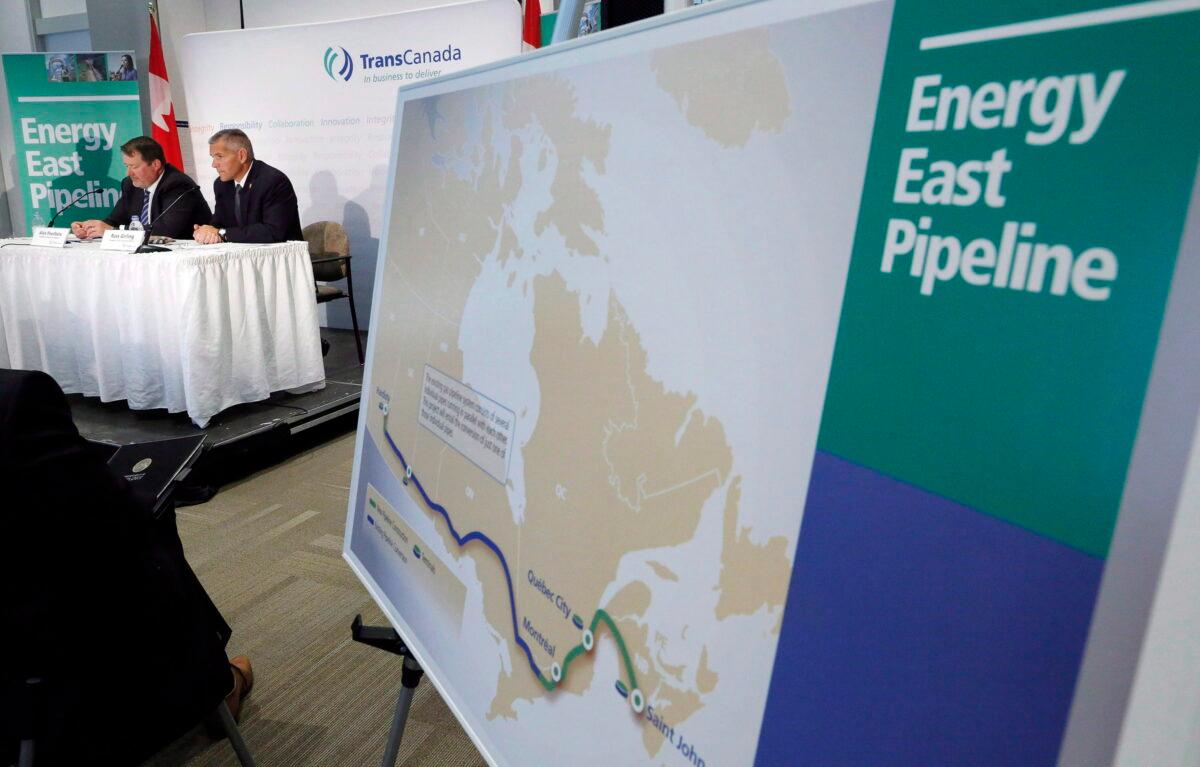
In 2013, TC Energy, at the time named TransCanada, pitched the 4,600-kilometre pipeline with a goal of carrying up to 1.1 million barrels per day of crude oil from Alberta to a coastal terminal in St. John, N.B., for export. The pipeline would have converted the partially unused natural gas Mainline pipeline to convey the oil for two-thirds of the distance.The usage of an already-existing pipeline would have significantly reduced costs and sped up the construction timeline, according to TC Energy’s plan. Project supporters said it would boost Canada’s energy security, cut Eastern Canada’s dependence on non-Canadian oil, and provided a major export point for Canadian oil to get from the east to overseas destinations.
Market Changes
The market has changed significantly in the eight years since the Energy East project was scrapped, according to several leading experts.Many of the considerations related to Canadian energy security and independence have also risen amid Carney’s advocacy for a “Buy Canadian” approach and recent promise to double non-U.S. exports in the next decade.
There’s also been interest from provincial leaders in a pipeline spanning West to East. Nova Scotia Premier Tim Houston said in January that the Energy East pipeline should be brought back in the face of U.S. tariffs, and to boost Canada’s energy independence and options for oil export to the global market.
Energy East Comeback?
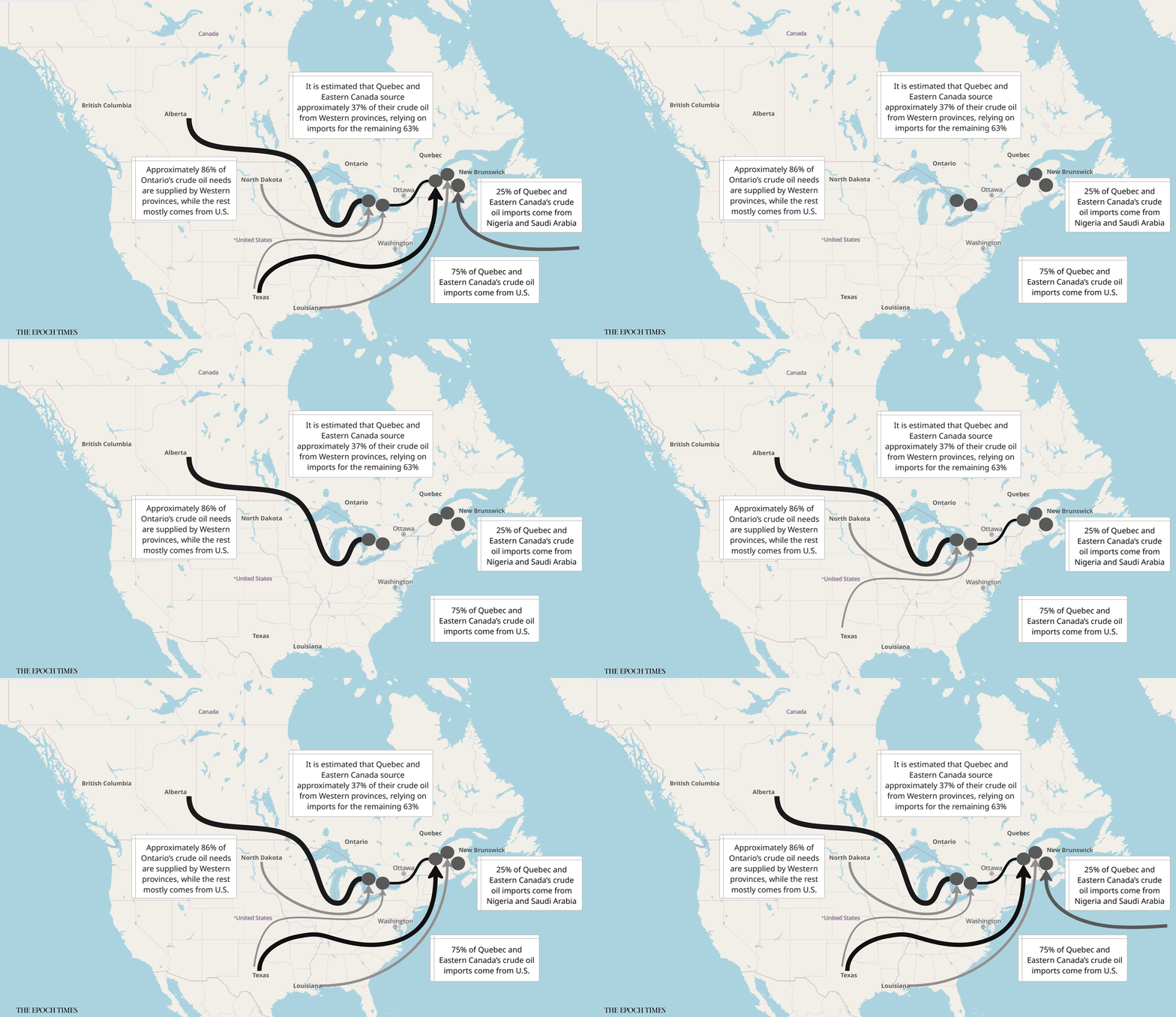
Eastern Canada remains largely dependent on imports of oil from the United States, with smaller quantities from countries including Saudi Arabia and Nigeria, according to the Canada Energy Regulator (CER).CER statistics up until 2022 demonstrated how New Brunswick, followed by Quebec and Ontario, are heavily reliant on foreign oil, with the majority consistently coming from the United States at 66 percent in 2021, and 72 percent in 2022.
Michael Binnion, CEO of the Calgary-based energy company Questerre Energy says that while the political environment for an East-West pipeline has actually improved, the economic conditions have not.
“The East-West pipeline is of some interest to discuss relative to Canadian sovereignty and not transporting our oil through the U.S.,” Binnion told The Epoch Times.
“Quebec has changed its tone on pipelines since the Energy East proposal and so has the federal government improving the political prospects. The economic incentives may have diminished, however.”
Oil Logistics and Economics
Kent Fellows, an assistant professor of economics at the University of Calgary’s School of Public Policy, says that while a comeback of a similar pipeline is “possible,” the economic advantages when Energy East was first proposed are largely gone, as the underused natural gas pipeline that was going to move the Energy East oil is now being used.“It is a possibility,” Fellows said in an interview, adding that “we’d need brand-new pipe, but it is very expensive.”
The demand to move away from importing oil in the east is also not there, according to Fellows.
“At the moment, Eastern Canada is able to satisfy their crude oil demand through a combination of buying from the United States and importing a little bit from coastal shippers,“ he said. ”So economically, it’s a more challenging case than just expanding export capacity from Alberta to markets that are easier to serve.”
Richard Masson, executive fellow at the University of Calgary School of Public Policy, likewise said the original motivation to build a relatively cheap pipeline on an accelerated timeline has vanished.
“The natural gas pipeline is no longer available and there is not enough oil-sands growth planned so the cost would be much higher and it would be difficult to fill the pipeline on a timely basis,” Masson told The Epoch Times.

Although Masson noted there is a chance that oil refineries in Sarnia, Ont., could be left in the lurch if Enbridge’s Line 5—which partially runs through the United States and has been subject to court action—gets shut down, the economics of a West-East pipeline still aren’t there and, even in a worst-case scenario, rail would be the go-to option.
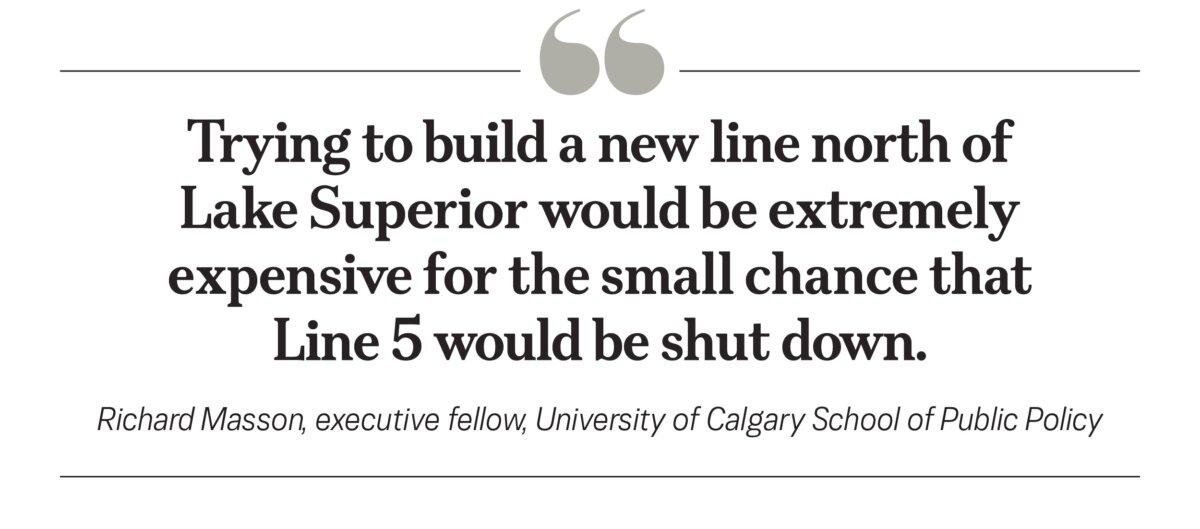
“Trying to build a new line north of Lake Superior would be extremely expensive for the small chance that Line 5 would be shut down,” he wrote. “[It’s] very unlikely that a pipeline will be built to the east now. Rail is another option for the Sarnia refineries that is cheaper and could be implemented much quicker if Line 5 is shut down.”
Focus on the West
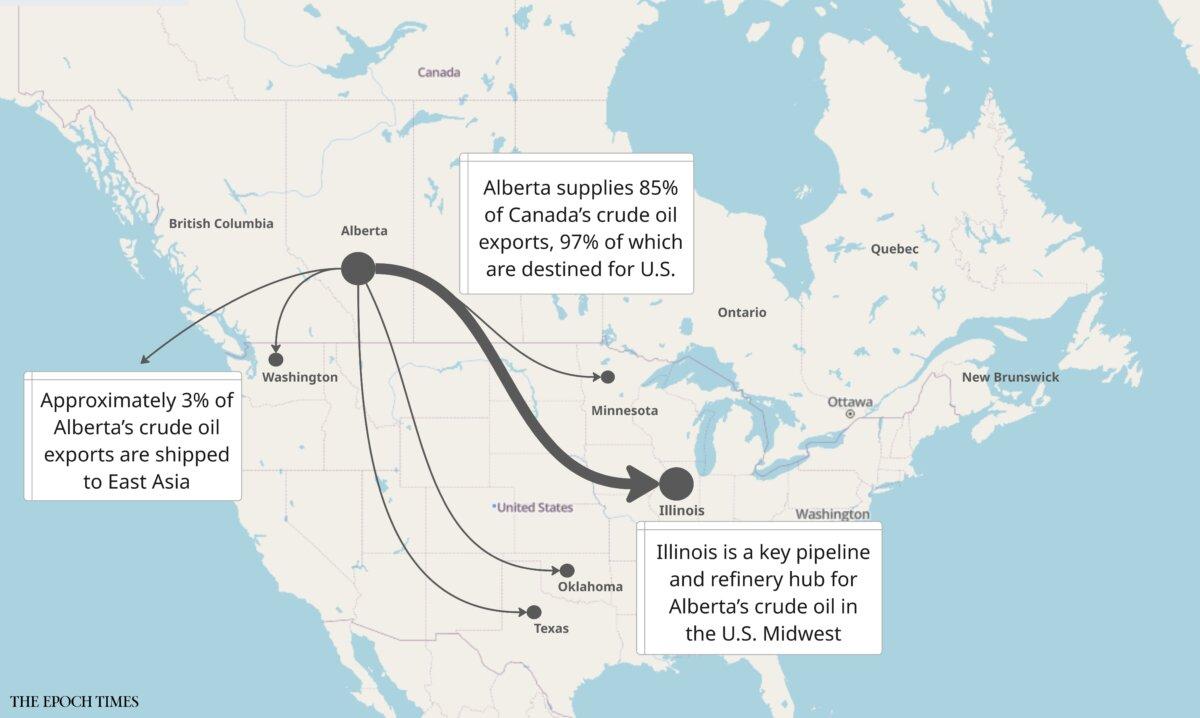
Ongoing discussions about a deal between Alberta and the federal government, which could include a pipeline to the B.C. coast alongside a carbon capture system, as well as U.S. conversations about bringing back Keystone XL, have put the focus on the West.Keystone was cancelled by former President Joe Biden in 2021, but the underlying market motivation of linking Alberta’s heavy crude oil to the Gulf Coast refineries that are perfectly suited to refine it remains firmly in place.
There are a number of reasons that talks have focused on the development of a Western energy corridor, such as the potential to grow existing infrastructure, increased demand from refineries in Asia and along the U.S. Gulf Coast, the limited number of provinces to navigate for First Nations and provincial approvals, and reduced overall costs.
“Overall, the North West pipeline is the shortest route to tide water and a very competitive shipping route to north Asia where there are several refineries tuned to heavy crude oil,” Binnion said. “This route satisfies both sovereignty and economic considerations best.”
This places the momentum of pipeline development firmly westward, rather than eastward.
Binnion adds that the prospect of potentially exporting more Canadian oil to Europe and Africa is less attractive than continuing to push for growing exports to Asia, for several reasons.
“Europe is primarily medium to light oil refineries well serviced by Norway, UK, Russia, the Middle East, and Africa,“ he said. ”As for Africa, it is a producer and exporter of oil.”
For its part, TC Energy said it is focusing future plans on the United States and has not backed any revival of a West-to-East pipeline in Canada.
Speaking more broadly about pipelines during the UCP convention on Nov. 29, Premier Smith said more likely projects to materialize are Enbridge’s expansion of its Mainline carrying oil to the United States, along with a further expansion of the Trans Mountain pipeline and reopening of some Keystone southbound routes. However, she said she’s still hopeful for an east-bound pipeline.
“We might be able to get more going east,” Smith said, adding that she’s in talks with Ontario Premier Doug Ford about a potential pipeline from Alberta to Eastern Canada.