Iran on Monday denied that it is holding negotiations with the United States, saying its current talks are instead with Oman on a new shipping route through the Strait of Hormuz, after President Donald Trump said he paused U.S. strikes against Iran to give space for negotiations.
“Would I rather make a deal? I’m not looking to kill people,” Trump said aboard Air Force One on Aug. 2, adding that he decided to hold off on the “massive attack” after being asked by Saudi Arabia, Qatar, and the United Arab Emirates to wait and give diplomacy another chance.
“Now, what we’re doing is talking to them in the form of a negotiation. It begins tomorrow afternoon.”
He said he hoped a deal could be reached in order to “save a lot of lives.”
Trump added that Iran also asked the United States to hold off on renewed strikes, insisting that Iranian negotiators said through backchannels that they would “like to make a deal,” while adding that Tehran could deny that any talks are taking place.
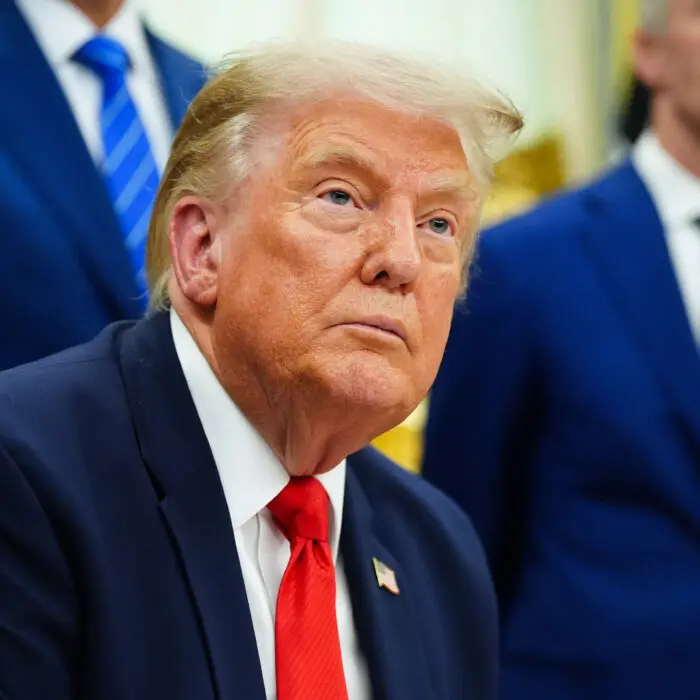
“I don’t know what they say because a lot of times they‘ll say that to me and then they’ll go out and say, ‘We don’t know what he’s talking about.’ Obviously, they don’t want to be attacked,” Trump said, repeating a point he’s made before, that Iran publicly denies negotiations while continuing discussions in secret.
Baghaei, meanwhile, told reporters during his weekly press briefing that no talks were currently being held with the United States.
“We are not currently negotiating with the United States,” Baghaei told reporters during his weekly press briefing.
“The talks are being held with Oman and are focused on reaching understandings regarding the safe passage of vessels through the Strait of Hormuz.”
Baghaei said Iran and Oman were seeking to establish, “as quickly as possible,” a temporary shipping route to ensure safe navigation through the narrow waterway, describing the discussions as bilateral talks between the strait’s two coastal states.
He said other countries could influence developments but were not parties to the negotiations.
Trump, meanwhile, has said that any agreement with Iran must include the immediate reopening of the Strait of Hormuz to international shipping and guarantees that Iran cannot develop nuclear weapons.
New Shipping Route Under Discussion
Baghaei said negotiations with Oman have intensified over the past week and have already produced progress toward a new maritime traffic arrangement.
He described the objective as creating a temporary route that would replace the current traffic pattern, which consists of an Iran-controlled northern route and a southern U.S.-backed passage along the Omani coast.
Under the current traffic arrangement in Hormuz, the United States and Iran have repeatedly clashed over freedom of navigation. Tehran has been trying to force ships to take the northern route, while opposing the southern passage, where it has periodically attacked ships and then said it’s unsafe for vessels.
In remarks broadcast Sunday evening by Iranian state television, Baghaei said the future shipping lane won’t be the current northern or southern routes, but rather a new corridor to be agreed upon by Iran and Oman.
He said the talks were aimed at protecting the two countries’ sovereign rights while ensuring safe navigation.
Baghaei added that, regardless of any agreement with Oman, there would be no return to the pre-war arrangement in the Strait of Hormuz, suggesting that Iran is intent on maintaining restrictions on freedom of navigation through the maritime chokepoint.
Iran has repeatedly said that future management of Hormuz should reflect its sovereign rights as one of the two countries bordering the waterway, through which around one-fifth of the world’s seaborne oil was shipped before the war.
A Sunday advisory by the Joint Maritime Information Center described maritime traffic as continuing at reduced levels through Hormuz, while maintaining a “severe” threat assessment following months of attacks on commercial shipping.
“However, a recently announced cancellation of strikes on Iran and the potential for a negotiated settlement may provide an opportunity for un-harassed transits,” the advisory states.
The Washington-based Institute for the Study of War said in its latest assessment that some Iranian negotiators—such as Foreign Affairs Minister Abbas Araghchi—appear willing to make “limited compromises” with the United States regarding Iranian control over the Strait of Hormuz.
Tempering that willingness is the stance of hardliners in the Iranian regime, such as a faction led by Islamic Revolutionary Guard Corps Commander Maj. Gen. Ahmad Vahidi, which appears to be dominating the decision-making and seems poised to reject any arrangement that meaningfully reduces Tehran’s control over Hormuz, according to the think tank.
The assessments, diplomatic exchanges, and renewed hopes for talks came as another commercial vessel was attacked near the strategic waterway.
The UK Maritime Trade Operations (UKMTO) said an explosion was reported near an oil tanker about 20 nautical miles northeast of Khasab, Oman, early Monday morning.
Iran’s state-run Islamic Republic News Agency published photographs it identified as showing the Marshall Islands-flagged tanker Velos Amber with its stern engulfed in flames.