This copy is for your personal, non-commercial use only. Distribution and use of this material are governed by our Subscriber Agreement and by copyright law. For non-personal use or to order multiple copies, please contact The Epoch Times Reprints.
A rainbow appears to come down on pumpjacks drawing out oil and gas from wells near Calgary, Alta., on Sept. 18, 2023. The Canadian Press/Jeff McIntosh
Alberta Premier Danielle Smith says the Impact Assessment Act—dubbed by her government the “no more pipelines act”—is among the “bad laws” Ottawa has agreed to address as part of its energy deal with the province.
But so far, few details have been released about how the implementation of this law, formerly known as Bill C-69, would be changed for Alberta, with both parties saying they will negotiate a “cooperation agreement” to avoid duplication in assessments. Smith said following the deal announcement on Nov. 27 that the two levels of government now agree that major projects in Alberta will be approved by the province.
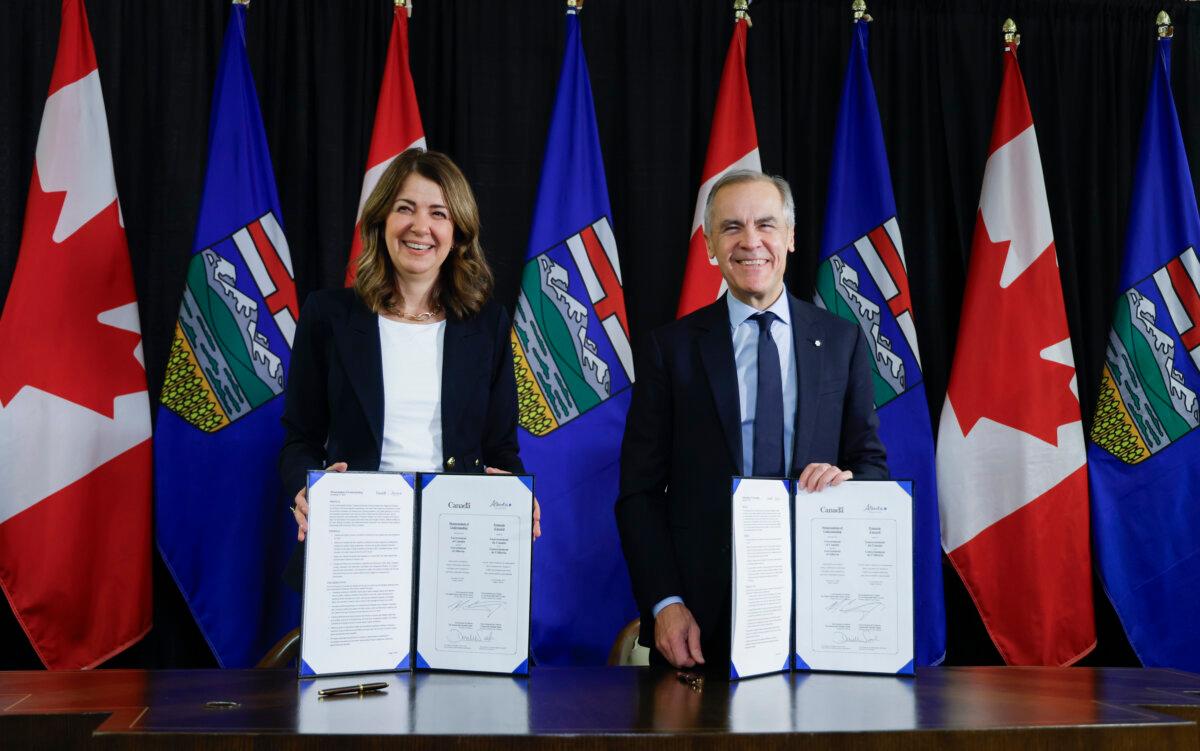
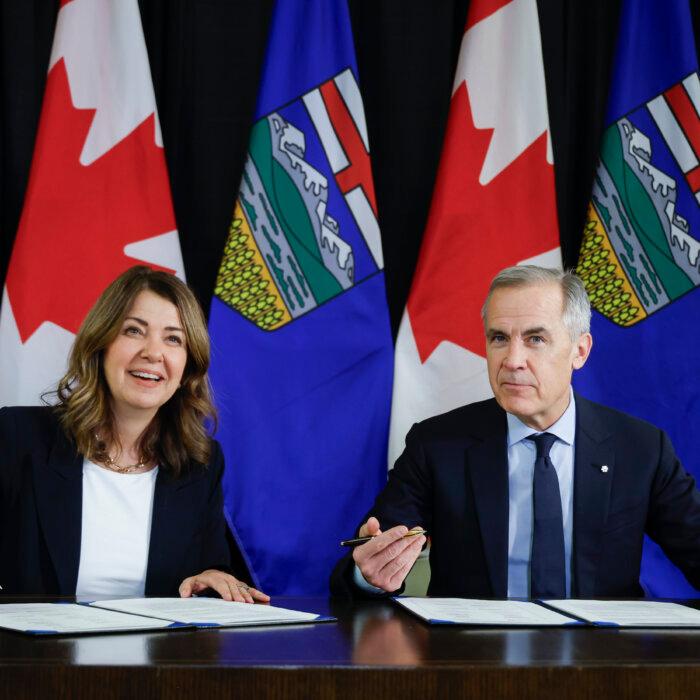
Prime Minister Mark Carney signs an MOU with Alberta Premier Danielle Smith in Calgary on Nov. 27, 2025. Jeff McIntosh/The Canadian Press
David Wright, a law professor at the University of Calgary, says the new deal with Ottawa would likely not require amending or repealing the Impact Assessment Act (IAA), as Smith has long urged, but would involve working “around and within” the act by using a provision that allows a provincial assessment to substitute for the federal process. Wright in 2021 was added to the national roster of experts who can review major projects under the IAA.
“I expect that the cooperation agreement will cover all projects that would trigger the federal regime, and for those projects, [Ottawa] will probably say, ‘It’s over to you, provincial government, to do the assessment. You just have to make sure you cover what we would have assessed under the federal regime,’” Wright told The Epoch Times.
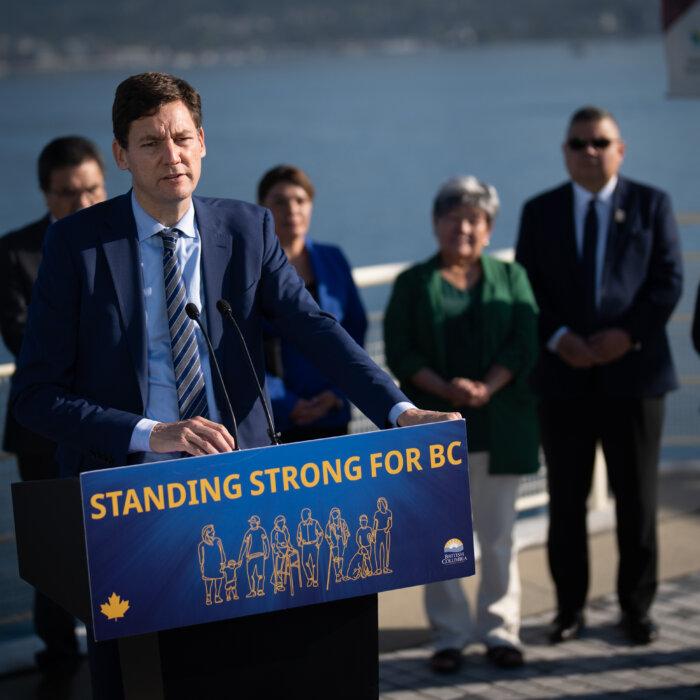
He noted cooperation agreements are not a new initiative by Ottawa, pointing to existing deals with provinces such as British Columbia and a draft agreement currently under review with New Brunswick. Draft agreements with Manitoba and Ontario are also open for public comment as of publication time.
Another way a deal on impact assessments could take shape between Alberta and Ottawa is by using the Building Canada Act, passed this summer, to exempt specific projects in the province from the IAA, Wright said.
As part of the Nov. 27 deal, Ottawa and Alberta agreed to build a new oil pipeline to the West Coast paired with a carbon capture project if a private proponent comes forward, and to lift certain energy-sector restrictions, including the cap on oil and gas emissions and adjustments to the tanker ban and the implementation of the IAA, in exchange for Alberta increasing its industrial carbon tax and reducing methane emissions.
Impact Assessment Act
The IAA, enacted in 2019, introduces federal environmental requirements for major projects such as dams, ports, nuclear facilities, and pipelines.
Alberta has long called for the repeal or overhaul of the IAA, saying it places unnecessary burden on projects and infringes on provincial jurisdiction. Ottawa maintains its actions under the act fall under federal jurisdiction because they relate to environmental impacts and indigenous rights.
Despite provincial opposition, Carney said during his election campaign that he would keep the IAA but streamline it by signing agreements with “all willing premiers” to allow their provincial assessments to substitute for the federal review. Carney also pledged at the time to establish a federal major projects office aimed at accelerating approvals by capping review timelines at two years.
Following his election as prime minister, Carney’s government launched the Major Projects Office in August under the Building Canada Act. The act, passed in June through Bill C-5, allows projects to bypass certain federal laws, including the IAA, to speed up their construction. The Conservatives have said that, rather than creating a mechanism to exempt select major projects from federal laws, the Carney government should repeal the laws outright to promote growth and investment.
Workers position pipe during construction of the Trans Mountain pipeline expansion in Abbotsford, B.C., on May 3, 2023. The Canadian Press/Darryl Dyck
Premier Smith has previously asked Ottawa to recognize Alberta’s provincial assessment as equivalent to the federal review. In an Oct. 3, 2024, letter to then-Prime Minister Justin Trudeau, she urged Ottawa to “recognize equivalency and the ability to fully substitute our provincial environment assessment for federal impact assessment.”
The suggestion was part of a list of proposed amendments to the IAA that Alberta said Ottawa needed to adopt to address the province’s “ongoing concerns” with the act, or face a second constitutional challenge.
Alberta challenged the constitutionality of the act in 2019, and in October 2023 the Supreme Court of Canada ruled the act was “largely unconstitutional.” This prompted Ottawa to amend the legislation, with the changes coming into effect in June 2024.
Alberta then took the federal government to court for the second time in November 2024, saying Ottawa’s amendments had failed to address the province’s concerns. The federal government said its amended act responded “meaningfully” to the Supreme Court’s decision.
Substituting Provincial Assessment for Federal Review
Wright says that if Alberta’s review replaces the federal one, Ottawa might ask the province to include the federal requirements in its own assessment.
“I think what you’re going to see is that the province will not have to completely reinvent the way it does its impact assessment—or environmental assessment, as the province would call it. Rather they may have to modify certain aspects of it,” he said.
However, Wright adds that the new arrangement wouldn’t go unchallenged. He says that substituting the federal review with the provincial one may draw criticism from advocacy groups such as the environmental community. MiningWatch Canada, for example, has argued that provincial reviews alone are inadequate and that federal oversight is needed to properly assess environmental impacts.
“Beyond the uncertainty created by a patchwork of inconsistent provincial requirements, the provinces are simply not equipped, or not willing, to take environmental assessment seriously,” said Jamie Kneen, the organization’s national program co-lead, in a May 2, 2024, statement expressing concern that Ottawa’s amendments to the IAA following the Supreme Court’s ruling diminished the federal government’s role in impact assessments.
Meanwhile, some industry groups have voiced support for recognizing provincial assessments as sufficient for project approvals.
The Canadian Association of Petroleum Producers said in a Nov. 28, 2024, statement it believes “the provinces are best positioned to review and regulate resource developments within their own borders.” It also described the amended IAA as “a barrier to attracting investment into the country” and called for “more cooperative federalism” to advance major projects.
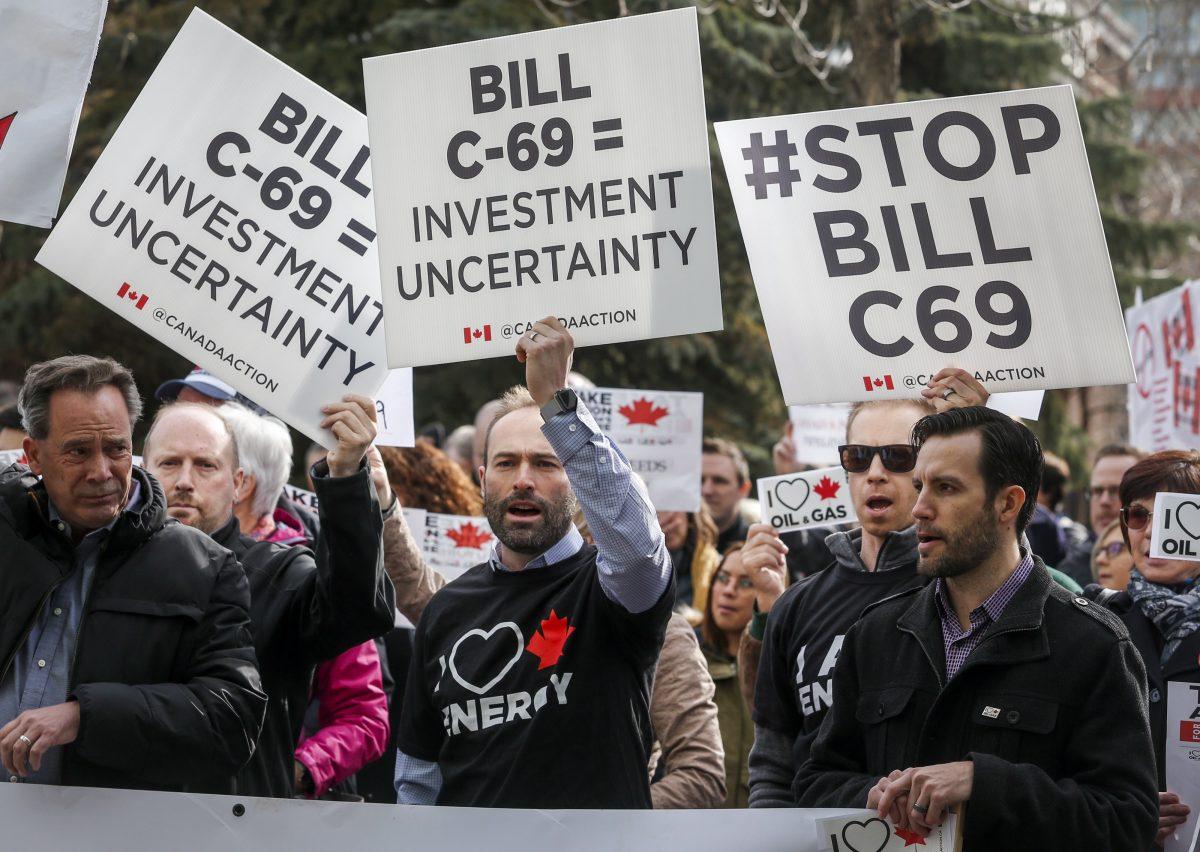
Pro-pipeline supporters rally outside a public hearing of the Senate Committee on Energy, the Environment and Natural Resources regarding Bill C-69 in Calgary on April 9, 2019. The Canadian Press/Jeff McIntosh
Wright says there may be further challenges to this arrangement under the current provisions of the IAA. If the province were given the final say on projects, as Smith has suggested, it would conflict with the act, which under Section 60(1) gives the federal environment minister the final word on the federal aspects of the assessment, even in a substituted process.
“It’s hard for me to see how a cooperation agreement can change that, because that’s in law,” Wright said. “So they would have to amend the Impact Assessment Act to make that change.”
He added, “Put another way, the federal minister can’t abrogate or derogate from their responsibilities to make a final decision under that act.”
Exemptions Under the Building Canada Act
Wright says another possible way the Alberta–Ottawa deal on impact assessments could work is that, instead of changing the IAA or using alternative pathways within it, Ottawa could use the Building Canada Act to fully exempt certain projects in Alberta from the legislation.
The legislation faced pushback from indigenous groups, which said the bill’s fast-tracking of project approvals would give them “minimal opportunity” to influence decisions affecting their communities.
Wright says issues such as who will have the final word on impact assessments and the mechanisms through which the province expects to gain more control over project approvals will be “tough negotiation points” in upcoming discussions between Alberta and Ottawa.
They are expected to reach an agreement over impact assessments by April 1 next year.