This copy is for your personal, non-commercial use only. Distribution and use of this material are governed by our Subscriber Agreement and by copyright law. For non-personal use or to order multiple copies, please contact The Epoch Times Reprints.
There is currently momentum in Canada to grow the economy through major projects, including around energy, but the jury is still out on whether enough can be done to reform regulations to attract the necessary investments.
While investments in Canada’s oil and gas sector fell alongside oil prices since 2014, investments in the sector didn’t bounce back to the same extent as before even after prices recovered.
The new Liberal government under Prime Minister Mark Carney has shown early signs of flexibility toward the oil and gas sector, by including “conventional energy” in its plan to make Canada an “energy superpower” and by tabling legislation aimed at circumventing—in rare cases—the Impact Assessment Act, a controversial federal legislation which places further regulatory requirements on major projects.
On the other hand, Ottawa has said it won’t veto provincial or First Nations‘ objections to pipeline projects, saying it would work by “consensus.” The comment comes in the context of provinces such as British Columbia and Quebec historically opposing pipeline projects sought by provinces such as Alberta and Nova Scotia.
Pro-pipeline premiers such as Danielle Smith and federal Conservative politicians have said that under former Prime Minister Justin Trudeau, the Liberal government enacted laws that impeded the development of resource projects, made it more difficult to export oil to Asia, and increased operating costs for oil companies through carbon pricing. They blame federal policies for the cancellation of billions of dollars in projects in the energy sector.
Over the last two decades, investment in Canada’s oil and gas sector fell from an all-time high of $80 billion in 2014 to just $24 billion in 2020. As a share of total investment in Canada, oil and gas fell from 24 percent to 7 percent during that period. Even as oil prices have recovered, investment in Canada’s oil and gas sector has not returned to its previous highs.
Dan McTeague, a former Liberal MP and the president of Canadians for Affordable Energy, said it will take a lot of time, effort, and “contrition” from the Liberals to roll back the policies impacting the energy sector.
“Our massive resource sector and the importance of the purchasing power of every Canadian is something we have to get back to. It’s getting back to basics,” he told The Epoch Times.
Carney has said that he wants Canada to become an “energy superpower” in both conventional and clean energy.
Oil Investment Over Time
In Canada, investment in oil has typically risen and fallen with oil prices. In 2008, as oil prices hit $147 a barrel, investment in the sector made up 18 percent of total industrial investment in Canada that year, at $50 billion.
The 2008 financial crisis led to both oil prices and investment falling, but by 2014 oil prices had mostly recovered and oil and gas investments reached a new high of $80 billion that year, making up 24 percent of investment in Canada.
Pumpjacks work to extract crude oil as the sun sets, in a file photo. Ronnie Chua/Shutterstock
In 2014, global oil prices crashed from over $110 a barrel to around $50 because of lower global demand and increased production by the United States and the Organization of the Petroleum Exporting Countries.
In 2020, as the global economy slowed due to the COVID-19 pandemic, oil prices fell below $40 per barrel, investment in the sector in Canada fell to $24 billion, and the industry’s share of total investment in the country dropped to a three-decade low of 7 percent.
Oil prices briefly recovered to pre-2014 highs in 2022 because of higher inflation and supply chain issues due to the Russia-Ukraine War, but have since hovered at around $70. In 2023, investment in Canada’s oil and gas sector was at $39.2 billion.
“While many factors are at play, investors point to Canada’s policy barriers as major deterrents to investment,” says a Fraser Institute study, citing surveys of oil companies. “Less investment means less money to develop new energy projects, infrastructure and technologies, and consequently fewer jobs and less economic opportunity for Canadians.”
Jack Mintz, President’s Fellow of the School of Public Policy at the University of Calgary, noted that oil prices are expected to stay at around $61 per barrel in the latter half of 2025 and $59 next year, according to the U.S. Energy Information Administration. He said this will put further pressure on new investment in Canadian oil and gas in the short term.
However, Mintz said with U.S. oil production projected to peak in 2027 and decline thereafter, that could make oil finds in other countries more promising for investment.
“I don’t think we’re at peak oil demand, … and the question is, who is going to be providing it?” he said in an interview.
“The more we load up costs in Canada on oil, the less competitive we are going to be compared to places like Guyana and Brazil.”
Policies Impacting the Sector
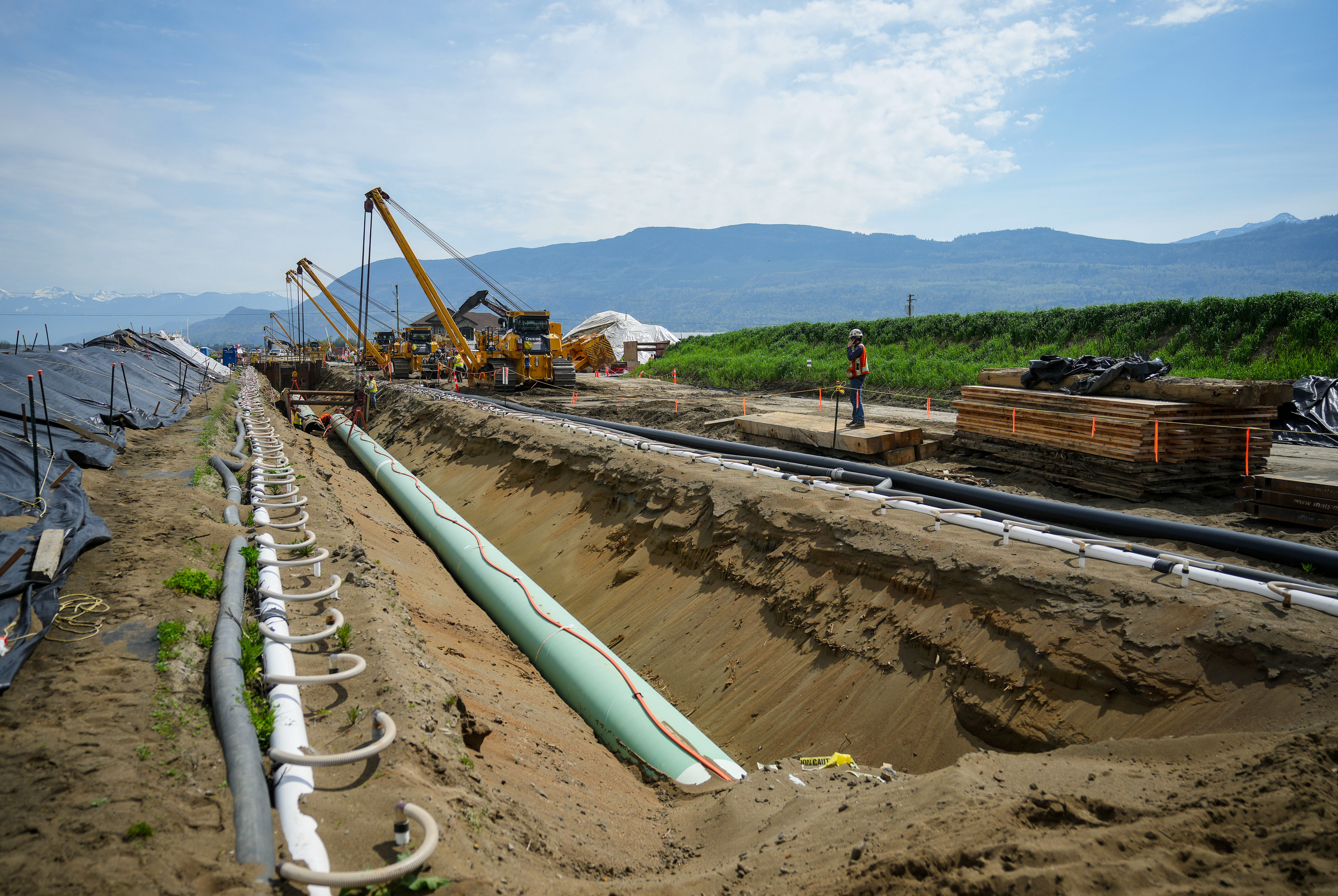
In 2018, Ottawa purchased the Trans Mountain expansion project for $4.5 billion to keep it alive after Kinder Morgan effectively abandoned it.
When announcing the suspension of non-essential spending on the project in April that year, Kinder Morgan said the federal government and the provinces of Alberta and Saskatchewan supported it, but it faced “continued active opposition” from the government of British Columbia. The company said B.C.’s NDP government, which came to power in 2017, said it would use “every tool in the toolbox” to stop the pipeline from being built.
Energy and Natural Resources Minister Tim Hodgson rises during question period in the House of Commons in Ottawa on June 6, 2025. The Canadian Press/Sean Kilpatrick
In 2016, Ottawa also effectively cancelled the Northern Gateway pipeline—which would have carried crude oil from Alberta—by introducing an oil tanker ban in northern B.C. waters following criticism from environmental and indigenous groups. TransCanada also cancelled the Energy East pipeline in 2017 citing regulatory changes driving up costs and uncertainty.
A previous analysis by The Epoch Times showed that between 2015 and 2020, $175 billion in energy projects were cancelled in Canada. Many of those projects were cancelled due to broader global conditions and owners’ reprioritizations. However, a significant number were also due to cited uncertainty in the regulatory process and environmental policies, as well as indigenous consultation complexities.
Alberta Premier Smith and Saskatchewan Premier Scott Moe have criticized federal legislation such as the Impact Assessment Act, also known as Bill C-69, which requires assessments for environmental, social, and economic impacts and the rights of indigenous people before a resource project can begin construction, saying it has slowed the development of resource projects and scared away investors. They have also criticized Bill C-48, the Oil Tanker Moratorium Act, which bans oil tankers off the coast of Northern B.C. to protect marine life.
Other federal policies they have criticized include net-zero vehicle mandates; limitations on plastics; control of the industrial carbon tax; the oil and gas emissions cap, which the two premiers say in effect limits production, an assertion the feds deny; and the Clean Electricity Regulations, which limit the use of energy sources such as natural gas in the electrical grid.
According to McTeague, the federal government created so much regulatory uncertainty and additional costs through its environmental policies that many energy projects were cancelled, which had the longer-term effects of reducing Canada’s GDP, increasing energy and food costs, and lowering the value of the Canadian dollar relative to the United States, and increased its dependence on the country.
Over the last two decades, investment in Canada’s oil and gas sector fell from an all-time high of $80 billion in 2014 to just $24 billion in 2020. Ryjkov_S/Shutterstock
“We’ve basically opted for a dead end which these green policies have led us to,” he said. “It has hurt Canada, hurt Canadians, and clouded our future.”
A majority of Canadian oil and gas executives polled believe that their sector in Canada is being harmed by environmental regulations. In a 2023 Fraser Institute study, which surveyed 165 senior executives in the sector from four Canadian provinces and 13 American states, 68 percent in Canada were deterred by the uncertainty concerning environmental regulations, while just 41 percent in the United States felt the same.
Although the Liberal government has not floated getting rid of the tanker ban in B.C., it recently introduced legislation that would allow the government to go around the Impact Assessment Act to build certain projects that are in the national interest. Bill C-5 would support the development of major projects that align with Canada’s interests, and seeks to reduce approval times for such projects from five years to two.
The Liberal government’s new Energy and Natural Resources Minister Tim Hodgson, who previously spent three years as a board member for MEG Energy, said in Calgary on May 23 that he is pursuing a “clean slate” in Ottawa’s relations with Alberta, and that every energy worker in the province is an “integral part of team Canada.”
“We need infrastructure that gets our energy to tidewater and to trusted allies,” he said. “We will invest in carbon capture, methane reduction, and other technologies to ensure Canadian oil and gas is not only produced responsibly, but is the most competitive in the world.”
Potential Shift
Dependence on the United States for trade amid the tariffs uncertainty brought in by the Trump administration has opened new conversations in Canada. This, coupled with lagging productivity and a widening gap in GDP per capita, made the economy a top area of focus during the recent election campaign.
During the election, Carney pledged to make Canada the “world’s leading energy superpower” through a combination of “clean energy” and the “lowest carbon conventional energy.” He also promised to speed up the approval process for energy projects.
Alberta Premier Danielle Smith speaks to an audience at the Canada Strong and Free Conference on April 12, 2024. Noé Chartier/The Epoch Times
The prime minister built upon those promises on June 2 when he met with Canada’s premiers to discuss streamlining the process for advancing major projects “deemed in the national interest.”
Several premiers expressed optimism following the meeting, with Ontario Premier Doug Ford calling it the “best meeting” between the premiers in a decade, and Alberta Premier Danielle Smith—who has often been at odds with the Liberal government over energy policies—saying she was “encouraged by the immediate change of tone.”
The Carney government followed the meeting with the tabling of related legislation. The One Canadian Economy Act (Bill C-5) would speed up the development of major projects that align with Canada’s interests, implementing a “one project, one review” process with the goal of reducing approval times from five years to two.
The federal government said it will be reviewing the list of projects suggested by premiers in the coming months based on criteria including whether they can increase Canada’s resiliency. Carney said the first ministers discussed a potential Western corridor going from the Pacific Northwest to James Bay, which could include a pipeline to bring “decarbonized barrels” to other markets.
Premier Smith called this project a “grand bargain” after the meeting, mentioning both a pipeline running from northwest B.C. to the port of Churchill, Manitoba, and a carbon capture and storage network known as the Pathways Alliance. She said the project would cost between $10 billion and $20 billion, and selling more oil to Asia would pay for it.
“If we had a million-barrels-a-day pipeline going to the northwest B.C. coast, that would generate about $20 billion a year in revenues. And so that seems like a pretty good value proposition, if both of those projects can proceed at once,” she said.
Mintz said it remains to be seen whether “decarbonized” oil could be competitive internationally if other countries are selling conventional oil. While the government has not provided a definition of what “decarbonized” oil and gas means, it is understood to mean minimizing greenhouse gas emissions during oil and gas extraction and processing.
Conservative MP and energy and natural resources critic Shannon Stubbs have maintained the Tories’ criticism of the Liberals, saying the recent first ministers’ meeting did not lead to “more certainty or clarity” for companies or the oil and gas sector. Stubbs said Liberal laws around energy have resulted in companies taking “historical levels of investment” to other countries that had “an efficient, predictable, fair, and timely assessment process.”
“That’s what has to happen in Canada,” she told The Epoch Times.
Energy Minister Hodgson said on June 6 in the House of Commons that he had recently met with all the premiers to discuss energy and had reached a “consensus.”
“Just five days later, we are tabling legislation to start building again,” he said, referencing the aspects of Bill C-5 that would potentially speed up the construction of energy projects.





 The federal government said it will be reviewing the list of projects suggested by premiers in the coming months based on criteria including whether they can increase Canada’s resiliency. Carney said the first ministers discussed a potential Western corridor going from the Pacific Northwest to James Bay, which could include a pipeline to bring “decarbonized barrels” to other markets.