



Tuesday’s (May 12) ruling by the German Federal Constitutional Court (the Karlsruhe Court) is a watershed moment in the European project.
The case concerns an ongoing tug of war between the EU’s supreme court—the European Court of Justice (ECJ)—and the Karlsruhe Court on the legality of the European Central Bank’s ongoing purchase of sovereign bonds.
Basically, the German court has declared that Germany is not required to go along with the ECB’s latest round of bailing out non-Germans.
The Karlsruhe Court Has Openly Challenged the ECJ’s Supremacy
In its press release, the court states:[The ECJ’s mandate] is exceeded where the traditional European methods of interpretation or, more broadly, the general legal principles that are common to the laws of Member States are manifestly disregarded….
[The Karlsruhe Court] is not bound by the [ECJ’s] decision but must conduct its own review to determine whether the Eurosystem’s decisions on the adoption and implementation remain within the competences conferred upon it under EU primary law.
In so doing, the Karlsruhe Court chose to disregard the ECJ’s approval of the ECB’s decision in question.
It is doubtful that parallel proceedings in the ECJ will suffice to restore its supremacy in the context of this case.
The European Commission may even launch proceedings against the German state to obtain some leverage, but it is unclear whether the Karlsruhe Court will retreat from its current position. The Karlsruhe Court is, after all, Germany’s constitutional court and is expected to believe in the primacy of the German Constitution over European treaties.
The Restoration of Rule of Law in Central Banking
The Karlsruhe Court laments the “self-imposed restraint” shown by the ECJ in reviewing the ECB’s decisions, and further requires that the ECB conduct a proper test of proportionality when resorting to extraordinary measures such as the its new Public Sector Purchase Programme (PSPP):[The ECB’s decisions] contain neither a prognosis as to the PSPP’s economic policy effects nor an assessment of whether any such effects were proportionate to the intended advantages in the area of monetary policy. It is not ascertainable that the ECB Governing Council did in fact consider and balance the effects that are inherent in and direct consequences of the PSPP, as these effects invariably result from the programme’s volume of more than two trillion euros and its duration of now more than three years. Given that the PSPP’s negative effects increase the more it grows in volume and the longer it is continued, a longer programme duration gives rise to stricter requirements as to the necessary balancing of interests.The above passage has two implications:
- The ECB must state reasons for the actions it takes.
- The reasons are subject to review (i) with the test of proportionality and (ii) with regard to not only the object, but the effects of the measures.
A New Limit for European Integration
The court has observed that “constitutional organs must … actively take steps seeking to ensure adherence to the [limits of the] European integration agenda, work towards the rescission of acts not covered by the integration agenda and—as long as these acts continue to have effect—take suitable action to limit the domestic impact of such acts to the greatest extent possible.”Specifically, the government and Parliament must “continue monitoring the decisions of the Eurosystem on the purchases of government bonds…to ensure that the ESCB [European System of Central Banks] stays within its mandate.”
An Economic Sword of Damocles
In the absence of a new proportionality test applied and communicated by the ECB within three months, Germany’s central bank (the Deutsche Bundesbank) has been ordered to “no longer participate in the implementation and execution of the ECB decisions at issue” and to “ensure that the bonds already purchased and held in its portfolio are sold based on a—possibly long-term—strategy coordinated with the Eurosystem.”There is, however, just a small problem: the ECB has no mandate to use a eurozone country’s budget to finance the budgets of another eurozone country, and that is precisely what it has been up to:
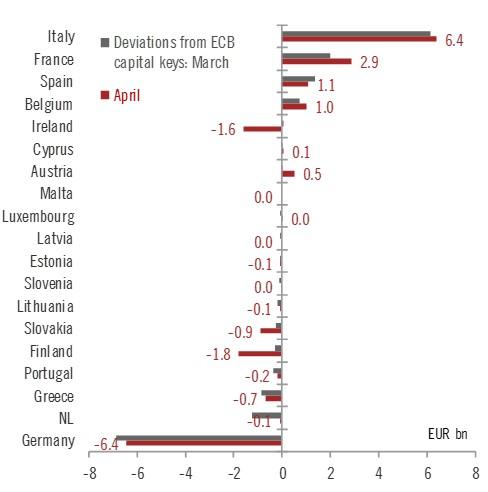
The ECB is going to have to come up with abstruse mental gymnastics to justify this decision, and the Karlsruhe Court has already made it clear that it is not bound by the ECJ’s reasoning, should the court decide to condone these mental gymnastics.
The Euro ‘Stumbles Along’
Although one may consider that this decision is a prelude to systemic events to come in the following months and years, it is equally likely that the eurozone will continue to “stumble along,” until the damage caused by the ECB’s monetary policies leads to an even deeper crisis. Initial reactions from the German government and the European Commission seem to suggest that the ECB’s strategy will be to delay any meaningful implementation of the Karlsruhe Court’s decision and to play for time until the case becomes moot.The Karlsruhe Court’s decision will surely give additional impetus to northern Europe’s skepticism toward the ECB’s policies, but whether it actually changes the direction of the ECB remains to be seen.
Viraj Bhide is an attorney at the Paris Bar. His website is BHide.fr.
This article was originally published on Mises.org.