This copy is for your personal, non-commercial use only. Distribution and use of this material are governed by our Subscriber Agreement and by copyright law. For non-personal use or to order multiple copies, please contact The Epoch Times Reprints.
Former South Korean President Given Suspended Jail Term for Lying During Election Campaign
Yoon will appeal the decision, but if the ruling is upheld, his People Power Party could be forced to return $27 million in campaign funds to the government.
Former South Korean President Yoon Suk Yeol arrives at a court to attend a hearing to review his arrest warrant requested by special prosecutors in Seoul, South Korea, on July 9, 2025. Kim Hong-Ji/Pool/Reuters
A South Korean court has handed former President Yoon Suk Yeol an 18-month prison sentence, suspended for three years, for lying during an election campaign.
Seoul Central District Court on July 27 determined that Yoon falsely claimed during the 2022 presidential campaign that he had not introduced a lawyer to a former tax official.
The court also found that Yoon had falsely claimed that he had not met shaman Jeon Seong-bae, whom he had first met through his wife, former First Lady Kim Keon Hee, and with whom he had maintained a long-standing relationship.
Both relationships had come under scrutiny during that election campaign.
“When a candidate personally announces false information at public events with a large impact, such as debates and interviews, the effect on voters’ decision making is very significant,” the court said in its ruling.
Yoon’s legal team said the ex-president maintains his innocence and will appeal the verdict.
If the ruling is upheld, Yoon’s People Power Party may be forced to return 39.7 billion won ($27 million) in election expenses to the government.
Under South Korean election law, if a candidate secures 15 percent of the vote or wins the presidential election, the parties will be reimbursed for their campaign expenses.
However, if a candidate is later convicted of an election law violation resulting in a jail term or a fine of at least 1 million won ($680), that party must return the funds to the National Election Commission.
Series of Trials
This conviction is the latest outcome in a series of eight trials the former president is facing, including his February conviction for abuse of authority and orchestrating an insurrection, connected to his failed 2024 martial law decree.
Yoon was ousted as president after attempting to impose martial law on Dec. 3, 2024. He backed down after six hours following a parliamentary vote to overturn the decree.
The former president said at the time that he had declared martial law in order to protect the constitution because the opposition, which controlled the National Assembly, was sympathetic to communists and North Korea.
The first in a series of convictions came on Jan. 16, 2026, when the Seoul Central District Court found Yoon guilty of mobilizing the presidential security service to prevent authorities from detaining him, fabricating official documents, and failing to follow the legal process required for declaring martial law.
He was sentenced to five years, but that was increased to seven years in April. On July 9, South Korea’s Supreme Court upheld this conviction and sentencing.
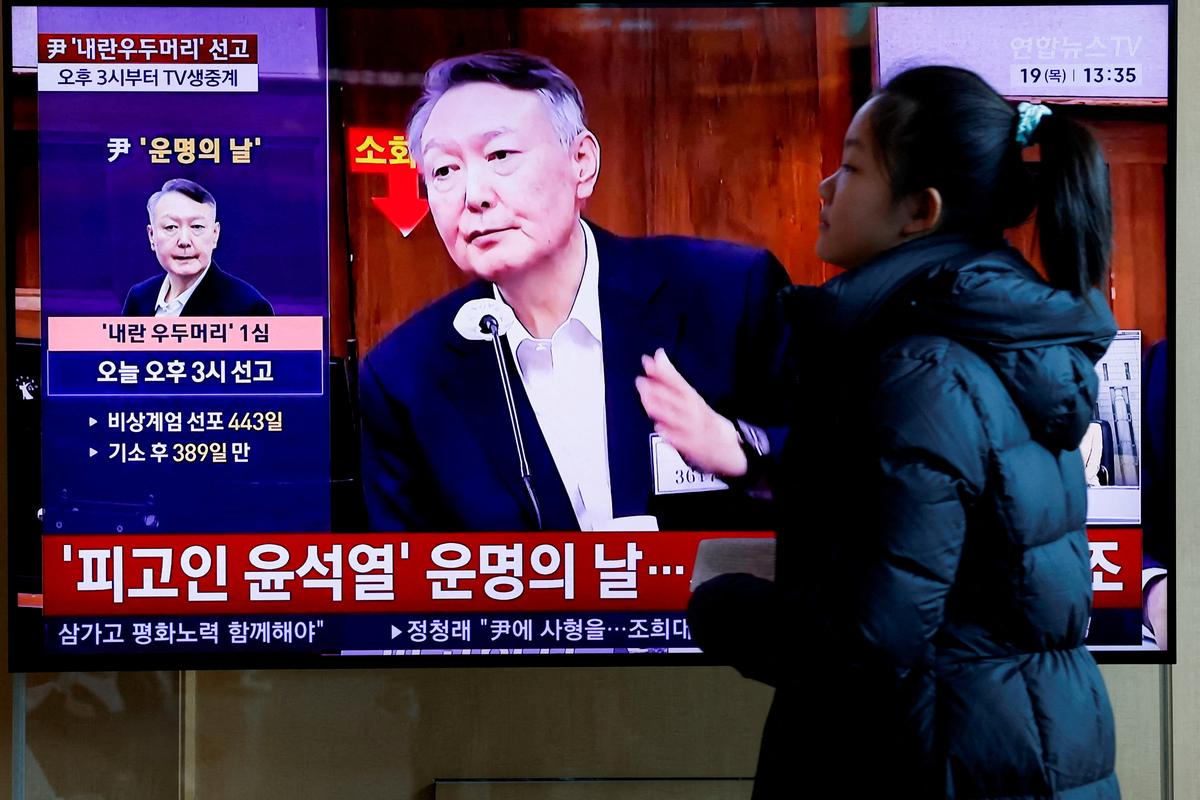
A person walks in front of a TV screen broadcasting a news report on the sentencing trial of former South Korean President Yoon Suk Yeol in his insurrection case, stemming from his short-lived declaration of martial law in December 2024, in Seoul, South Korea, on Feb. 19, 2026. Kim Soo-hyeon/Reuters
He was then convicted on Feb. 19 for the martial law decree, receiving a life sentence. Prosecutors had initially called for the death penalty, although there has been a moratorium on carrying out capital punishment since 1998.
The conservative politician’s third conviction came on June 12, when he was sentenced to 30 years in prison after the court found him guilty of ordering the flying of drones over Pyongyang, North Korea, in October 2024 to provoke the North Korean regime and manufacture a security crisis to use as a pretext for his declaration of martial law.
Yoon was then convicted on July 13 of accepting illegal political funds in the form of free opinion polls and received a two-year prison sentence on top of his other multiple custodial sentences.
Yoon and his legal team deny all charges and are appealing the convictions.
Victoria Friedman is a UK-based journalist covering a wide range of international stories, with a particular interest in technology, eastern Europe, and defense.