Aircrew on two international aircraft failed to notice a warning from Melbourne airport, which led to two near misses in less than two weeks, placing hundreds of passengers at risk, according to a report from the Australian Transport Safety Bureau.
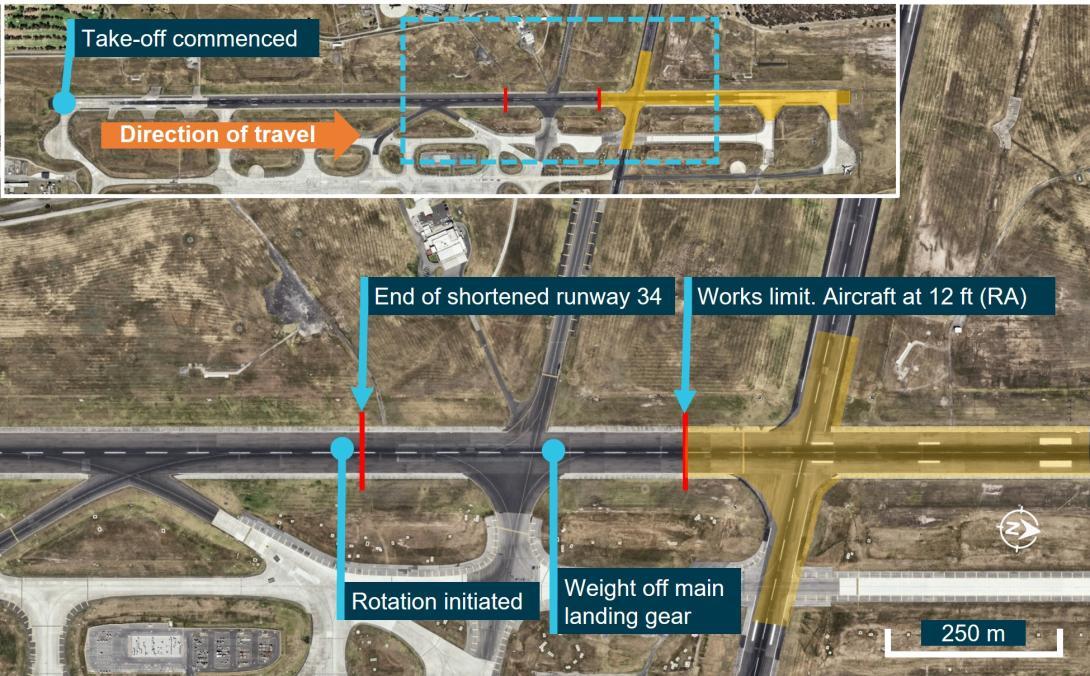
Both flights overshot a runway which had been temporarily shortened to accommodate resurfacing work, and lifted off the ground just metres from airport workers and equipment.
Both aircraft flew so close to the worksite that the jet blast affected the area, impacting runway unserviceability lights, works lights, and marker cones.
A worker also reported the first near-miss caused their vehicle to shake violently. The second event caused a stress-related injury to a worker.
The Bureau noted that both crews were informed in two ways that the runway was 1.5 kilometres shorter than usual—firstly, in a notice to airmen (NOTAM), and then via the voice automatic terminal information service (ATIS), a pre-recorded preflight briefing.
However, their review of the written information was “insufficient,” and they listened only to the part of the recorded message that dealt with weather conditions.
They consequently used standard take-off performance calculations, with reduced engine thrust causing them to overshoot.
The aircraft involved were a Malaysia Airlines Airbus A330‑300, which took off on Sept. 7, 2023, and a Vietnamese Bamboo Airways Boeing 787-9, which departed on Sept. 18, 2023. Both carried over 200 people at the time.
The airlines’ dispatchers were also partly responsible, the report found.
They provided briefing packages for the flight crews that accounted for the reduced runway length in their take-off performance calculations, but failed to draw attention to this information because calculating the required take-off thrust is the pilot’s responsibility.
“Additionally, in the case of Bamboo Airways, the dispatcher included a misleading crew briefing note that indicated there were no significant NOTAMs for the departure,” which was compounded by the fact that the aircraft “experienced delays and additional workload due to repeated ... power outages.”
The flight crews also failed to confirm the shortened runway with air traffic control, which, in turn, neglected to challenge them.
ATSB Chief Commissioner Angus Mitchell said both were classed as “serious incidents.”
“That’s why we’ve been so detailed in the investigation, but also in our safety recommendations to ensure that this type of thing does not occur, particularly in Australia, again,” Mitchell said.
Both airlines have updated their procedures to ensure that changes to runway distances are directly communicated to flight crews.
While the risk controls for such incidents were “predominantly procedural, relying on the flight crew responsibility to carefully review sources of essential aerodrome information,” there have been “a number of previous similar occurrences,” the Bureau noted.
Therefore, “considering the potentially catastrophic consequence ... the introduction of additional defensive layers aimed at directly assuring flight crew awareness and/or visually alerting departing flight crews to significant runway hazards should be considered,” it recommends.
“While visual aids may not always be completely effective, they would provide an additional defensive layer for flight crews, who would otherwise be presented with a visual image almost identical to that of a normal runway.”
This would include the use of conspicuous construction and other warning signs, which had been trialled successfully in other jurisdictions. However, this was not currently required under Australian law.
The International Civil Aviation Organisation has already committed to introducing additional highly visible signage to alert crews of runway changes, and the Bureau has recommended it also review air traffic control communication procedures to crews on “safety-critical” aerodrome conditions.
Airservices Australia, in consultation with the Civil Aviation Safety Authority, is reviewing its air traffic control procedures as a result of the near misses.