OTTAWA—Hundreds of protesters travelled to Ottawa to demonstrate against the federal government’s proposed Toronto to Quebec City high-speed rail line, which they say would involve the expropriation of land from farmers and the dividing up of rural communities.
The project is also opposed by the Conservatives, who say the cost is too high, while the Bloc Québécois opposes the current approach to the project.
Communities in Ontario and Quebec are concerned with the government’s powers to expropriate land for the railway if Alto is unsuccessful in purchasing it from owners, and do not want to see the railway run through their communities.
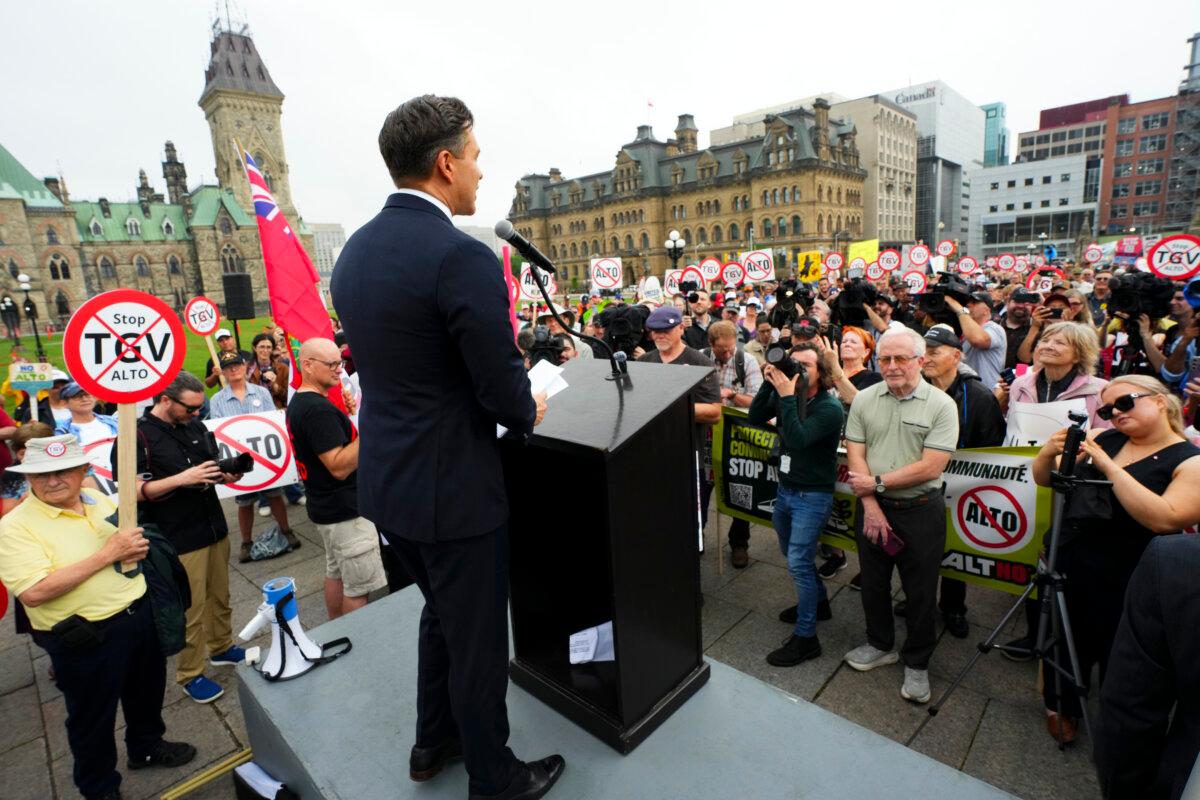
Groups such as the Coalition for Better Rail, Rideau Lakes Against Alto, Save Stone Mills, and l’Union des producteurs agricoles representing Quebec farmers, participated in a march on June 10 through downtown Ottawa, which culminated in speeches on the lawn of Parliament Hill.
Robert Charron, a city councillor in Mirabel, Que., and emcee for the event, told the protesters that they were “here to send a clear message to the government,” and that their presence “demonstrates that this opposition is real, widespread, and growing.”

“This is a marathon, my friends, not a sprint. And despite the challenges ahead, I remain optimistic that we can still change the course of this project,” Charron said.
Rideau Lakes Councillor Paula Banks told the audience that the railway would “literally cut [the community] in half” and “devastate our economy.” Banks said that despite the city council voting unanimously to oppose the railway, Alto had ignored their concerns and had been “pressuring us with gag orders.”
Banks said the railway could harm rural communities’ businesses, tourism services, emergency services, school bus routes, and farmers. “A high-speed rail corridor cutting through that landscape does not enhance those economies. It endangers them, and the federal government has closed their eyes to that,” she said.
Norman Burns, who lives in a village called Portland southwest of Ottawa, told The Epoch Times that one of the proposed railway routes would go “right through our town” along an oil railway track that has been converted into a recreational trail.
Burns said in addition to his concerns about losing access to the trail, many of the roads leading to his town would be cut off by the railway. Burns said he would like to see the railway instead be built alongside Highway 401, which would be the “cheapest, easiest, and smartest” option.
James Young told The Epoch Times that while he likes “the concept” of a high-speed rail, “I’m a little worried that it won’t be as cheap ... and I feel that the fear that the burden on taxpayers will be very large.”
Young also said VIA Rail has been unreliable and underfunded for many years, and he would prefer to see the rail system upgraded and subsidies increased instead. Young also said he has spoken with many people in his community in rural Ontario, and “none of them” support Alto’s rail project.
“Let’s look at the problem, let’s look at a solution that fits the problem, rather than over-engineering a solution, which is very risky,” he said.
The government’s omnibus budget bill, introduced last year, included measures that would streamline land acquisition for the high-speed rail project. Under the proposed changes, the Crown could expropriate property without first following certain standard procedures required under the current Expropriation Act.
Existing rules generally require the government to attempt to purchase private land through negotiation before resorting to expropriation. The amendments would exempt the high-speed rail project from that requirement, allowing the government to proceed directly to expropriation.

Opposition Parties
Conservative Leader Pierre Poilievre made an appearance at the protest, saying that the Liberal government will force struggling Canadians to spend around $8,000 each in taxes “for a train they will never take.” The Tory leader said his party would “rather save the $90 billion, let our farmers keep their land, [and] let our communities enjoy their peace and tranquility.”Poilievre noted that during the 1960s, the federal government expropriated land from more than 3,000 farmers for the Mirabel airport project in Quebec, “that nobody uses, and Canadian taxpayers got the bill.” The government later sold back the expropriated land to the families, and the airport’s passenger terminal was demolished in 2016.
“Well, they’re doing it all over again. We won’t let them do it. Conservatives are launching a nationwide campaign to save the $90 billion, to fight for affordability, to fight for our farmers and our landowners, and to put this country back in your hands,” Poilievre said.
Prime Minister Mark Carney recently noted that Quebec voted for a Liberal government in the last federal election, which included its policy of building a high-speed rail. “We have to be for great projects on a national scale ... This will be the biggest infrastructure project in Canada’s history,” he said.
Transport Minister Steven MacKinnon has called the project a “generational investment.”