This copy is for your personal, non-commercial use only. Distribution and use of this material are governed by our Subscriber Agreement and by copyright law. For non-personal use or to order multiple copies, please contact The Epoch Times Reprints.
Demonstrators carrying Alberta flags gather near a truck displaying pro-Alberta sovereignty messages during a rally in Taber, Alta., on June 28, 2026. The Canadian Press/Matthew Bruce
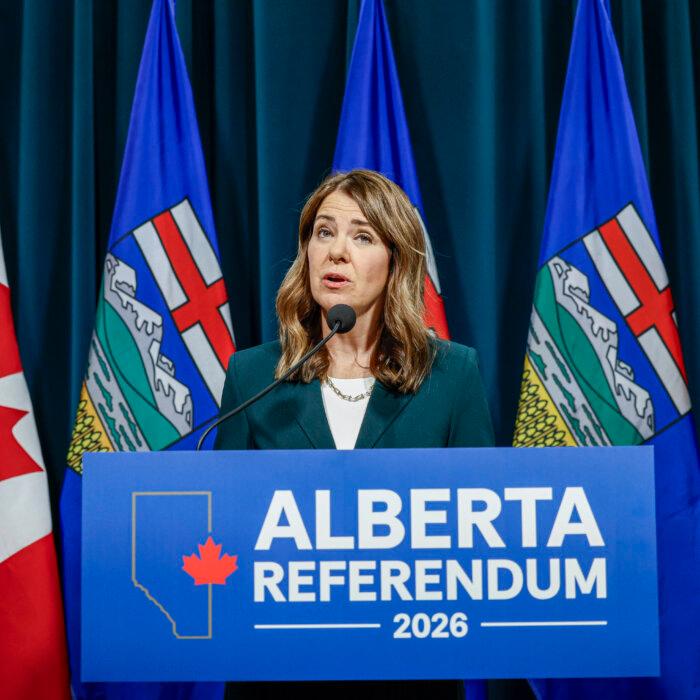
Alberta’s Chief Electoral Officer released guidance materials on referendum advertising this week that could provide greater clarity for individuals campaigning for or against the separation question to be presented to voters this fall.
Chief Electoral Officer Gordon McClure has published a Referendum Advertising Interpretation Bulletin outlining what does and does not constitute referendum advertising under the Election Finances and Contributions Disclosure Act (EFCDA).
The bulletin also outlines campaign spending rules and clarifies when organizations must register as third-party advertisers for the Oct. 19 vote.
The bulletin comes roughly a week after Calgary Mayor Jeromy Farkas asked city legal experts during a council meeting about whether the municipality has the authority to use city resources for historical research and advocacy efforts supporting Alberta remaining in Canada.
Council was told that while the city could conduct research into the potential impacts of separation, it could not act as a third-party advertiser or spend municipal funds to promote a position on the referendum question. Individual councillors, however, can advocate in their personal capacities
Farkas argued the city should be able to examine and communicate potential economic impacts, but legal counsel cautioned that using municipal resources for advocacy could conflict with provincial referendum advertising rules. Council may still be able to pass a non-binding resolution expressing a position on the issue.
McClure described the bulletin as his response to “much confusion and misinformation about what qualifies as referendum advertising” although he did not cite the Calgary city council meeting or any other groups.
“This Interpretation Bulletin helps political participants and electors understand and comply with the legislation,” McClure said in a press release announcing the bulletin.
Referendum advertising is defined as any message transmitted to the public during the referendum period that promotes or opposes a question on the ballot, according to the bulletin.
“In other words, the advertising in question must be an attempt to convince an elector to vote in a certain way in response to an identifiable referendum question,” McClure’s office said.
The bulletin also says several types of communication are exempt from the definition of referendum advertising, including unpaid messages on an organization’s own website, uncoordinated sharing of messages, direct communications to members or employees, and general non-partisan “get out the vote” calls.
Organizations spending more than the prescribed limits are required to register and comply with spending, reporting, and contribution rules detailed in the Guide for Referendum Third Party Advertisers, according to the bulletin.
Premier Danielle Smith has said she will actively campaign for the province to remain a part of Canada in the months leading up to the Oct. 19 referendum. Smith said she plans to hold a number of town hall meetings this summer to convince Albertans that confederation is the right choice.
She first announced in May that a question would be added to the ballot in the upcoming provincial referendum to gauge voters’ thoughts on staying in Canada. The decision followed a court decision that rejected a proposed referendum petition from the separatist group Stay Free Alberta concerning the province leaving Canada.