Leaders of NATO’s eastern member states said “repeated airspace violations on the Eastern Flank” highlight the urgent need to consolidate the alliance’s air defenses against missiles and drones, in a joint statement on May 13.
The leaders of Bulgaria, the Czech Republic, Estonia, Latvia, Lithuania, Poland, Romania, Slovakia, and Hungary—the so-called Bucharest Nine group—and the Nordic nations of Denmark, Finland, Iceland, Norway, and Sweden, released the statement after a summit in the Romanian capital.
The meeting was also attended by NATO Secretary-General Mark Rutte and Ukrainian President Volodymyr Zelenskyy, with representatives from the United States also present as observers.
“Russia is and will remain the most significant, long-term and direct threat to Allies’ security,” the leaders said in the joint statement.
“We condemn Russia’s highly confrontational actions against Allies and partners, including sabotage, cyber-attacks, and a wide range of hybrid attacks and destabilising activities. Repeated airspace violations on the Eastern Flank underscore the urgent need to continue strengthening NATO’s air and missile defence, including against [unmanned aircraft system] threats.”

According to the statement, expanding the transatlantic defense industrial base by boosting production capacities, strengthening supply chains, and implementing efficient multinational procurement is necessary to address security challenges.
Stray Ukrainian Drones Hit Latvia
The call to boost aerial defenses builds on calls made by Latvia and Lithuania on May 7, after two suspected stray Ukrainian drones crossed over the border with Russia and crashed in Latvia, one of which exploded at an oil storage facility.Police and firefighters said that four empty oil tanks were damaged at a storage facility in Rezekne, Latvia, about 25 miles from the Russian border and that debris believed to be from a crashed drone was found at the site.
Then-Latvian Defense Minister Andris Spruds told reporters that the drones were likely launched by Kyiv to attack Russia and accidentally strayed into the wrong side of the frontier.
“I have raised this with our allied partners, including within the NATO framework in this region, that the defense of our airspace is a shared responsibility,” Spruds said at a news conference near the crash site in the eastern part of the country.
“This is shared [NATO] airspace, and it is necessary to have [military] units here.”
At the time, Swedish Defense Minister Pal Jonson told public broadcaster Sveriges Television that the suspected violation of Swedish airspace occurred while a Russian military ship was in Swedish waters.
Kremlin spokesman Dmitry Peskov said on Feb. 27 that he was not aware of the incident, and that it was “quite absurd” to claim that the drone was Russian just because a Russian ship was nearby.
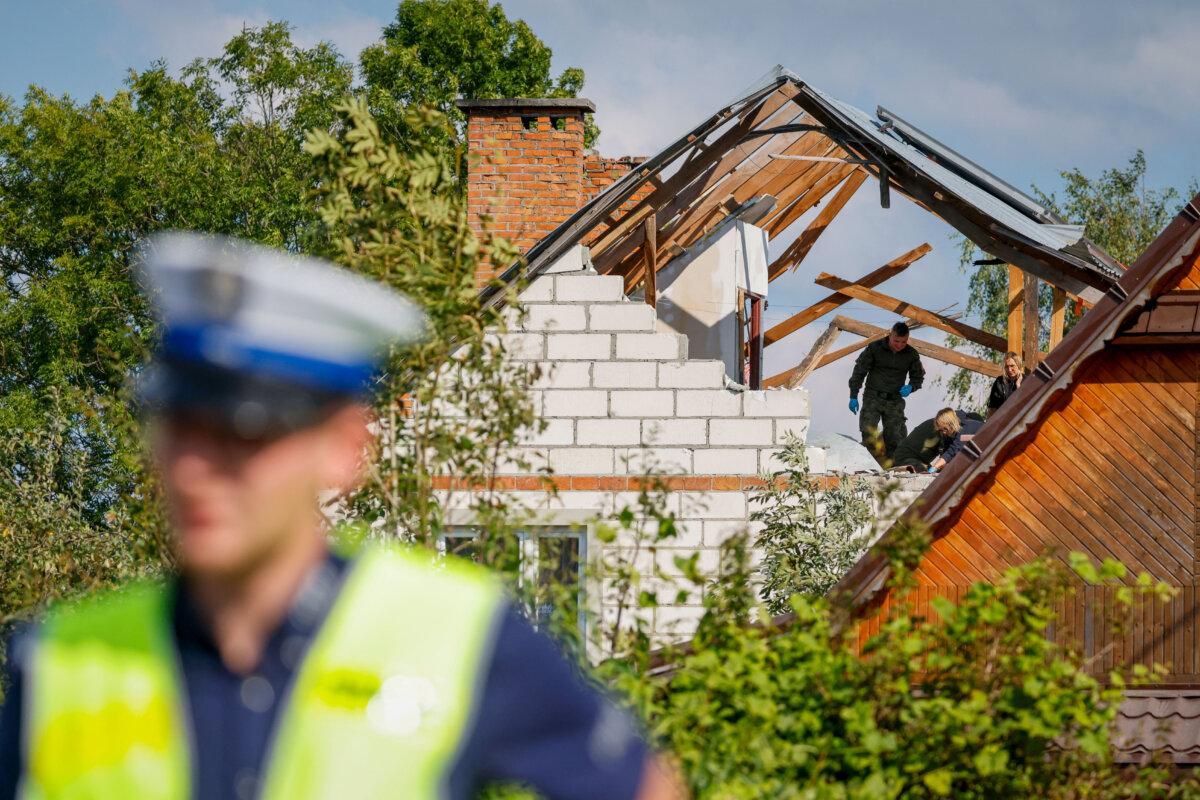
Polish authorities said at the time that a home in the village of Wyryki-Wola had likely been hit by a Russian drone that entered Poland’s airspace on the night of Sept. 9.
Polish Coordinator of Special Services Tomasz Siemoniak told Polish television later that month that the house was likely hit by a missile fired from a Polish F-16 fighter jet.
“Everything indicates that it was a missile fired by our plane, defending Poland, defending the fatherland, defending our citizens,” Siemoniak said at the time.
NATO has recently introduced three projects aimed at countering aggression from Moscow, named Baltic Sentry, Arctic Sentry, and Eastern Sentry.
NATO said at the time that the operation would involve both traditional military capabilities and novel approaches, including “elements designed to address challenges associated with drones.”