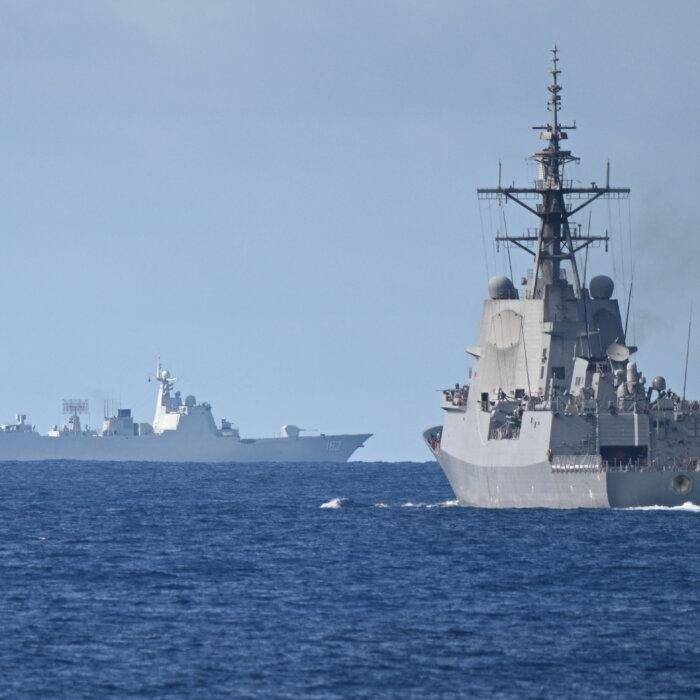
The challenging strategic environment in the Indo Pacific—characterised by Beijing’s increasing aggression toward its neighbours and influence among Pacific nations—means Australia is gearing up for a programme of continuous naval shipbuilding, says Minister for Defence Industry Pat Conroy, who told the Indo Pacific Conference that Australia was focused on procurement speed.
Conroy told the conference that the recently purchased Japanese Mogami-class frigates are slated to be the “fastest acquisition of a major defence platform in the history of Australia in peacetime.”
The choice of vessel was made five months ahead of schedule, with the first one expected to be in service by 2030, with another three by 2035.
“This is the speed that we all need to embrace in this area, and it requires bravery. It requires government to make decisions like acquiring the first three from the existing production line in Japan before shifting production to Australia. It requires bravery by the Royal Australian Navy to embrace no changes [to the design] ... because that’s how you get the best capability as fast as possible,” Conroy said.

He cited the Anduril Ghost Shark (underwater autonomous vehicle) factory as “another poster child for speed and capability.”
“The decision by Navy, by Defence Science and Technology Group, to co‑invest with Anduril [was made] in the middle of 2022 [and] to acquire three prototypes in three years. They were delivered on budget and one year ahead of schedule.
“So, factory-built, first production-level Ghost Shark will be delivered to the Royal Australian Navy in January 2026, three and a half years after the first decision to invest in R&D around this capability.”
Along with AUKUS, these projects illustrate the government’s commitment to what Conroy called “continuous Naval shipbuilding.”
“At the end of the build of the Anzac‑class frigates, we were building [them] faster and cheaper than our friends in Germany could with the MEKO class frigate they were based on. Why were we able to do that?
“Because we had scale and certainty of demand, and we’re intent on replicating that through our commitment to continuous naval shipbuilding in South Australia, doing major surface vessels and submarines, and in [Western Australia] producing patrol boats, frigates and landing craft.
“That requires huge political commitment, because the initial investment is always more expensive than trying to find something off an existing production line,” Conroy said. “But it’s about a long‑term investment in our defence industrial base, recognising that not only does that provide more supply chain resilience and sovereignty for our ADF, it broadens the economic base of those states and it ultimately gives [more options to the] ADF.”