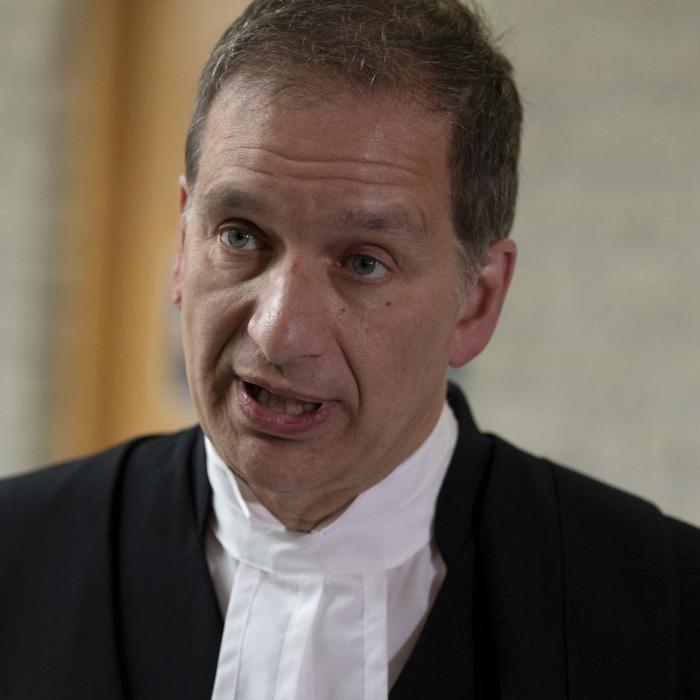
“The Crown is suggesting that from a few sentences in a couple of emails you should conclude that there is criminally culpable conduct,” defence lawyer Ian Donaldson said in his closing submission to the court April 27.
“That doesn’t read as if it’s a criminal plan,” Donaldson added, referring to portions of an email Majcher wrote to a colleague in 2017.
The prosecution has argued that excerpts from the email prove his intent to issue criminal threats on behalf of Beijing.
Majcher worked for the RCMP from the mid-1980s until 2007, retiring after more than two decades before working in anti-money laundering and asset recovery.
Sun was wanted in China for alleged involvement in major bank fraud tied to the Industrial and Commercial Bank of China.
Case
The Crown’s case centres on a 2017 email Majcher sent to a former RCMP officer and longtime associate, Kenneth Marsh, in which Majcher allegedly tried to coordinate efforts to get Sun to return to China and surrender his assets. In one excerpt, Majcher described meeting to coordinate efforts to arrest a “crook” wanted by China.“I hope to have a copy of the warrant before it is issued so we can impress upon the crook that we hold the keys to his future. I am meeting an associate of the target tomorrow in HK [Hong Kong] to see if he can help negotiate a settlement as the Chinese want to use this as a precedent case to settle economic crimes quietly and expeditiously,” he wrote to Marsh, who had been publicly identified as an unindicted co-conspirator in the case.
“The fraudster is now a ... major real estate mogul in Vancouver and we have located over $100M of assets. The Chinese Police have opened a Task Force and standing by to issue a global arrest warrant,” Majcher added.
Although the Crown had indicated Marsh would be a key witness, he was not called to testify.
The defence has argued that the case is circumstantial and there is no proof that Majcher was knowingly acting as a proxy for China with criminal intent. In his closing submissions April 27, Donaldson said the email from Majcher to Marsh should not be “construed” to infer guilt.
“One ought not to, in my respectful submission, extract a sentence or two [and] construe those in the most negative fashion possible,” Donaldson said, adding that it would be a “leap of logic” to convict Majcher.
Donaldson said that it is lawful to threaten to sue an individual or seek to regain money via legal means on behalf of a foreign nation. He added that the 2017 email sounds like Majcher “was talking about chasing a fraudster for a bunch of money,” rather than engaging in a criminal act.
“That email, in my respectful submission, is powerful evidence that tends to negate any ulterior criminal intent of any sort,” Donaldson said.
‘Flawed’ Investigation
Marsh later released a statement saying he was “deeply disappointed” that he was “not called to testify after waiting for the opportunity to clear my name.”He also said the case is based on a “flawed” investigation and has done enormous harm to his reputation.
“My life has been turned upside down. My home was searched, my name was dragged through the mud, and years later I still haven’t been cleared,” Marsh wrote.
“The damage to my reputation, my work, and my family is something I’m still living with every day. I believe this court was not told the full story, and that my evidence would have helped show how flawed the investigation really was,” he added.
The expected date of Devlin’s verdict has not been announced.