China is pressuring Papua New Guinea not to agree to a mutual defense pact with Australia.
Some of the core principles of the Pukpuk Treaty will include a mutual defense alliance, which recognises that an armed attack on Australia or PNG would be a danger to the peace and security of both countries.

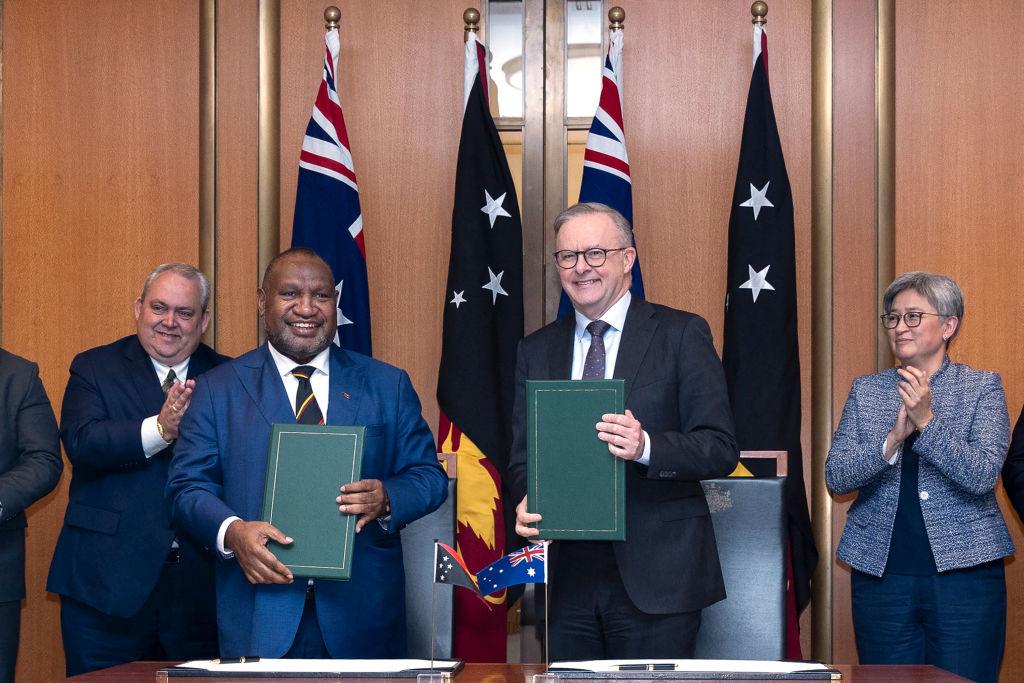
“I made a conscious choice that Australia remains our security partner of choice,” Marape said, adding that his country could not defend its land and ocean space alone and that the deal was in the national interest.
The failure to seal the treaty was the second setback to defence ties for Australia in the Pacific islands in a month.
Albanese traveled to Vanuatu last week, but was unable to sign a AU$500 million (US$326.5 million) security partnership because a coalition partner in the Vanuatu government called for further scrutiny.
It said that PNG was the first Pacific island country to sign a bilateral document on the Belt and Road initiative with China, which is a major part of Beijing’s economic thrust to become the dominant power in the region.
It is also the largest recipient of Chinese aid in the Pacific.
As the island nation of PNG looks out over the south-western Pacific, the ocean increasingly appears set to remain a flashpoint in the struggle for geopolitical dominance.
The people of the Cook Islands, a self-governing country, are historically and culturally aligned with New Zealand and possess New Zealand passports.
A spokesperson for New Zealand Foreign Minister Winston Peters said in a statement on June 18 that New Zealand had decided to suspend payment of NZ$18.2 million (US$10.9 million) in development funding for 2025–26 as this “relies on a high trust bilateral relationship.”
Communist China has been New Zealand’s largest trading partner since 2017, and New Zealand has a policy that does not recognize Taiwan.
RUSI said the Cook Islands maritime domain, which is rich in marine resources and critical minerals such as manganese, cobalt, and polymetallic nodules, is difficult to manage effectively.
Its vastness and remoteness, however, make it susceptible to illegal, unreported, and unregulated fishing and exploitation of marine and mineral resources, waste dumping, and a range of potential nontraditional security risks.
The think tank said Beijing’s engagement with Pacific island nations follows a consistent pattern: Economic assistance, grants and loans without due diligence, untenable infrastructure investments, and diplomatic recognition maneuvers.
“Through a clever mix of ‘cheque-book diplomacy’ and ‘no-strings-attached’ aid policy, China has cultivated strong ties with several Pacific island countries, including Tonga, Kiribati, Solomon Islands, Fiji, and Papua New Guinea,” the report stated.