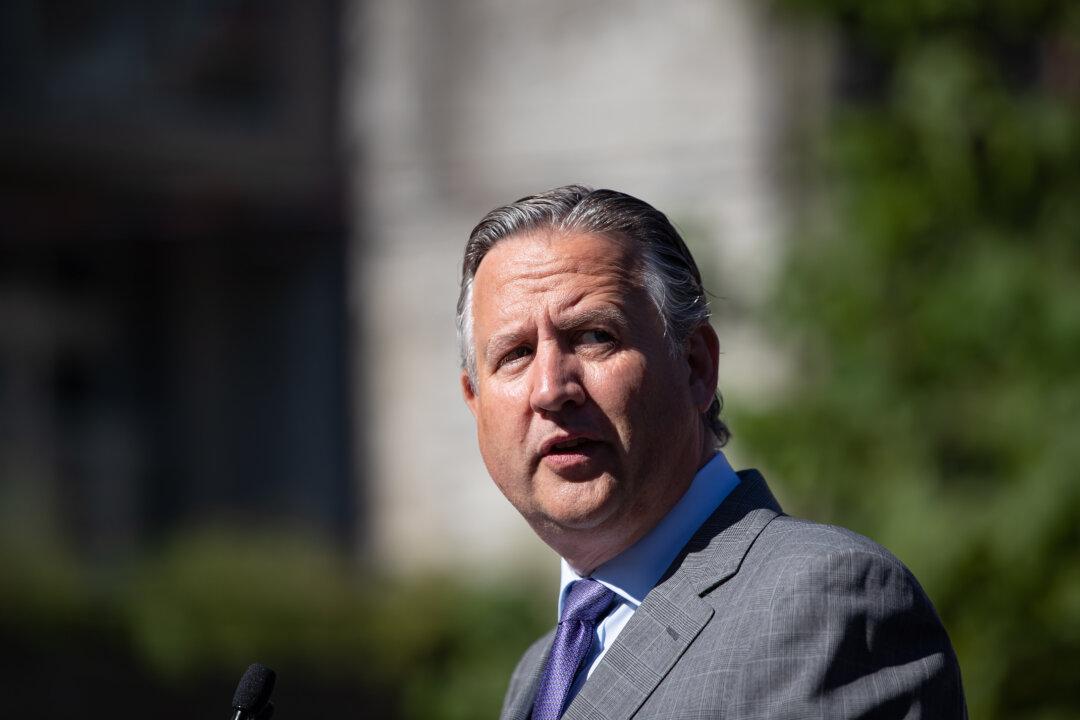
Prime Minister Mark Carney has announced a 25 percent increase to the GST credit and a list of measures that he says will aid lower-income consumers in coping with the steep costs of groceries.
“On average, these payments make up for the higher level of food prices since the pandemic,” Carney said during the Jan. 26 announcement at an Ottawa grocery store.
An average family of four currently receives roughly $1,100 per year from the GST credit, but Carney said the new credit will bump that to an average of $1,890 this year followed by $1,400 per year in the following four years. The PMO said the expanded credit will also provide an average $950 for an eligible single person this year and $700 per year for the next four years, compared to the current average amount of $540.
Carney said those who receive the cheques can spend the money on whatever they want since it is a “free country.” He added that lower-income Canadians will be more likely to spend it on food since a higher share of their income is put toward essentials such as food and housing.
Ottawa estimates the GST top-up will cost $3.1 billion in its first year, with lower but gradually rising costs over the remainder of the projection period. An analysis from Desjardins estimates the cost of the top-up at $10.5 billion over five years.
The government said it will also put aside $500 million to assist businesses in dealing with added costs from supply chain disruptions, as well as $150 million to make a Food Security Fund to support small and medium businesses dealing with tariffs.
Ottawa will also allocate $20 million to help food banks via the Local Food Infrastructure Fund, as well as a wider national food security strategy that will aim to ensure there is fair competition in the food market and work to improve domestic food production and access.
Carney said the government is also “working to address the root causes of inflation and working on longer term solutions to bring down the cost of groceries in Canada.”
One way to do that, Carney said, is by allowing food producers to fully write off new greenhouses that were acquired on or after Nov. 4, 2025 and are functioning before 2030. The PMO said this measure would support “increased domestic supply and investment in food production over the medium-term.”
Opposition Responds
Conservatives MPs Sandra Cobena and Vincent Ho issued a statement saying the Liberal government is responsible for food inflation in Canada. They said the proposals presented by Carney fail to address the underlying issues contributing to the escalation of food prices.“It is a home-grown problem of high Liberal taxes on farmers, fertilizer, and food processors and rampant inflationary deficits,” the statement reads, noting that Canada’s food inflation has surged to the highest level in the G7 since Carney assumed office, and is approximately twice that of the United States.
“Today’s reannounced rebate–which Conservatives will allow to quickly pass–will barely cover a single trip to the grocery store for most families,” the MPs wrote, adding that a previous doubling of the same credit in 2022 did not fix the existing crisis.
Cobena and Ho argued that “real solutions” suggested by the Tories could make food more affordable by lifting taxes and extra costs that impact food production.
“Conservatives have real solutions that could be adopted immediately: repeal the food inflation packaging tax, the industrial carbon tax and the fuel standard that will add 17 cents per litre of gas so that the food Canadians eat can get from field to fork affordably,” the statement said.
Professor and researcher in food distribution and policy Dr. Sylvain Charlebois, who also serves as project lead at the Agri‑Food Analytics Lab that published the 2026 Food Price Report, said instead of a tax credit, the government should consider cutting the GST on food.
“A GST cut would lower prices at the checkout, immediately, for all Canadians — not just some, not later, not via bureaucracy.”