Bulgarian President Rumen Radev announced that he is stepping down from the mostly ceremonial post on Jan. 19.
Left-leaning Radev has suggested he may contest an upcoming election, widely expected after protests he supported forced the previous center-right government to step down.
In a televised address from the capital Sofia, Radev said that he would submit his resignation to the Constitutional Court on Jan. 20.
The date of the next election is yet to be decided. A vote must be held within two months of the establishment of a caretaker government, which will now be appointed by Yotova.
“Nine years ago, you voted for me to work for Bulgaria as president. You did it again in 2021. Honor and responsibility that I tried to justify in all my actions,” Radev said.
“Together we have experienced a number of crises, the oligarchy’s attacks on democracy, and the major protests of 2020 and 2025. Circumstances forced me to appoint caretaker governments seven times, to defend, within the framework of my powers, of course, the state and public interest.
“The battle for the future of our homeland lies ahead, and I believe we will face it together with all of you—the worthy, the inspired, and the unyielding! We are ready. We can, and we will succeed!
His resignation, the first by a head of state in the nation’s post-communist history, comes as Bulgaria—a member state of both the European Union and NATO—struggles to overcome a political crisis that has gripped it for some years.
Large anti-corruption protests last month forced the resignation of the governing coalition, led by the center-right GERB party.
Attempts to form a new government within the current parliament have since failed, meaning an eighth parliamentary election since 2021 is set to be held.
The 62-year-old former Air Force general has been a prominent opponent of the leader of the right-wing GERB party, Boyko Borissov, and of politician and oligarch Delyan Peevski, who is under U.S. and UK sanctions and whose MRF New Beginning party has repeatedly backed the outgoing GERB-led coalition.
Radev’s resignation capped weeks of unrest.
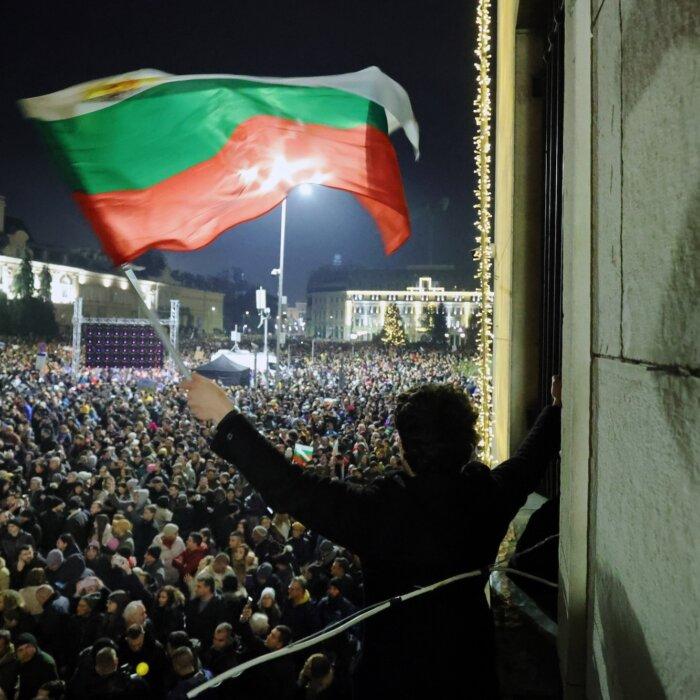
Initially sparked by the government’s draft 2026 budget, later withdrawn under public pressure, the protests quickly turned into mass demonstrations driven by public anger over corruption and the perceived sway Peevski had over government policy.
Opponents have accused Peevski of using his influence to shape government policy in line with oligarchic interests.
Students from Sofia’s universities joined the rallies, which local media estimated reached 100,000 or more, making the demonstrations among the largest since Bulgaria joined the EU in 2007.
Then-Bulgarian Prime Minister Rosen Zhelyazkov said his coalition would probably have survived the no-confidence vote, but that the sheer scale of the mass protests made remaining in office untenable.