Analysis
Bolivians are preparing to head to the polls on Aug. 17 to decide their future, which analysts and political insiders say could lead to better relations with the United States.
The South American nation has been experiencing its worst economic crisis in decades. Foreign currency—including dollars— is scarce, driving the annual inflation rate past 24 percent as of July, according to Bolivia’s Central Bank.
With a flattened local currency and inflated commodity prices across the board, the black-market U.S. dollar rate is more than double the officially posted exchange rate in the streets. Meanwhile, persistent fuel shortages have created long lines of angry locals at the pumps for months. Altogether, Bolivia’s multi-faceted economic crisis on the run-up to the election has laid the groundwork for the first elected regime change since Evo Morales and the Movement for Socialism Party (MAS) came to power in 2006.
From a pool of eight presidential candidates, the country will decide who can stop the nation’s currency bleed, bring down food and fuel prices, and whether a reset with the United States is back on the table after years of frosty diplomatic relations.
During his first term, former President Morales expelled the U.S. ambassador and law enforcement agencies. This was followed by the 2013 expulsion of the U.S. Agency for International Development for allegedly conspiring with the political opposition. Bilateral relations have been strained ever since.
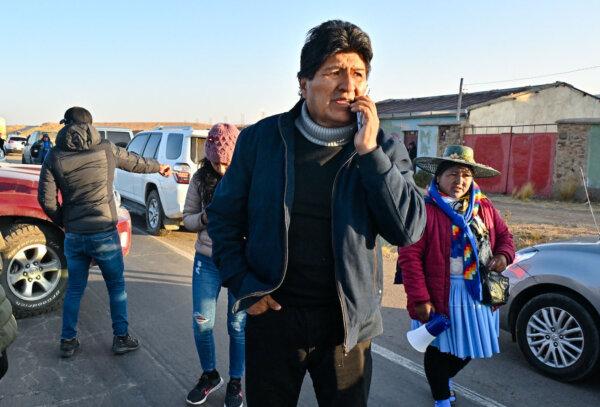
Former Bolivian President Evo Morales speaks on the phone before taking part in the so-called "March to Save Bolivia" against his former ally, leftist leader Luis Arce, in Ayo Ayo, Bolivia, on Sept. 21, 2024. Aizar Raldes/AFP via Getty Images
Local media polls in August show a commanding lead for right-wing conservative candidates Samuel Doria Medina and Jorge Quiroga—known locally as “Tuto”—with polling numbers coming in at 21 and 20 percent, respectively. The long-dominant MAS party’s normally unified vote has been fractured by the country’s deepening economic crisis and months of political sparring between former Morales and the current head of state under the MAS banner, Luis Arce.
The left vote is now split between the president of the Senate, Andrónico Rodríguez, and former minister of the government for the MAS party, Eduardo Del Castillo.
A former protege of Morales and fellow cocalero, Rodríguez is the leading left-wing candidate with polling numbers of 5.5 percent. The official MAS party candidate, Castillo, is trailing at 1.5 percent.
If no one captures 50 percent of the vote or 40 percent with a minimum 10 percent margin over the next candidate, a runoff election in October will be scheduled.
In either case, a conservative candidate victory would mark Bolivia’s sharpest political turn in nearly two decades, one that some Bolivians feel is essential to putting the country on a path to economic recovery.
Critical Crossroad
“This is the breaking point for Bolivia. We become Venezuela 2.0 or we try to surge and become the power that we could be,” Alejandro Quiroga, a volunteer for Tuto’s campaign, told The Epoch Times.Quiroga has witnessed his family suffer for years under the existing economic policies. He said that Tuto doesn’t plan to wait to get the ball rolling, if elected. Much like Argentinian President Javier Milei, Quiroga said Tuto will “get to work the day after he’s elected.”
When asked what priority is at the top of his candidate’s list, Quiroga said, “First and foremost, you have to bring in U.S. dollars.”
Like Venezuela’s regime under President Nicolas Maduro and his predecessor, Hugo Chavez, Bolivia has struggled with decreasing mineral and gas exports from a combination of depleted reserves and a lack of new resource exploration and investment.
Bolivian attorney Manuel Torres told The Epoch Times the Aug. 17 election will be critical for how Bolivia moves forward as a nation, and also on the world stage. “We are on the verge of becoming Venezuela. If a similar candidate [to the MAS] comes in, they'll make sure to never leave,“ Torres said, adding that ”any change of political leadership that includes different economic policies” is an ideal outcome.
He said Castillo and Rodríguez, both members of the ruling government, would just be “more of the same.”
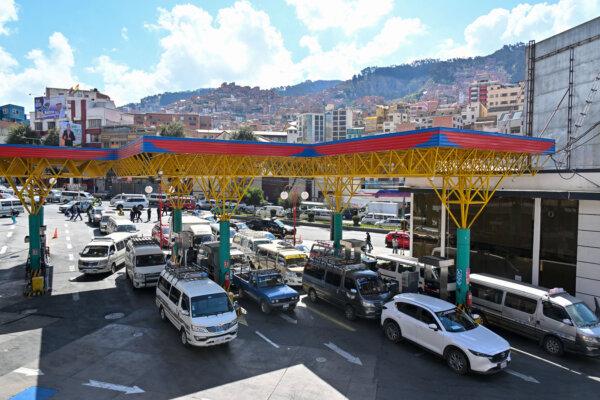
Vehicles queue up to get petrol at a service station in El Alto, Bolivia on May 23, 2025. Aizar Raldes/AFP via Getty Images
“We need U.S. dollars and U.S. investment. This will never happen if someone with the same economic policies is elected,” Torres said.
In a June report, the International Monetary Fund stated Bolivia’s macroeconomic outlook under existing policies is “unsustainable” and the current fiscal crisis is set to worsen without considerable changes.
A Latin America research professor with the U.S. Army War College, Evan Ellis, said this is where cooperation with the United States could be mutually beneficial.
“In the short term, there’s a chance for expanded financial cooperation and expanded political alignment,” Ellis told The Epoch Times.
He said if a right-wing candidate wins, it may give the United States a foot in the door for other types of cooperation. For Bolivia, it would mean access to U.S. dollars and a more favorable climate for foreign investment.
America could also help revitalize Bolivia’s depleted natural resources sector.
“There’s the possibility of U.S. companies investing in critical sectors, not just Russia and China,” Ellis said.
A Bolivian president with a more free-market approach could also give the United States access to critical agricultural exports and minerals like lithium.
However, should an opposition candidate win, Ellis said they should proceed with caution. He pointed to the failed interim regime of Jeanine Áñez as an example of how a right-wing president could easily hand the power right back to the other side if it fails to keep its promises.
Despite the polls, left-wing candidate Rodríguez said Bolivia’s political left is not dead and promised that “victory will be ours.”