This copy is for your personal, non-commercial use only. Distribution and use of this material are governed by our Subscriber Agreement and by copyright law. For non-personal use or to order multiple copies, please contact The Epoch Times Reprints.
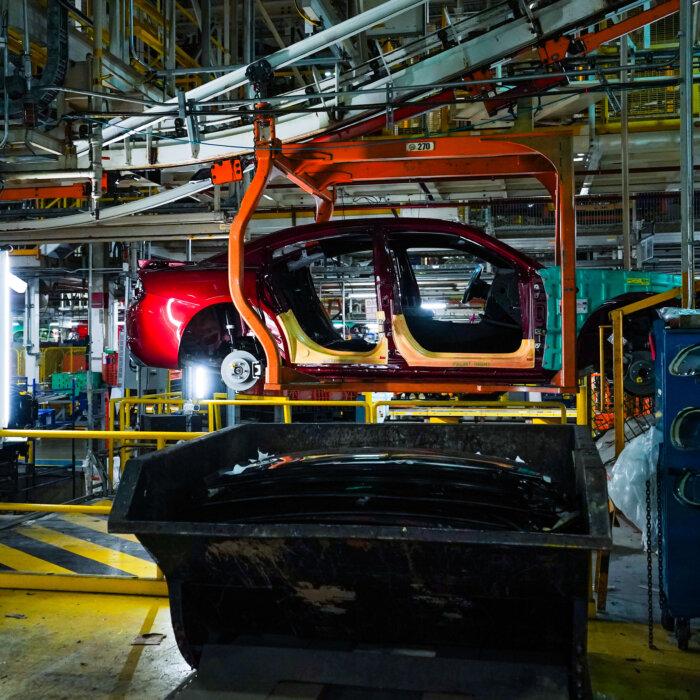
GM workers use human assistance automation to weld vehicle doors at the General Motors assembly plant in Oshawa, Ont., on March 19, 2021. The Canadian Press/Nathan Denette
The industry group representing GM, Ford, and Stellantis says Ottawa’s recent decision to limit the number of vehicles Stellantis and GM can import into Canada from the U.S. tariff-free is a mistake that will undermine the competitiveness of Canada’s auto manufacturing sector.
President of the Canadian Vehicle Manufacturers’ Association Brian Kingston wrote in a statement that his group supports the aim of safeguarding Canada’s automotive industry and workers, but he called decision to reimpose quotas on vehicle imports by GM and Stellantis an “unforced error at the worst possible time.”
Ottawa announced on Oct. 23 it will limit how many Stellantis and GM vehicles can be sold in Canada without facing tariffs, after both companies cut back on their Canadian operations. Stellantis said it will relocate manufacture of the Jeep Compass from Brampton, Ont., to Belvidere, Illinois, while GM announced earlier this week that it is ceasing production of BrightDrop electric vans at the automaker’s CAMI plant in Ingersoll, Ont.
Ottawa granted several automakers exemptions in April from the 25 percent tariffs imposed by Canada on U.S.-manufactured vehicles based on the condition these companies preserved their levels of employment and investment in Canada. This allowed companies including GM and Stellantis to keep importing vehicles from the U.S. into Canada tariff-free.
Ottawa has lowered the tariff-free quota for imported vehicles by 50 percent for Stellantis and 24 percent for GM in response to the recent announcements of production cuts from both companies.
Kingston said that the competitiveness of Canada’s auto industry is being damaged by government actions, which he said should focus on collaboration instead of retaliation against its southern neighbour.
“Combined with legal threats and a costly EV mandate, Canada’s competitiveness as an auto manufacturing jurisdiction is rapidly eroding,” he said.
Finance Minister François-Philippe Champagne said he is disappointed with both Stellantis and GM, saying that the government decision to remove the exemption was made to protect the Canadian auto industry.
“Our government stands firmly with its auto industry and its workers and will not hesitate to take strong action to protect it, and ensure that support goes only to those who invest in Canada’s future,” Champagne said in a release.
Industry Minister Mélanie Joly has also threatened legal action against Stellantis over the move. Ottawa and the Ontario government previously committed $1.4 billion to Stellantis to improve its electric vehicle battery production capabilities in Canada, along with an investment of $259 million to support GM’s $2 billion electric vehicle projects.
Prime Minister Mark Carney said he’s looking at the possibility of using GM’s CAMI plant for other uses, including for potential defence-industrial purposes. GM has said employees laid off at the CAMI plant will receive six months of salary and additional benefits, but Carney has said he is “not satisfied” with these measures.
Canada’s second-largest class of exports are vehicles and, in past comments, Carney has said the auto sector provides work to 125,000 Canadians directly and 500,000 in secondary industries.
U.S. President Donald Trump has since spring applied a 25 percent tariff on all completed vehicles that do not comply with the U.S.-Mexico-Canada Agreement. He also approved more tariffs Oct. 17 that will put a 25 percent levy on Canadian medium and heavy-duty trucks and 25 percent on truck components exported to the United States. The latest tariffs are scheduled to take effect on Nov. 1.
The imposition of tariffs on an increased number of GM and Stellantis vehicles comes as Trump announced Oct. 23 that he had ended all trade negotiations with Canada because Ontario had aired ads criticizing U.S. tariffs. Trump accused Canada of using the ads to interfere with a case before the U.S. Supreme Court and other courts reviewing Trump’s tariffs.
Jennifer Cowan and The Canadian Press contributed to this report.