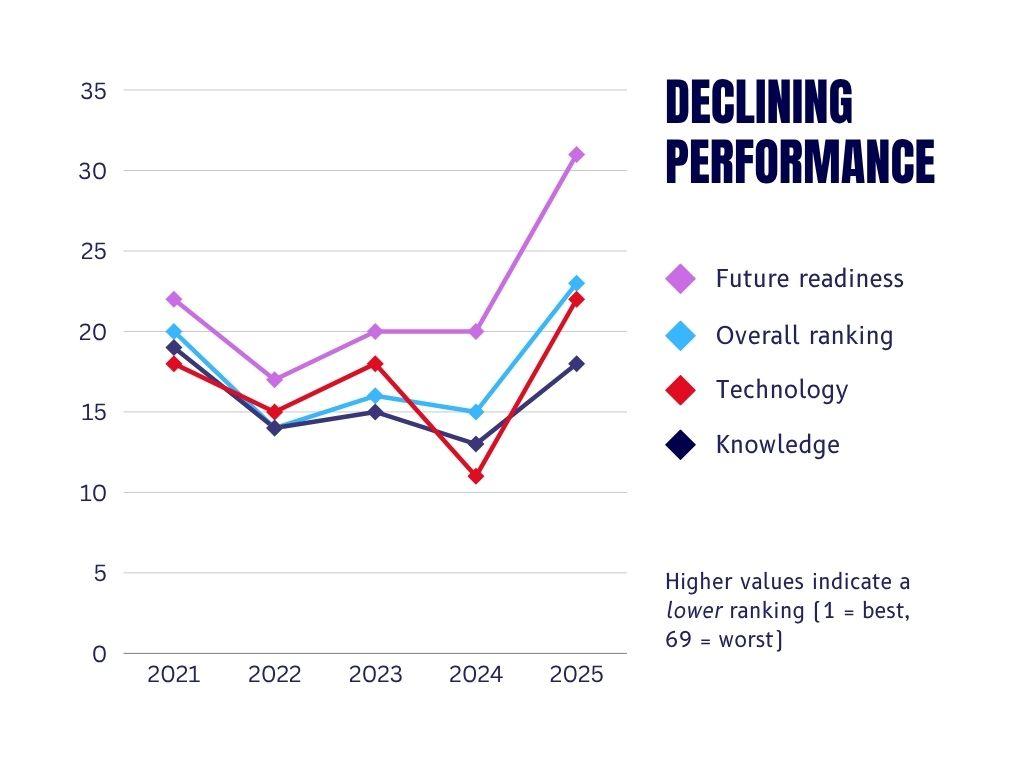
Australia has fallen eight places in an international ranking of digital competitiveness, with poor performance across every measure that contributes to the final figure.
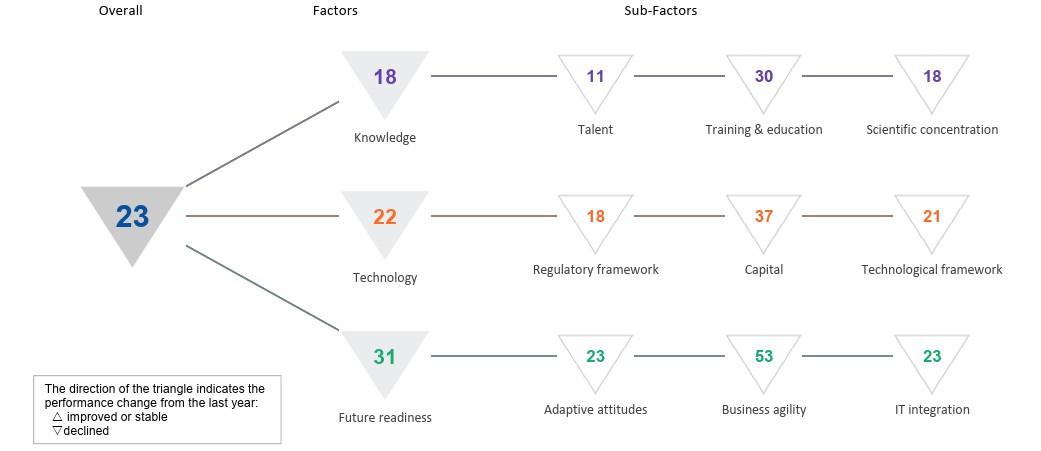
The country is now 23rd out of the 69 nations studied in the IMD World Digital Competitiveness Ranking (WDCR) released on Nov. 4. In 2024, it was 15th.
It was the worst result Australia has recorded since the study began nine years ago.
The Committee for Economic Development of Australia (CEDA)—a think tank comprising members from industry, government, community and academia—has warned the country risks being left behind “in the key areas that will drive future opportunity and prosperity.”
The group’s chief executive, Melinda Cilento, said that while the data showed Australia had gone backwards on most measures, “it is particularly concerning to see our big falls in education and training, and our persistently weak scores on business agility.”
“We tumbled to 60th on employee training and 59th on international experience of talent. In other words, Australia is neither adequately training employees nor properly recognising international qualifications and experience. This risks leaving us behind in the adoption of technologies amid rapid change brought on by AI,” she said.


Australia’s worst performance was on business agility, ranking just 65th, while companies’ ability to respond quickly to opportunities and threats dropped from 37th place to 57th.
Top Rankers
Globally, Switzerland topped the ranking this year, followed by the United States and Singapore.The Swiss-based Institute for Management Development’s (IMD) World Competitiveness Centre said the top three nations were frontrunners primarily due to their infrastructure and talent.
But it also warned that it would be “unsustainable for economies to hedge all their bets on these areas,” as trade and investment barriers were having an impact on the digital capability of economies.
“We know that U.S. President Trump has shaken the ground that trade moves upon, but it will seem surprising to some that trade fragmentation could so significantly affect digital competitiveness because, at first glance, the digital economy doesn’t seem dependent on traditional trade flows due to its intangibility,” the Centre’s Director Arturo Bris said.
Australia’s Bright Spots
Areas in which Australia performed well included the net flow of international students, which it ranked second, and the computer science education index, where it came in fifth.It’s also the eighth-ranked country for women with degrees, and comes in first place for country credit rating.
The caution that forum participants mentioned is shown by its 30th ranking for entrepreneurial fear of failure.
It also does well in some aspects of its regulatory environment, scoring fifth for the ease of starting a business and sixth on enforcing contracts.
However, it falls down when it comes to immigration laws (30th), AI policies passed into law (34th) and the development and application of tech (38th).
“In a fragmented world, regulatory advantages are becoming a key determinant of digital competitiveness. Regulatory clarification and safety enable companies and governments to incorporate the technology available as efficiently and effectively as possible,” Bris said.
The report cites cross-border enforcement of differing laws on data use and privacy as a major obstacle. “ASEAN’s efforts at regulatory harmonisation are undermined by national divergences and geopolitical sensitivities, which delay data exchange and weaken digital supply chain integration,” it says.
In the Asia-Pacific region, Australia ranks an overall sixth, behind Singapore, Hong Kong, Taiwan, South Korea and China.
Digital competitiveness was assessed across three main factors: knowledge, technology and future readiness.
These are broken down into 61 criteria quantified through both hard data and survey responses from executives. CEDA is the Australian partner for the report.