

Alberta, Ontario Premiers Sign Pact to Expand Trade, Build Energy Corridors

Alberta, Ontario Premiers Sign Pact to Expand Trade, Build Energy Corridors
Alberta Premier Danielle Smith and Ontario Premier Doug Ford speak at a press conference in Calgary on July 7, 2025. Carolina Avendano/The Epoch Times
|Updated:
0:00

CALGARY—The premiers of Alberta and Ontario signed two agreements on July 7 committing to the development of infrastructure to boost energy and critical minerals exports, and strengthening interprovincial trade to support key industries in both provinces.

The premiers signed two memorandums of understanding (MOUs) at a press conference during Ontario Premier Doug Ford’s visit to the Calgary Stampede. The first agreement focuses on the development of infrastructure like pipelines and railways for Alberta’s and Ontario’s oil, gas, and critical minerals to reach global markets.

The second increases interprovincial trade opportunities, with Alberta committing to prioritize Canadian-made vehicles for its government fleets, and Ontario expanding the availability of Alberta-made alcohol products in its retail stores.
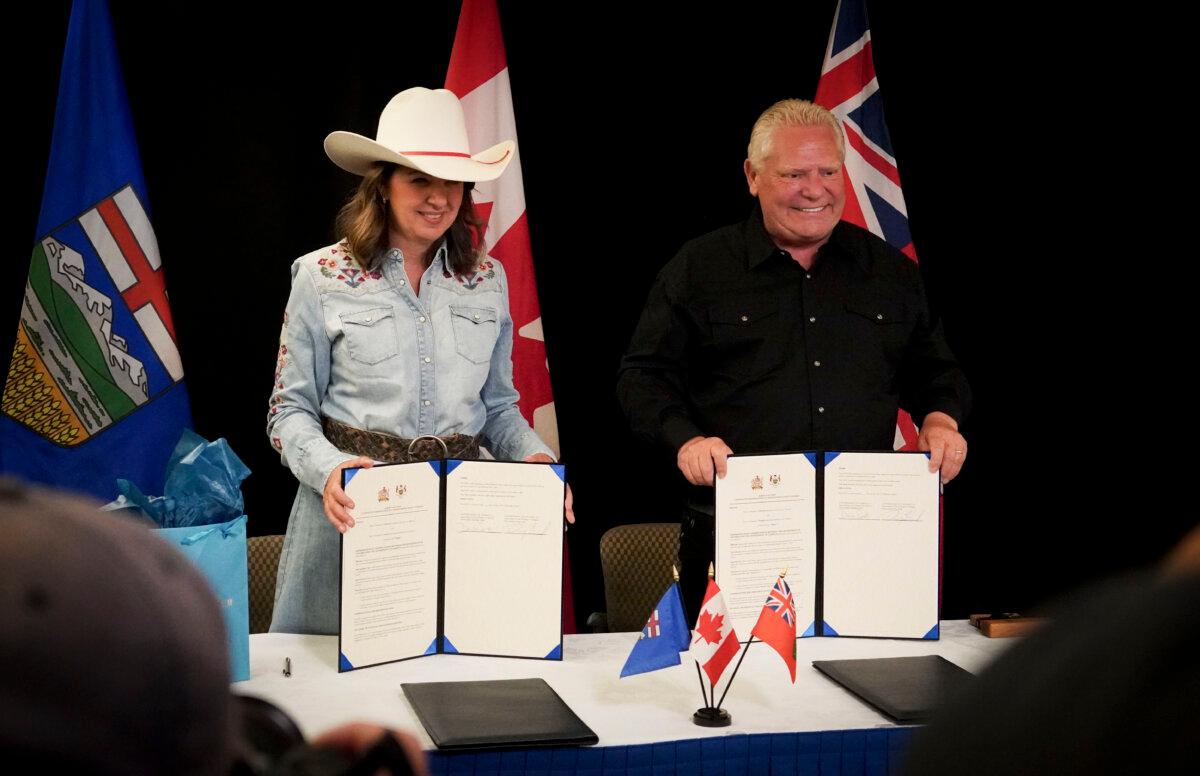
Alberta Premier Danielle Smith and Ontario Premier Doug Ford hold signed memorandums of understanding between the two provinces in Calgary on July 7, 2025. (Carolina Avendano/The Epoch Times)
Alberta Premier Danielle Smith and Ontario Premier Doug Ford hold signed memorandums of understanding between the two provinces in Calgary on July 7, 2025. Carolina Avendano/The Epoch Times

“Today marks an important step forward in uniting our country as Alberta joins forces with Ontario to pursue our shared goals of economic growth, opportunity, and prosperity,” Alberta Premier Danielle Smith said.

“We are uniting with Ontario to amplify our voices and double down on our efforts to carve a path forward together for Alberta, for Ontario, and for Canada.”
The latest agreements come after the two premiers signed an MOU on June 1 in Saskatoon to remove interprovincial trade barriers.

During the July 7 press conference, Smith renewed her call for Ottawa to repeal or revise federal policies she says are stifling growth in Canada’s energy sector, as well as in mining and manufacturing.

She pointed to the Impact Assessment Act, the B.C. oil tanker ban, net-zero electricity regulations, and the oil and gas emissions cap—all of which she has repeatedly urged the federal government to scrap in recent months.

Ford echoed Smith’s calls for changes to federal policies, saying Canada needs “regulatory certainty” to “attract the kind of private sector investments that will be critical to build this energy and trade infrastructure.”

“No one will build a pipeline to tidewater if there is a ban on tankers—its the craziest thing Ive ever heard, a ban on tankers,” Ford said. “No one will invest in opening a mine if it takes 15 years to get it to ‘yes’.”

Infrastructure Projects

Ford said the two provinces aim to support major infrastructure projects, including new pipelines—built with Ontario steel—to transport western Canadian oil and gas to existing and potential refineries in southern Ontario. He also said Canadian energy could reach international markets through a new James Bay deep-sea port in northern Ontario.

Ford also pitched new rail lines to link Ontario’s Ring of Fire region, critical mineral mining projects, and processing facilities to western Canadian ports.

Alberta and Ontario will launch a joint preliminary feasibility study this year to identify optimal routes for economic and energy corridors, assess financial and commercial tools, explore ways to attract private investment, and leverage domestic supply chains to support the projects.
Asked how the two recently signed MOUs would be different from previous agreements and affect any change, Ford said the difference is that he and Premier Smith are “doers,” not “talkers.”

Giving Carney the ‘Benefit of the Doubt’

Ford said at the July 7 press conference that western Canada had been “treated terribly” by the federal government over the last decade, and that he hopes all premiers will be able to work with the new Liberal government under Prime Minister Mark Carney.

“Ottawa has to start showing respect to the great folks in the West, especially Saskatchewan and Alberta,” Ford said. He argued that Carney appears to take a different approach from his predecessor, Justin Trudeau, describing it as more focused on business and efficiency.

“I am giving Prime Minister Carney the benefit of the doubt, so far so good.”

The Liberal government recently passed the One Canadian Economy Act, a bill aimed at speeding up major project approvals and reducing interprovincial trade barriers. It received Royal Assent on June 26 and was part of Carney’s campaign promise to remove all federal internal trade barriers by July 1.
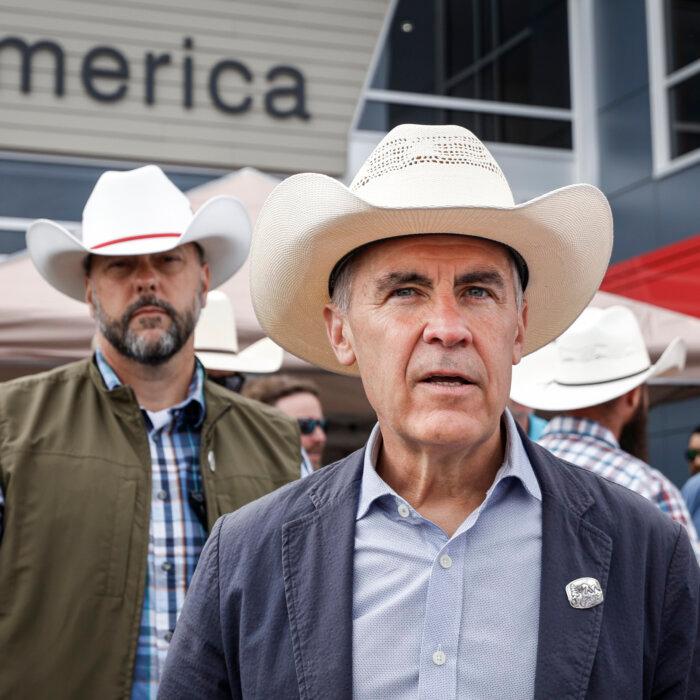
Carney has also said he will work with the provinces and stakeholders to develop projects of national interest, including pipelines—which Smith has been a vocal advocate for—if there is “consensus” for their development. During a visit to Alberta for the Calgary Stampede on July 6, Carney said a new oil pipeline from Alberta to the B.C. coast is “highly likely” following the passing of the One Canadian Economy Act.
Projects of national interest must meet certain criteria to be fast-tracked, including their potential to advance Canada’s economy, the interests of indigenous peoples, and the government’s climate goals, Carney previously said.

Smith, for her part, said it won’t be long before provinces find out whether Ottawa’s commitment to boosting the national economy through major projects will translate into action. She added she aims to have key Alberta projects on the national projects list by the fall.

“There will be a moment where the rubber hits the road,” Smith said. “You can only talk the talk for so long before you start putting some real action around it.”