This copy is for your personal, non-commercial use only. Distribution and use of this material are governed by our Subscriber Agreement and by copyright law. For non-personal use or to order multiple copies, please contact The Epoch Times Reprints.
Air Canada flight attendants walk through the Montreal-Pierre Elliott Trudeau International Airport in Dorval, Que., on Aug. 15, 2025. The Canadian Press/Christinne Muschi
With less than 24 hours remaining before Canada’s largest airline fully grounds nearly all flights, unionized Air Canada flight attendants have rejected Ottawa’s attempts to consider binding arbitration to force a deal.
Intervention by Ottawa to bring the eight-month dispute to a close through binding arbitration should be “firmly rejected,” according to an Aug. 15 statement from the Air Canada chapter of the Canadian Union of Public Employees (CUPE), saying it amounts to interference. Air Canada had previously asked the union to consider a binding arbitration to bring the dispute to a resolution.
Canada’s Minister of Jobs and Families Patty Hajdu said Aug. 14 that she had asked for union members to respond to Air Canada’s request concerning the resolution of the dispute through binding arbitration. Binding arbitration occurs when an independent mediator hears the arguments of both sides and makes a legally binding decision to resolve the matter.
CUPE’s Air Canada chapter, which represents approximately 10,000 flight attendants, has been in contract negotiations with the airline since the beginning of the year. The union is seeking higher wages and improved work conditions. It announced on Aug. 5 that 99.7 percent of unionized flight attendants had voted to authorize the union to strike over unmet salary and work condition demands.
Particularly at issue is the unpaid work of flight attendants prior to takeoff and after landing, as well as wages, which the union says fall far below the pace of inflation. Wesley Lesosky, president of CUPE’s Air Canada chapter, says the airline’s flight attendants perform roughly 35 hours of unpaid work per month.
The vote to authorize a strike was followed by picketing at several airports on Aug. 11, as the union rejected an offer from Air Canada offering a 38 percent pay raise over the next four years as well as more benefits, pensions, and vacation time. Lesosky said the offer was deceptively framed and actually represented only a 17 percent raise.
“Air Canada has offered 8 percent in the first year as a one-time catch-up. Meanwhile, flight attendants have taken a 9 percent cut to their real wages due to inflation over the course of their last contract since 2015,” Lesosky said. “In reality, the company has offered a 17.2 percent wage increase over four years.”
CUPE’s Air Canada chapter issued a 72-hour strike notice on Aug. 13, leading to Air Canada announcing a lockout.
Air Canada Offer
For its part, Air Canada described its Aug. 11 offer as “industry leading,” saying it would give its flight attendants above-average salaries.
“It will make Air Canada Flight Attendants the best compensated in Canada. Already, cabin crew earn up to $17 more per hour than their counterparts at the company’s largest domestic competitor,” Air Canada said in an Aug. 14 statement.
Air Canada leadership added that it is disappointed in the actions of CUPE, which it says forced it to issue a lockout and interrupt the plans and needs of many travellers.
“The disappointing conduct of CUPE’s negotiators and the union’s stated intention to launch a strike puts us in a position where our only responsible course of action is to provide certainty by implementing an orderly suspension of Air Canada’s and Air Canada Rouge’s operations through a lockout,” Air Canada CEO Michael Rousseau said Aug. 13.
“As we have seen elsewhere in our industry with other labour disruptions, unplanned or uncontrolled shutdowns, such as we are now at risk of through a strike, can create chaos for travellers that is far, far worse.”
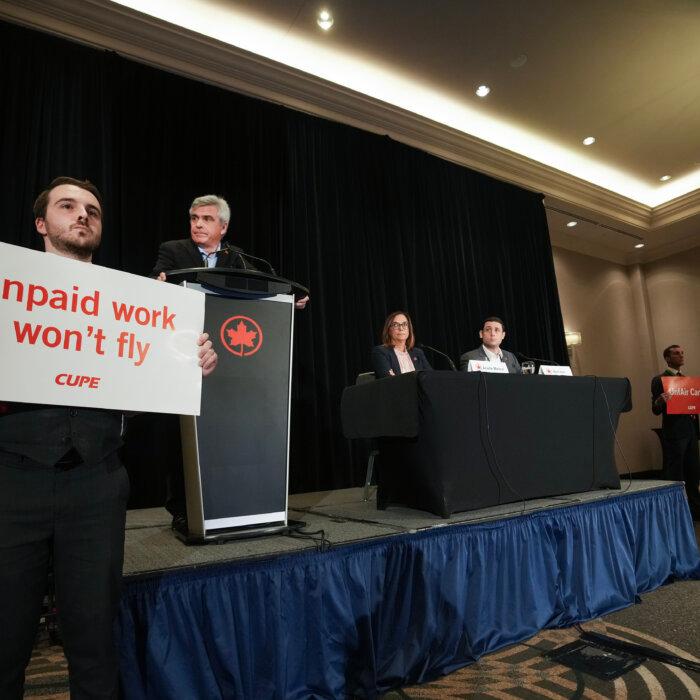
At an Aug. 14 press conference announcing flight cancellations, escalating tensions were on display as dozens of union members interrupted and held up protest signs, leading to the event being ended prematurely by Air Canada spokesperson Christophe Hennebelle. According to a recent poll conducted Aug. 14–15 by Abacus Data, 88 percent of Canadians support flight attendants’ demands.
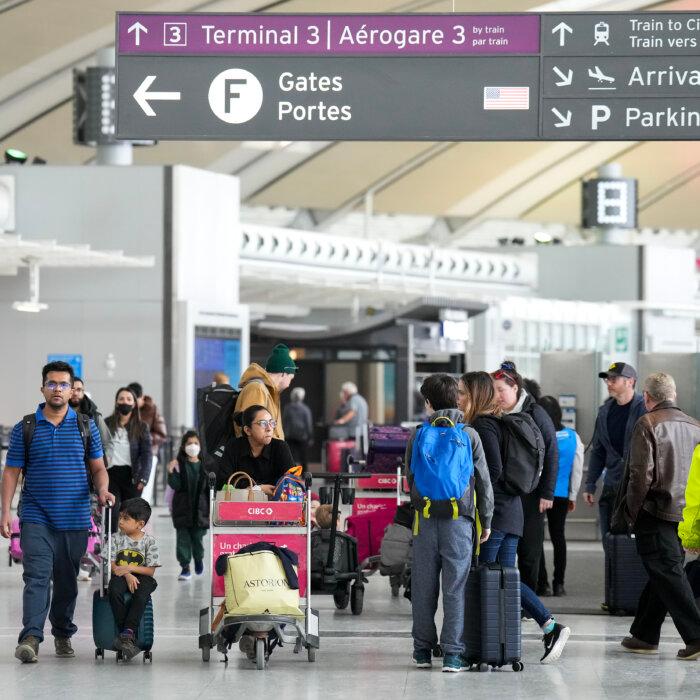
Air Canada has said it plans to ground all Air Canada and Air Canada Rouge flights by Aug. 16 if a deal is not reached with unionized flight attendants by that time, and has already cancelled flights affecting more than 55,000 passengers. An estimated 130,000 passengers per day fly on Air Canada flights, the airline said, noting it is either rebooking customer flights, including with competitors, or offering a full refund.
The Toronto Region Board of Trade commented on the dispute Aug. 15, saying that it supports moving to binding arbitration. The board added that even a short shutdown of Air Canada flights would cause “broad-reaching economic consequences” and harm “Canada’s global reputation as a reliable trading partner at a time when it is essential that we reinforce our diverse international economic relations.”