Meteor-spotting in June has traditionally been both a gamble and a tease.
A duo of meteor showers have always occurred the first month of summer, and when the odds fall in our favour, we win the meteor lottery—seeing spectacular outbursts of shooting stars from one among the pair.
The other tantalizes, being a daytime-only meteor shower, eternally out of sight due to its proximity to the sun, though it does teasingly sputter a few over the night horizon.
The Arietids
The first to occur will be the Arietid meteors, which will peak around June 7 but last from late May to early July. The Arietids are said to be the most active daytime meteor shower, though daylight makes them mostly invisible.Though mostly unseen, this strong shower pours down an average number of around 60 shooting stars per hour. A very few may be sighted in the twilight of pre-dawn, so that’s one way to catch them.
Meteors are actually bits of cosmic dust and frozen gas floating along great orbits through space, and they become meteors when Earth collides with debris streams along its own orbit—which it does faithfully the same time every year.


Since meteors travel along predictable and unchanging vectors along an orbit, that’s why they always appear to shoot from the same spot in the dome of Earth’s sky. That spot is called the radiant, and the Arietid’s radiant happens to be in our daytime hemisphere, in constellation Aries. Hence the name Arietids
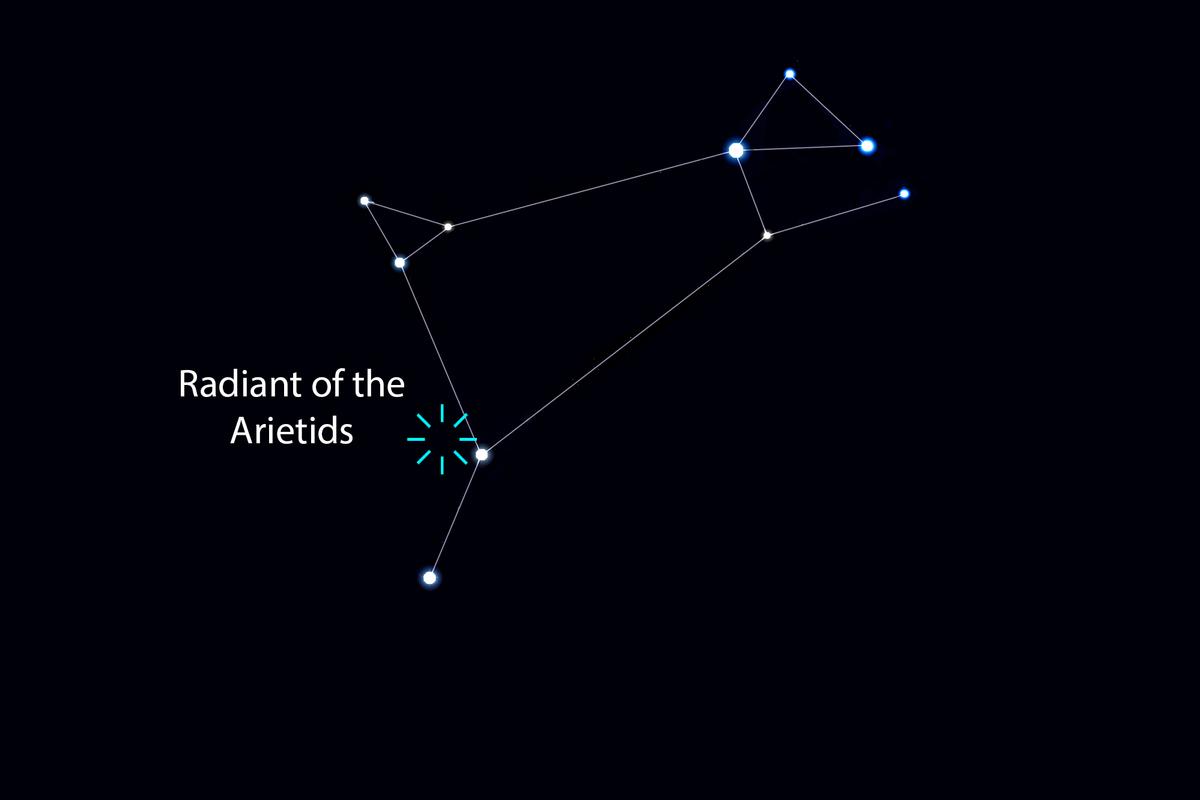
Although the Arietids are mostly a daytime meteor shower, its radiant will rise slightly over the pre-dawn horizon to the east just before sunrise, and a few meteors may also appear. Since the radiant is just 30 degrees from the sun, the best time for viewing the Arietids is in the darkest period of twilight when the sun is between 12 to 18 degrees below the horizon and it will still seem to be nighttime.
Alas, an observer may see only one meteor per hour or fewer.
The Bootids
The second of the two showers, the Bootids, is more bountiful but highly sporadic. They are ordinarily weak but can randomly slam the Earth with huge outbursts, though it happens infrequently.Irregular in number, the Bootids are still punctual. Their dust stream rendezvous with Earth every late June till early July, and they peak around June 27.
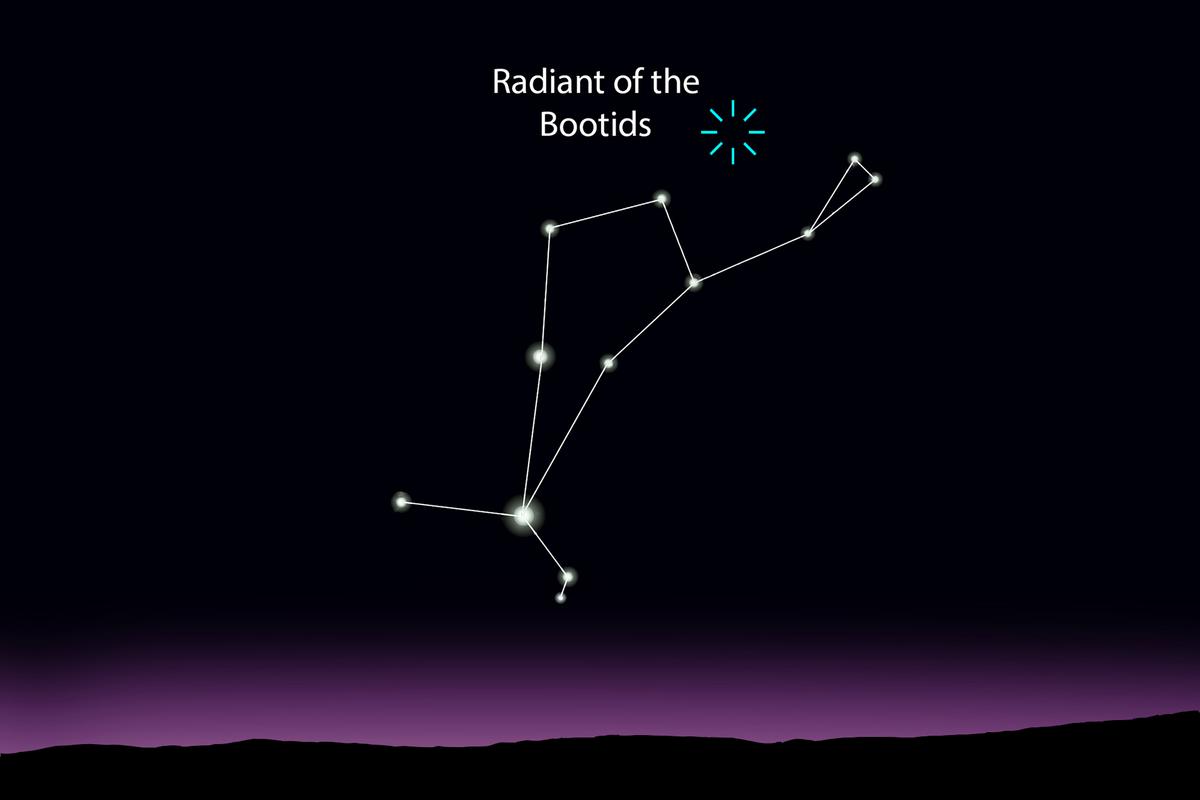
Look to the Boötes constellation to find their radiant. Unlike the Arietids’ radiant, it will rise at night—ideal for meteor viewing.
Don’t look to the radiant itself and expect to see meteors, though, as these fiery streaks are best seen from a three-quarter view as opposed to head-on. They fan out from the radiant, so seek meteors all across the grove of stars.
The big gamble in spotting the Bootids is that they normally yield just one or two meteors per hour. But taking in the yearly shower may be worth it, since every so often they come in droves. During one of their outbursts, 100 Bootids or more per hour may be seen.
Where Do the Arietids and Bootids Originate?
The dusty cosmic nurseries of meteors crisscross through space, but where does that dust come from? Astronomers say it’s the debris of comets or asteroids, which shed bits of themselves to from vast complexes of matter stretching for millions of kilometres. These streams follow the same orbit as their “parent” object, so sometimes that comet or asteroid shows up too.While Earth orbits the sun once a year, some comets take several years or decades to loop the sun.
When it does arrive, and when a comet nears the sun, it flares up due to solar radiation causing its frozen nucleus to sublimate into gas (comets have been likened to dirty snowballs made of gases such as ammonia). Then it can be visibly seen producing a trail of dust in the form of a tail and a bright gaseous envelope, or coma.
This comet last visited the sun on Jan. 31, 2023, and won’t return until May 12, 2028. Its path around the sun intersects Earth’s daylight side—so do its meteors, which is why we never see them.
As comets go, the parent object of the Bootids, Comet 7P/Pons-Winnecke, isn’t ordinary. Astronomers have described its dust trail as “clumpy,” thus explaining the Bootids’ sporadic outburst.
Comet 7P/Pons-Winnecke was discovered by French astronomer Jean-Louis Pons on June 12, 1819, and rediscovered by German astronomer Friedrich Winnecke on March 9, 1858.
Looping the sun once every 6.37 years, travelling from just beyond Jupiter’s orbit, this comet last visited our nearest star in May 2021. It won’t come again until August 2027.