


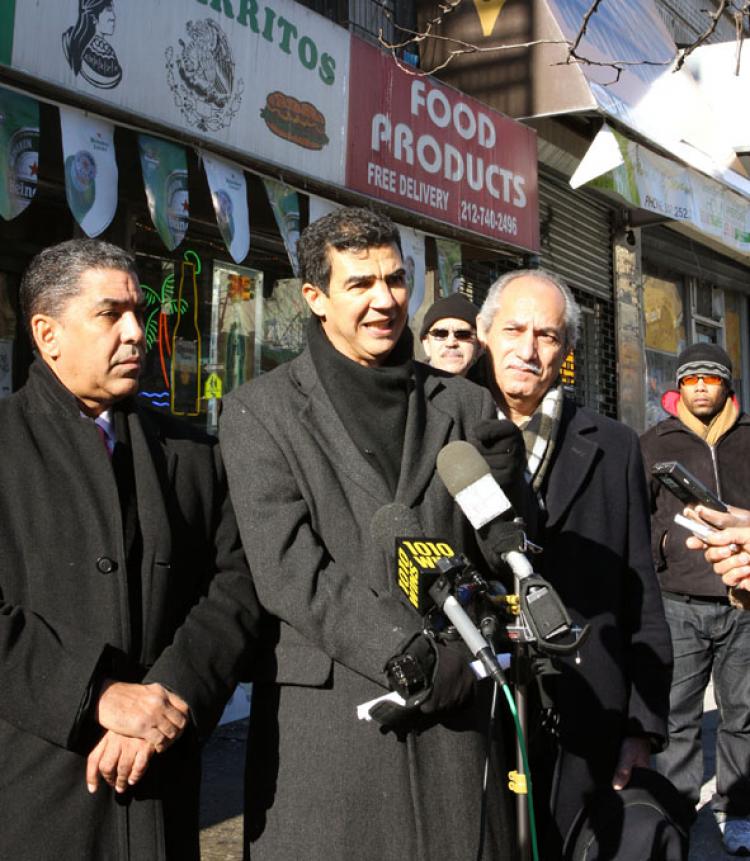
NEW YORK—Washington Heights has had as many homicides this month as it had during the entire year of 2009. Three young men have been killed in the last three weeks. Politicians and community members gathered Sunday afternoon in front of a bodega on St. Nicholas Avenue, the scene of the most recent murder, to discuss how they will address the problem of gang-related violence.
“We don’t want Washington Heights going back to the bad old days of the old west, when there were rampant shootouts here and these corners were adorned with wreaths for the people who had been killed,” said state Sen. Adriano Espaillat, recalling the turbulent 1980s and 1990s.
In those days, over 100 homicides took place in Washington Heights every year. Assemblyman Guillermo Linares was a Council member for the district during the 1990s. He says with a strong union of city, state, and federal law enforcement, as well as community involvement, they were able to bring the number of homicides down to seven by 1998.
Three homicides took place in Washington Heights in 2009, and four people were killed in 2010.
According to the NYPD weekly crime statistics report, 25 homicides have taken place across the city over the past 28 days—nearly 31 percent fewer than during the same period a year ago, from the end of December 2009 to the end of January 2010, when 36 murders were reported.
It’s hard to tell when comparing figures this way whether or not there is a growing problem, but gang violence is an issue that has been on the minds of Washington Heights’ elected officials and community organizations since two teens died earlier this month. A 16-year-old male was stabbed on West 186th Street and St. Nicholas Avenue at about 12:45 a.m. on Jan. 9. About two hours later, an 18-year-old male was shot to death at West 136th Street and Lenox Avenue.
In light of these crimes, elected officials had gathered with community leaders and officers from the 33rd and 34th precincts to talk about combating violence on Friday afternoon. The meeting established that 70 more police officers would be assigned to the area’s precincts, and educational programs would be ramped up in the local schools to talk to youth about gangs and violence.
At 8:30 p.m. on Friday, a 20-year-old man was fatally stabbed in front of a bodega on West 188th Street and St. Nicholas Avenue.
Councilman Robert Jackson made it clear during Sunday’s event that community involvement can make a huge difference in the campaign against violence.
“Please stop the violence,” he pleaded. “Please communicate with your family members. Please go to meetings held by your elected officials, by your church organization, by your community-based organization and communicate with your mayor, your governor, your elected officials that we need more resources in our community in order to stop the violence.”
Jackson’s brother died of a stab wound at the age of 21. “I think about it even as of today, and that was approximately 35 years ago,” said the councilman.
Assemblyman Linares said he hopes to see FBI involvement in the future. He encouraged NYPD to open up a dialogue with federal law enforcement.
“This is a problem that goes beyond our boundaries here,” Linares said. “It connects to the rest of the city, the rest of the state, and the rest of the country.”
Although Washington Heights has seen a spike in homicides this month, it is not the only setting for youth violence in the city. Keenen Upson, 20, was arrested in Fort Greene, Brooklyn, over the weekend for wounding five teens when he pulled out a gun and started firing at a basketball court on Jan. 14.
Incidents of this nature are so common among males between the ages of 18 and 34 that the estimated annual cost associated with hospitalizations for non-fatal assaults is $53 million, according to the 2010 Department of Health and Mental Hygiene Report. The report also shows that homicides among men within this age range are most common in Crown Heights, Brooklyn, and Hunts Point of the Bronx.
Councilman Ydanis Rodriguez pointed out that Washington Heights has been considered a safe neighborhood since the end of the 1990s.
“We are here not because of 10 or 20 crimes. We are here because we know how much we suffered in the 80s and the 90s, and we know that most of our teenagers are doing good things—they are going to school, they are going to college,” Rodriguez said.
“We don’t want Washington Heights going back to the bad old days of the old west, when there were rampant shootouts here and these corners were adorned with wreaths for the people who had been killed,” said state Sen. Adriano Espaillat, recalling the turbulent 1980s and 1990s.
In those days, over 100 homicides took place in Washington Heights every year. Assemblyman Guillermo Linares was a Council member for the district during the 1990s. He says with a strong union of city, state, and federal law enforcement, as well as community involvement, they were able to bring the number of homicides down to seven by 1998.
Three homicides took place in Washington Heights in 2009, and four people were killed in 2010.
According to the NYPD weekly crime statistics report, 25 homicides have taken place across the city over the past 28 days—nearly 31 percent fewer than during the same period a year ago, from the end of December 2009 to the end of January 2010, when 36 murders were reported.
It’s hard to tell when comparing figures this way whether or not there is a growing problem, but gang violence is an issue that has been on the minds of Washington Heights’ elected officials and community organizations since two teens died earlier this month. A 16-year-old male was stabbed on West 186th Street and St. Nicholas Avenue at about 12:45 a.m. on Jan. 9. About two hours later, an 18-year-old male was shot to death at West 136th Street and Lenox Avenue.
In light of these crimes, elected officials had gathered with community leaders and officers from the 33rd and 34th precincts to talk about combating violence on Friday afternoon. The meeting established that 70 more police officers would be assigned to the area’s precincts, and educational programs would be ramped up in the local schools to talk to youth about gangs and violence.
At 8:30 p.m. on Friday, a 20-year-old man was fatally stabbed in front of a bodega on West 188th Street and St. Nicholas Avenue.
Councilman Robert Jackson made it clear during Sunday’s event that community involvement can make a huge difference in the campaign against violence.
“Please stop the violence,” he pleaded. “Please communicate with your family members. Please go to meetings held by your elected officials, by your church organization, by your community-based organization and communicate with your mayor, your governor, your elected officials that we need more resources in our community in order to stop the violence.”
Jackson’s brother died of a stab wound at the age of 21. “I think about it even as of today, and that was approximately 35 years ago,” said the councilman.
Assemblyman Linares said he hopes to see FBI involvement in the future. He encouraged NYPD to open up a dialogue with federal law enforcement.
“This is a problem that goes beyond our boundaries here,” Linares said. “It connects to the rest of the city, the rest of the state, and the rest of the country.”
Although Washington Heights has seen a spike in homicides this month, it is not the only setting for youth violence in the city. Keenen Upson, 20, was arrested in Fort Greene, Brooklyn, over the weekend for wounding five teens when he pulled out a gun and started firing at a basketball court on Jan. 14.
Incidents of this nature are so common among males between the ages of 18 and 34 that the estimated annual cost associated with hospitalizations for non-fatal assaults is $53 million, according to the 2010 Department of Health and Mental Hygiene Report. The report also shows that homicides among men within this age range are most common in Crown Heights, Brooklyn, and Hunts Point of the Bronx.
Councilman Ydanis Rodriguez pointed out that Washington Heights has been considered a safe neighborhood since the end of the 1990s.
“We are here not because of 10 or 20 crimes. We are here because we know how much we suffered in the 80s and the 90s, and we know that most of our teenagers are doing good things—they are going to school, they are going to college,” Rodriguez said.


