Telescopes with 1,000 times greater range. Propulsion systems for deep space travel. Electric grid models that trim interconnection simulations from months to minutes. A flight-test vehicle that measures pressures on a nuclear weapon in transit. Advances in replicating genomes. Progress in the decades-long quest to map the cell’s protein structure to produce new pharmaceuticals and therapies.
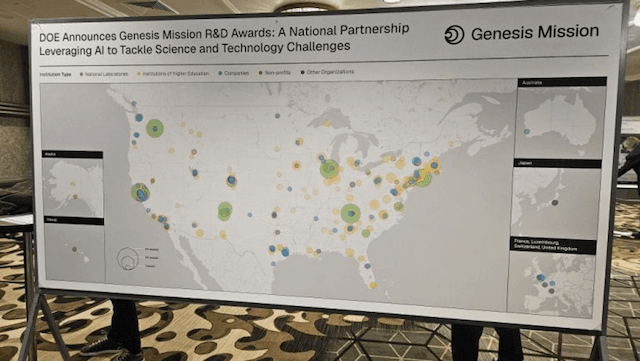
These are among diverse initiatives launched at more than 340 universities across the United States and in the nation’s 17 national laboratories under the Department of Energy’s Genesis Mission, a multibillion-dollar “whole-of-country” project to “harness” artificial intelligence and incorporate it into every realm of federally funded research and development.
“This is happening right now,” Energy Department Undersecretary Darío Gil said at the July 22 Genesis Mission Summit at the Capital Hilton in Washington, comparing this coalescing confluence of the nation’s “science ecosystem” to study and implement AI to the Manhattan Project of the 1940s and the aerospace industry’s response to its “Sputnik moment,” when it rallied in the 1960s to be first to the moon after the Soviet Union launched the first man into orbit in 1957.
The day-long invitation-only summit included addresses from U.S. Energy Secretary Chris Wright, a “fireside chat” with Japanese Ambassador to the United States Shigeo Yamada, roundtable discussions, “platform showcases,” and a congressional panel touting robust bipartisan support for the Genesis Mission.


The Genesis Mission was launched as a result of President Donald Trump’s November 2025 executive order that called for a mission-driven synthesis of research awards, funding opportunities, specialized scientific datasets, and research assets—such as the 17 national labs and their staff—to address 26 AI-related science and technology challenges.
Gil said the “whole-of-government” effort is spurring “whole-of-country” momentum, announcing 278 awards by 20 federal agencies totaling more than $250 million to 342 “participating institutions” to target 21 of the 26 Genesis Mission initiatives that, he later revealed, have been expanded to 33 science and technology challenges.
Through the Genesis Mission Consortium, which Gil said includes more than 40 industry and nonprofit partners, the Trump administration aims to use federal research and development allocations to seed and steer the nation’s $1 trillion research industry into aligned efficiencies and focus.
“The federal government spends $200 billion a year [on research and development programs],” Gil said. “Private sector spends $700 billion a year, and the rest is spent by the states, universities, and philanthropies.
“We have created a consortium that can bring and aggregate investment and alignment. We have also designed explicitly into our programs that collaboration is required.”
Private investment in Genesis Mission projects now tops $800 million, he said, with Japan committing $1 billion over five years and Microsoft announcing on July 22 that it will commit $60 million in “AI computation credits” over three years to “power the large-scale AI and scientific workloads at the heart” of the Genesis Mission.
Already Producing Results
Brookhaven National Laboratory AI chief scientist Dr. Hendrik Hamann, National Institutes of Health (NIH) Director Dr. Jay Bhattacharya, and NASA Administrator Jared Isaacman were among those who joined Gil and Kratsios for a panel discussion on how Genesis Mission AI-generated innovations are being incorporated into federal research programs.
It has already paid tangible dividends in the nation’s urgent drive to grow an electric grid that must dramatically expand to meet growing demand, Hamann said.
“AI is often considered to be a burden on the grid,” he said. “But with Genesis, the opposite can actually be true. It is actually a huge opportunity to build the most secure, affordable, and reliable grid for the American people.”
Modeling expansions to the nation’s grid—“one of the largest and most complex systems humanity has ever built,” with “200 million access points,” 50 million transformers, and 10 million miles of transmission wires “all interacting nearly at the speed of light”—is “where AI can come in; where AI actually must come in,” Hamann said.
With AI, modeling expansions and interconnections can now be achieved “1,000 times faster,” he said, reducing these vital projections from “months, sometimes years” to “literally, minutes.”
The Genesis Mission is referred to as the Bio Genesis Mission at NIH, Bhattacharya joked, because AI is enhancing institute initiatives spanning “basic scientific discovery to clinical application to the randomized trials and very mundane things, like recruitment of patients to solving pediatric cancer.”
NIH Genesis Mission projects include efforts to understand “how the genome interacts with the cells to [develop] models of the cell so that we can better figure out what drugs are likely to work and what are not likely to work in human bodies,” he said.
“Everyone knows about the protein structure, right?” Bhattacharya said, referring to decades of global research seeking to replicate the protein structure, the atoms in the amino acid chain that support a cell.
“That’s not yet a solved problem, but it’s so much closer than ever thought would be possible.
“Things that we just couldn’t imagine before we can do now. We have amazing tools now that look to me like science fiction.”

Isaacman said that since its 1958 creation, NASA has collected more data than it knows what to do with. AI is being used to ferret through decades of data, he said, to learn what we have missed and what we are likely to miss in the years ahead.
It has already filled in some blanks.
“[Merging] NASA’s archival data with ... off-the-shelf AI applications discovered a new galaxy,” Isaacman said. “There happen to be over 2 trillion [galaxies] out there, so I guess it’s not that unusual. But this opportunity is only going to get bigger in the years ahead.”
NASA is studying chemical and fusion propulsion systems that will power space exploration beyond Earth’s Milky Way galaxy in addition to refining the 20 megawatt Space Reactor-1 for its 2028 Mars mission, he said.
AI-enhanced research will be on display with the Aug. 30 launch of “the nation’s greatest exploration asset ever, the Nancy Grace Roman Space Telescope,” Isaacman said.
“You’re talking about 100 times the field of view of Hubble with 1,000 times the scan rate,” he said.
With the new space telescope operating in tandem with the National Science Foundation’s Vera Rubin Observatory in Chile and the Near-Earth Object Surveyor Telescope at NASA’s Jet Propulsion Laboratory in Pasadena, California, he said: “We’re going to be able to catalog potentially all of the dangerous asteroids in a very short period of time, which will give us opportunities for planetary protection missions in the future.
“Which, again, is just incredibly exciting.”